comicMemoriPhase 3 — Archive and RetrievalEpisode 7 of 37
The archive, storing information outside the desk
An application can store information outside the model context and later retrieve a permitted record into a new request. Storage alone does not make it visible to the model.

On this page
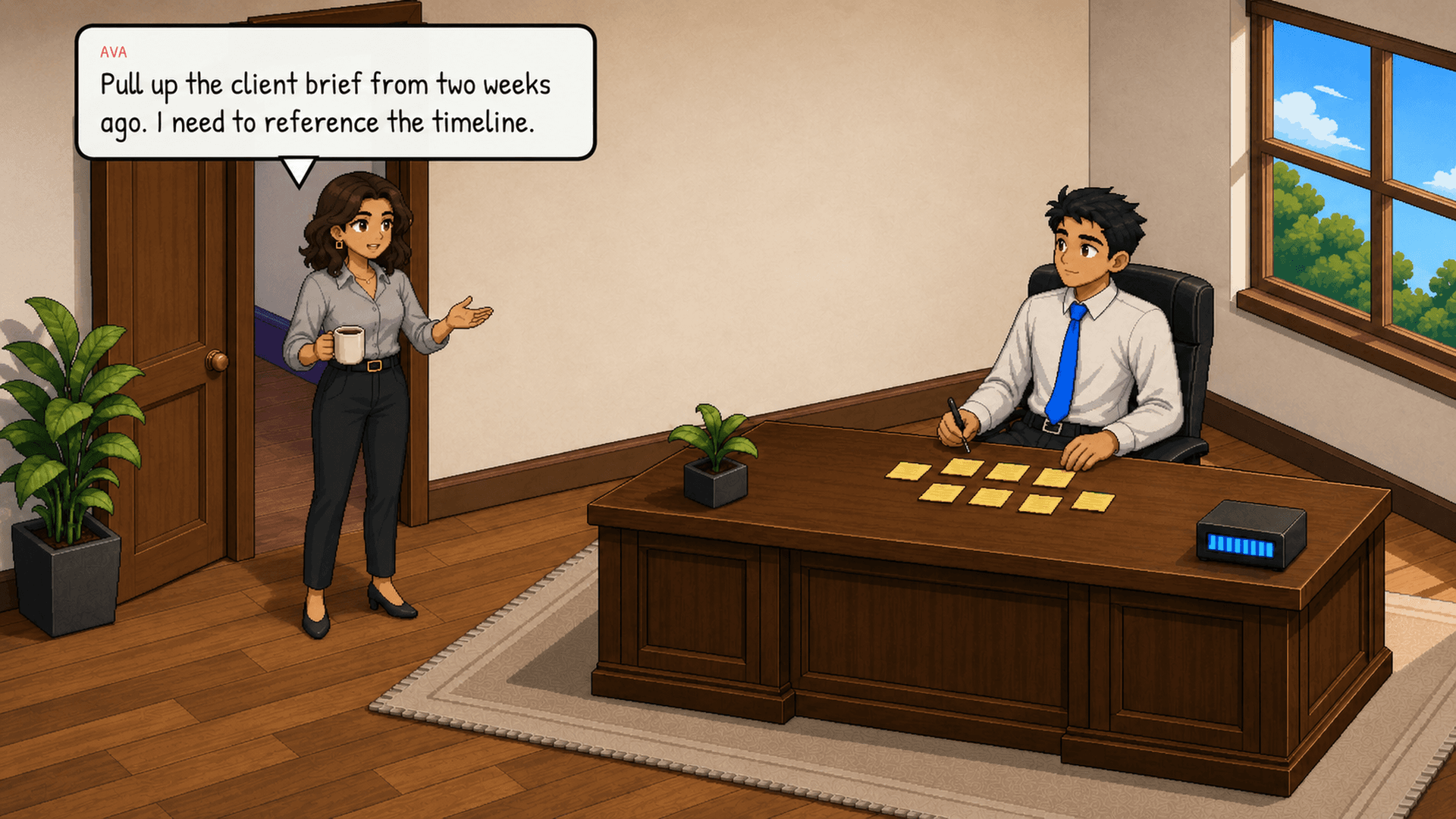
Ava asks for a record from two weeks ago. The application did not include it in Lex's active context, but a retained copy may exist elsewhere. Then, from the archive, someone speaks up.
Session amnesia is the bare-model baseline: a model call does not retain private state from earlier calls unless the application supplies it again. Context window limits still bound whatever material the application assembles for that call. The context window is the bounded material available to the model for this model call.


Problem: A model cannot use a record that the application did not include in the active request, even if the product stored it elsewhere.
Resolution: External storage can retain records under access and retention policies. Retrieval selects a permitted record and the application adds it to the model context.
Section 1: The model call and the product are different
A bare model call does not carry private state from a previous call unless the application supplies it again. That is the baseline behind the session-amnesia metaphor. A product, however, may save chat history, user memory, documents, summaries, or application records outside the model.
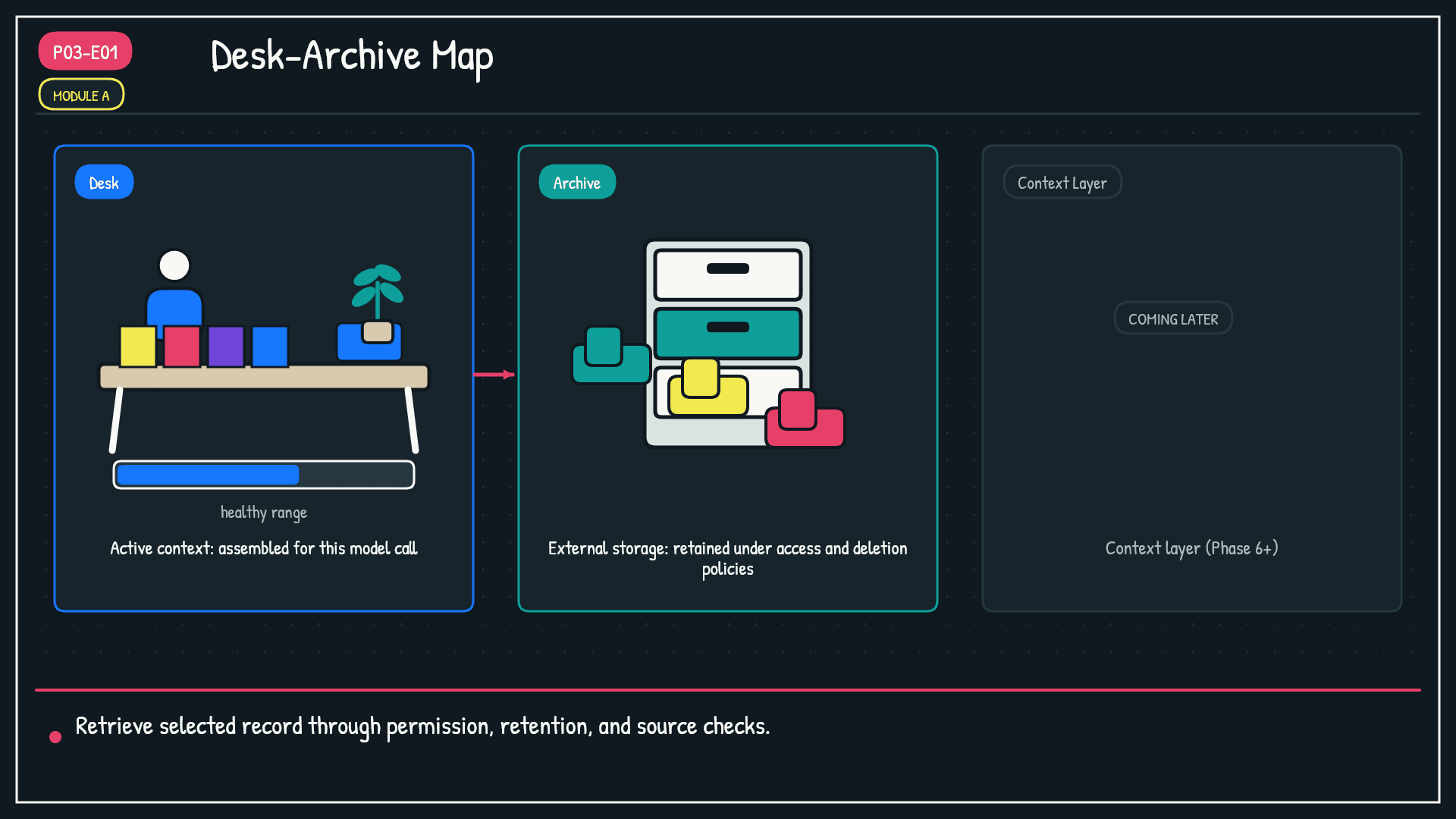
That external store is the archive. It does not necessarily contain every conversation, and records do not necessarily remain forever. What is saved depends on product design, user choice, permissions, retention periods, deletion requests, and source-system policy. The important separation is simple: stored somewhere is not the same as included in this model call.
Section 2: Storage vs active context
The desk and archive serve different purposes. The desk is the active context assembled for one call. It can contain user messages, instructions, selected history, retrieved passages, and tool results. The model operates on that bounded input. It does not directly browse arbitrary application storage unless a tool or retrieval workflow gives it access.
The archive is external storage governed by its own capacity, latency, permission rules, retention, and deletion rules. An application can search it for a permitted record and decide which material to place into the active context. The model can then use that material, subject to the same context and reliability limits as any other input.
Section 3: Meet Ria
Ria has been in the background organizing the archive while Lex worked at the desk. She wears Archive Teal glasses and speaks precisely. When Ava asks for something absent from the request, Ria searches the stored records and returns a candidate with its labels intact.
Ria represents the archive search and handoff. She does not cross into Lex's desk area. The application carries selected material from archive to context. A stored record is unavailable to the model until the application finds and supplies it. How that search produces candidates, and what happens when ordering is wrong, is the next question.
Glossary
- Long-term storage / persistence
- External records retained beyond one model call according to product, permission, retention, and deletion policies. | Office analogy: Folders remain in the archive only while their filing rules allow. | Example: A project system stores an approved brief until its retention period ends or an authorized user deletes it.
- Storage vs active context
- Stored data exists outside the model call. Active context is the bounded material assembled for the call. | Office analogy: Archive shelves versus the papers delivered to Lex's desk. | Example: A saved document is not available to the model until retrieval adds a permitted excerpt.
- Session amnesia
- A bare model call has no private state from prior calls unless the application supplies it again. | (origin: P01-E01)
- Context window limits
- Model and service boundaries constrain the request the application assembles. | (origin: P01-E03)
Try it yourself
- Check the product's settings and documentation: what is stored, for how long, who can access it, and how can you delete or export it?
- When an old detail appears, ask whether it came from visible history, saved memory, an archive search, or the model's learned patterns. Do not treat a plausible answer as proof of storage.
- For retrieved material, inspect the source and timestamp before relying on it.
