
comicMemoriPhase 3 — Archive and RetrievalEpisode 8 of 37
Retrieval, bringing the right pages back
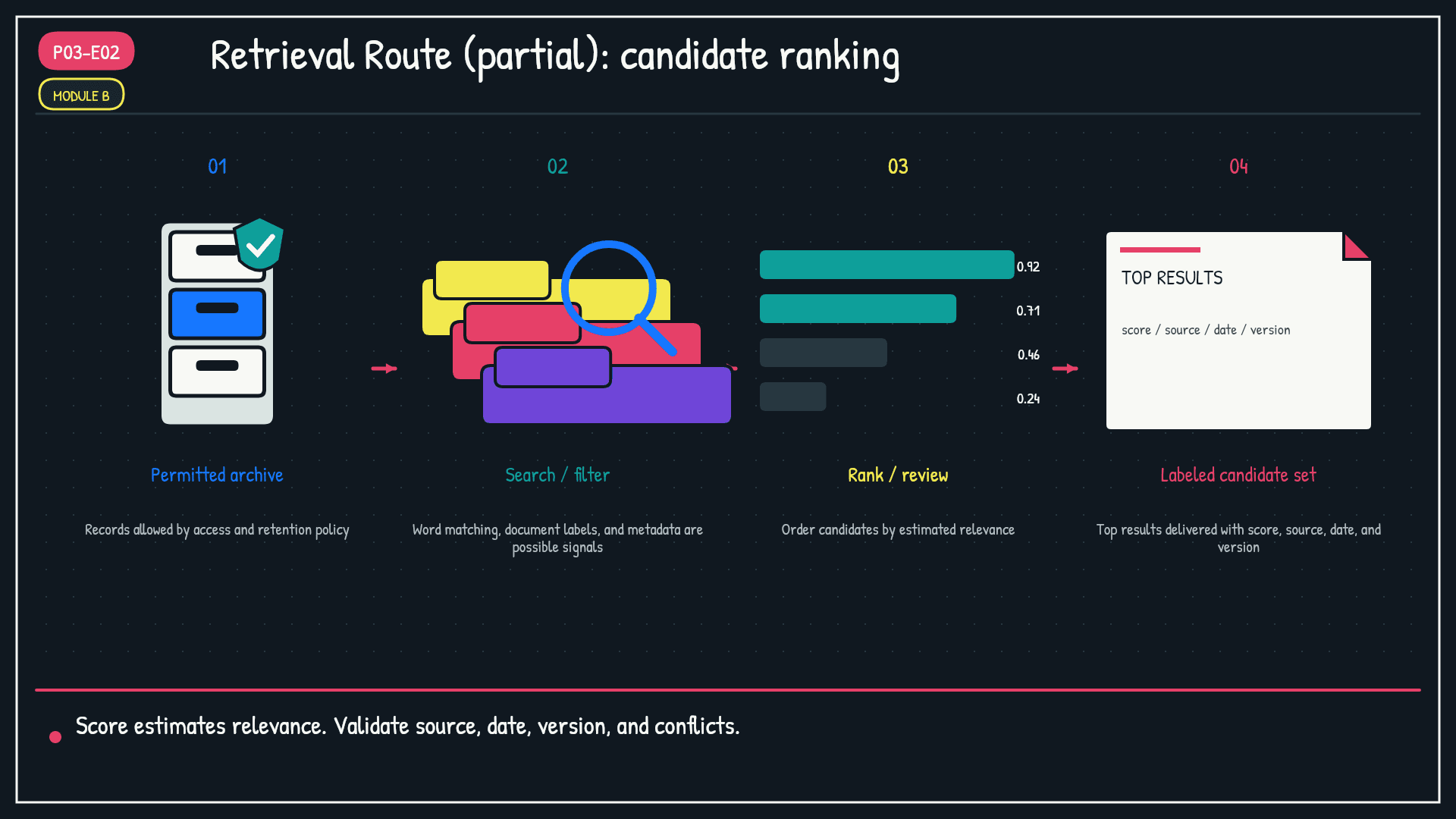
Retrieval narrows stored information to a ranked candidate set, but relevance scores are estimates. Source, date, version, permissions, and conflicts still need checking.

On this page
The archive holds many permitted records. When Ava asks for one document, Ria searches and ranks candidates, but a high score is only an estimate of relevance. Source and version labels still decide what should be trusted.
Storage vs active context separates records kept in the archive from material assembled for a model call.


Problem: The archive has many folders. Retrieving the right one is not obvious when multiple candidates look similar.
Resolution: Retrieval narrows a permitted corpus to a ranked candidate set. Ranking estimates relevance. Validation checks whether a candidate is current, authoritative, and appropriate for the task.
Section 1: The archive is big
The archive contains records that are still retained and permitted for this user and task. When Ava asks for the "onboarding guide," the eligible corpus might include an obsolete draft, a current guide, an orientation schedule with similar wording, and other documents that share terms. The retrieval problem is not only "can we store information" but "can we surface useful evidence without crossing policy boundaries."
This matters because long-term storage, the archive's ability to hold documents between sessions, only solves half of the equation. Having information stored somewhere is not the same as having it available when you need it. A library with ten thousand books and no catalog is technically a library, but finding a specific passage means pulling books off shelves one by one. The archive is the same. Scale makes search necessary.
The desk, where Lex works with whatever is in front of him, cannot hold the entire archive. It has limited space. So retrieval is the bridge: a way to find the right piece in storage and bring it to where the AI can actually use it. Without retrieval, the archive is just a room full of folders that nobody visits.
Section 2: How Ria picks the right one
Ria's process has steps, although real systems arrange them differently. Access and metadata filters can define the eligible corpus. A search may compare words, document labels, or other signals to produce candidates. A later step can order those candidates using additional evidence. Many systems deliver a short candidate set, not one winner.
Think of it like sorting resumes for a job opening. Filters remove ineligible records, broad search finds plausible candidates, and closer review reranks the finalists. The ranked list helps a reviewer decide where to look. It does not certify any resume as accurate.
The key insight is that retrieval is a pipeline, not one magical lookup. Search narrows the corpus, ranking orders candidates, and context assembly chooses excerpts that fit. Scoring improves ordering, but it does not make retrieval trustworthy by itself. Trust also depends on permissions, provenance, freshness, source quality, conflict handling, and whether the relevant evidence was available to search at all.
Section 3: Good enough is not always right
Relevance scores are model- and query-dependent estimates, not probabilities that a document is true. Two documents can be close, the top result can be obsolete, and the authoritative record may be missing from the index. A precise request and clean metadata help, but they do not eliminate these risks.
Consider the orientation schedule. Simple word matching may rank it because terms overlap. Another signal may still confuse related requests. Metadata filters can help with document type and date, and closer review can compare content more carefully. No single technique guarantees the right set, so systems often combine signals and preserve labels for downstream checking.
For now, the key point is that ranking creates candidates for use, not proof. The application or user should validate source, date, version, access, and conflicts before a retrieved passage governs the answer.
Glossary
- Retrieval systems
- Application components that filter or search eligible stored records, return candidates, rank or rerank them, and pass selected excerpts toward context assembly. | Office analogy: Ria searches the permitted shelves and sends a labeled candidate set through the retrieval tray. | Example: A support assistant retrieves several current policy passages before drafting a response.
- Relevance scoring
- A query-dependent estimate used to order candidates. It does not certify truth, authority, freshness, or permission. | Office analogy: Score tags help order folders, while source and version labels determine which can govern the answer. | Example: A current guide ranks first, but a reviewer still confirms its owner and effective date.
- Long-term storage / persistence
- External records retained under access, retention, and deletion policies. | (origin: P03-E01)
- Storage vs active context
- Stored records remain outside the model call until the application adds selected material. | (origin: P03-E01)
Try it yourself
- Search your email for a common word like "meeting." Compare the ranking with date, sender, and thread labels. The top score is a starting point, not proof that the result is authoritative.
- Think about the last time an AI tool retrieved the wrong document or surfaced an irrelevant suggestion. What went wrong? Was the search too broad? Was the scoring based on keywords alone?
- When a tool cites retrieved information, inspect whether it returned one result or a set, and verify source, date, version, and conflicts.
