comicMemoriPhase 1 — FoundationsEpisode 1 of 37
The intern who writes fast, and what the desk is
An LLM works with the context assembled on its desk for the current response. Memory and tools only help when the surrounding product puts their results there.

On this page
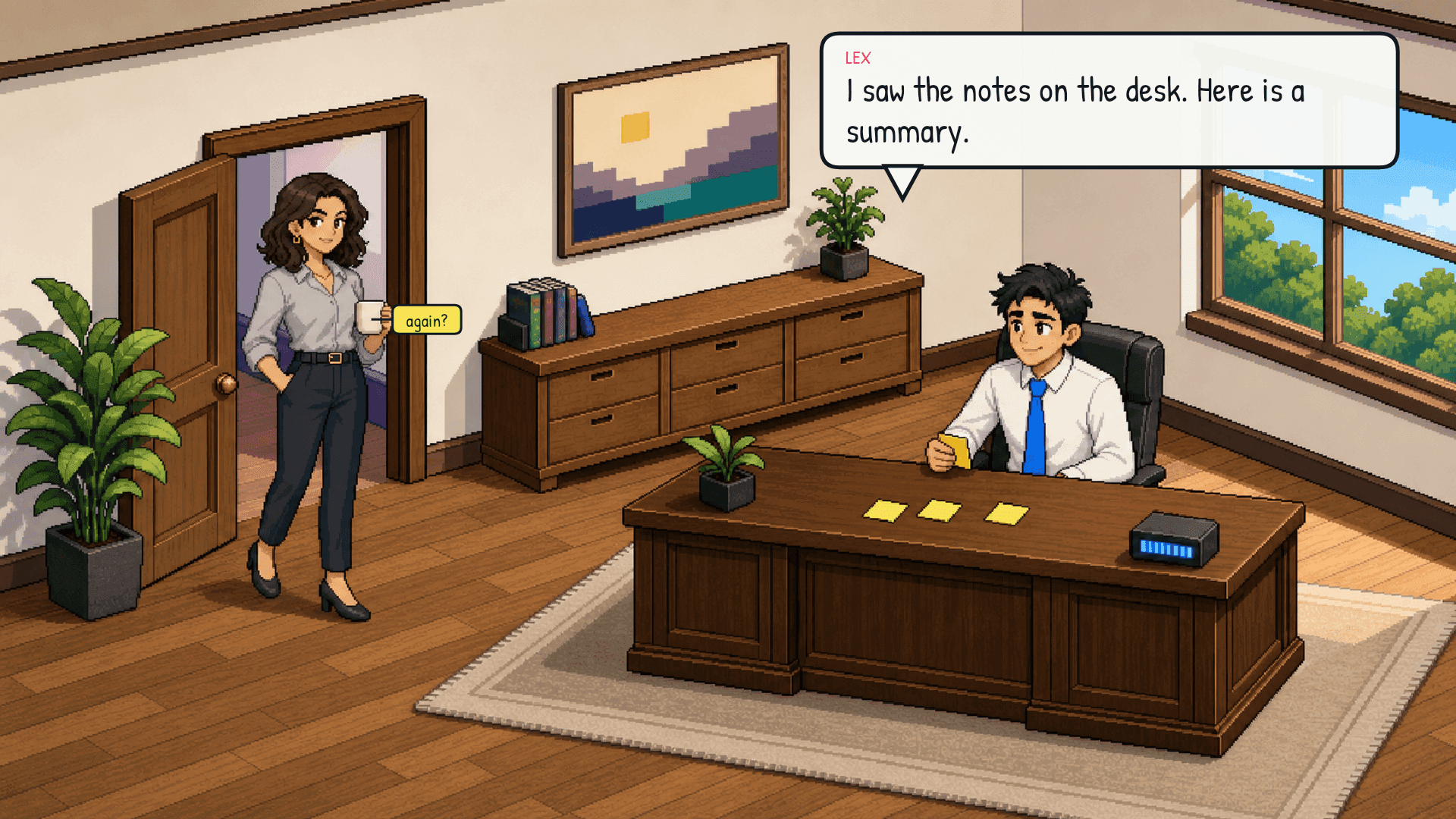
In a small office, an intern named Lex sits at a desk covered in today's notes. He works fast and writes well, but last week's project is missing from the context prepared for him.


Problem: Lex cannot use a prior conversation because no earlier context was placed on today's desk.
Resolution: The reader sees that Lex is not broken. The model works with the context assembled for the current response. Memory, history, retrieval, and tools belong to the surrounding system and only help when they put useful material on the desk.
Section 1: The intern at the desk
Picture an intern sitting at a desk. You hand him a stack of notes and ask for a summary. He reads the desk, writes a clear response, and slides it back to you. He is fast. He is thorough. And he works from the material prepared for this task.
That is the useful starting point for a large language model. An LLM receives input and generates a response from that input. By itself, the model does not decide to search a filing cabinet or open another application. A product can give it tools, retrieve documents, or add remembered details, but those results must still be placed in the model's input before it can use them.
Lex represents that model call, not the whole AI product around it. When Ava drops meeting notes on the desk and asks for a summary, Lex reads the notes and delivers. But last week's project is absent because this office has not yet added memory or retrieval. Lex cannot use a paper that never reaches his desk.
This is the first thing worth understanding: a model response is shaped by the context assembled for it. The model, the application, its tools, and its memory are different layers. The desk analogy describes the boundary between them.
Section 2: The desk is active context
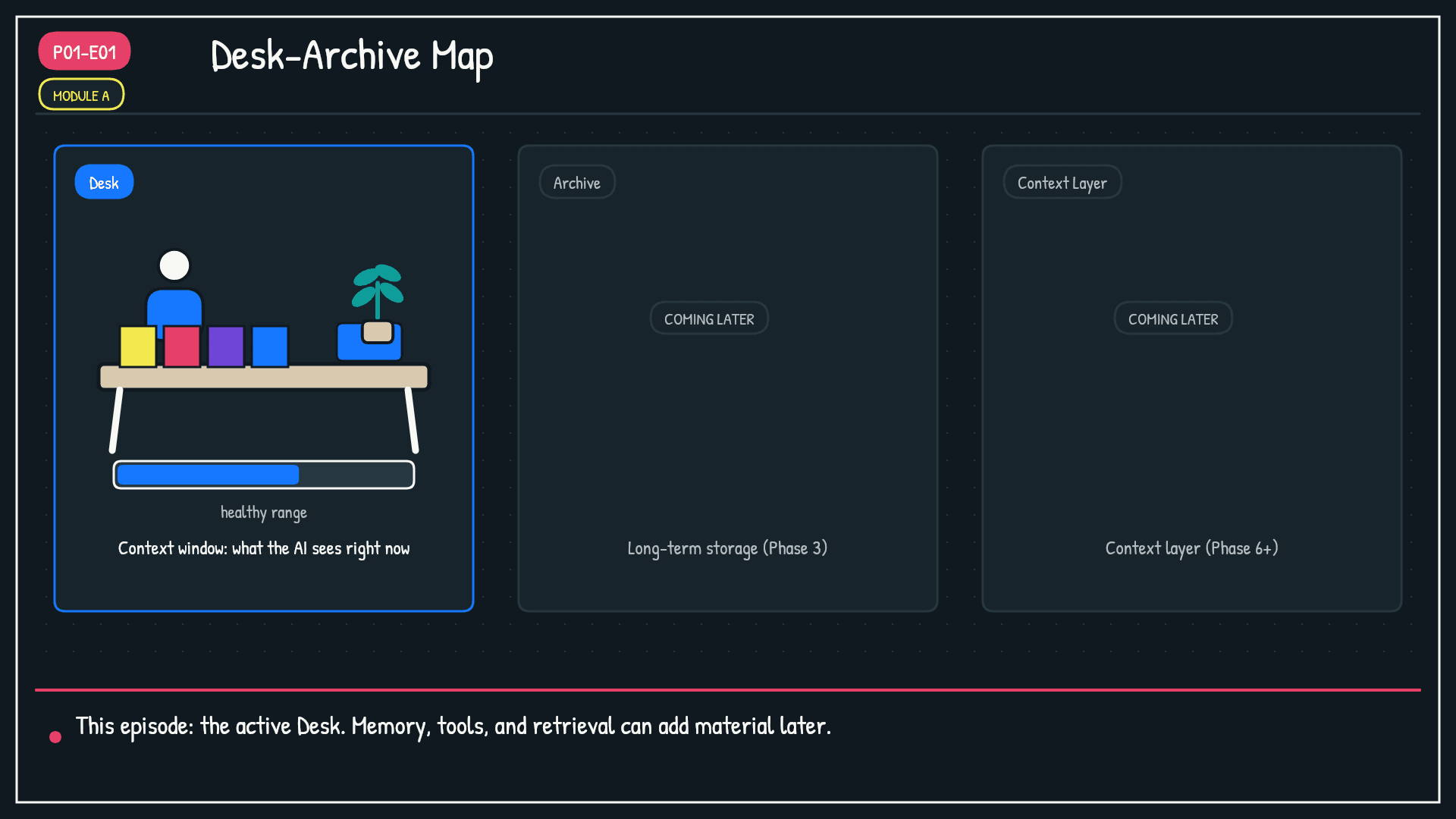
So what exactly is on the desk? The context assembled for the current model call.
Your latest message is usually there. Relevant earlier messages may be there too, along with system instructions, retrieved documents, tool results, or memory selected by the application. The visible chat and the model's active input are related, but they are not always identical. The bounded workspace available to the model is called the context window.
The context window is the boundary of what the model can use for that response. Lex can reference material placed inside it. Information stored elsewhere is unavailable until the application retrieves it and adds it to the desk.
Think of it this way: Lex's desk surface is the active context window. The office may keep far more material in other rooms, but only the selected notes and documents on this desk participate in the current task.
The context window has a size limit, but that is a topic for a later episode. The key idea right now is simpler: stored information and active context are not the same thing. Something must place a useful page on the desk before Lex can work with it.
Section 3: The desk gets cleared
Here is where things get frustrating.
In the simple office shown here, Ava finishes her conversation and walks out. When she returns, no earlier material has been prepared for Lex. The product may still store the old conversation somewhere, but storage alone does not place it in the next model call.
This baseline is called session amnesia: a new model call lacks earlier information unless the product reintroduces it through selected history, memory, retrieval, tools, or other input. The context window is newly assembled rather than being a permanent desk that survives forever.
This is why some tools make you re-explain your role, preferences, and project details. Other products now retrieve past chats or maintain memory, so their desks may not be blank. The question is not simply whether the information was stored. It is whether the right context was selected and delivered for this response.
Session amnesia is the no-memory baseline, not a universal rule for every AI product. The underlying model still works from a bounded context window even when an application builds continuity around it.
Glossary
- LLM
- A model that generates a response from the input assembled for it. Think of it as Lex working from the current desk. The surrounding product may add tools, retrieval, or memory. | Example: A chat application can retrieve a file, then place excerpts in the model's input before it answers.
- Context window
- The bounded workspace available to the model for one response. It can include messages, instructions, retrieved documents, tool results, and selected memory. | Office analogy: Lex's desk. Material elsewhere in the office must be brought to the desk before Lex can use it.
- Session amnesia
- The no-memory baseline in which a new model call lacks earlier information unless the product supplies it again. Products can reduce it by retrieving history or adding memory. | Office analogy: Ava returns, but no one prepared yesterday's papers for today's desk.
Try it yourself
- Open two separate sessions with the same AI tool and ask what context it can use from the other session. Note whether the product retrieves history, uses memory, or starts without either.
- Ask the tool what source supplied a remembered detail. A stored chat, a saved preference, and active model context are different layers.
- Pay attention to when a detail is absent because it never reached the current desk versus when it was present but the model failed to use it. Those are different failure modes.
