
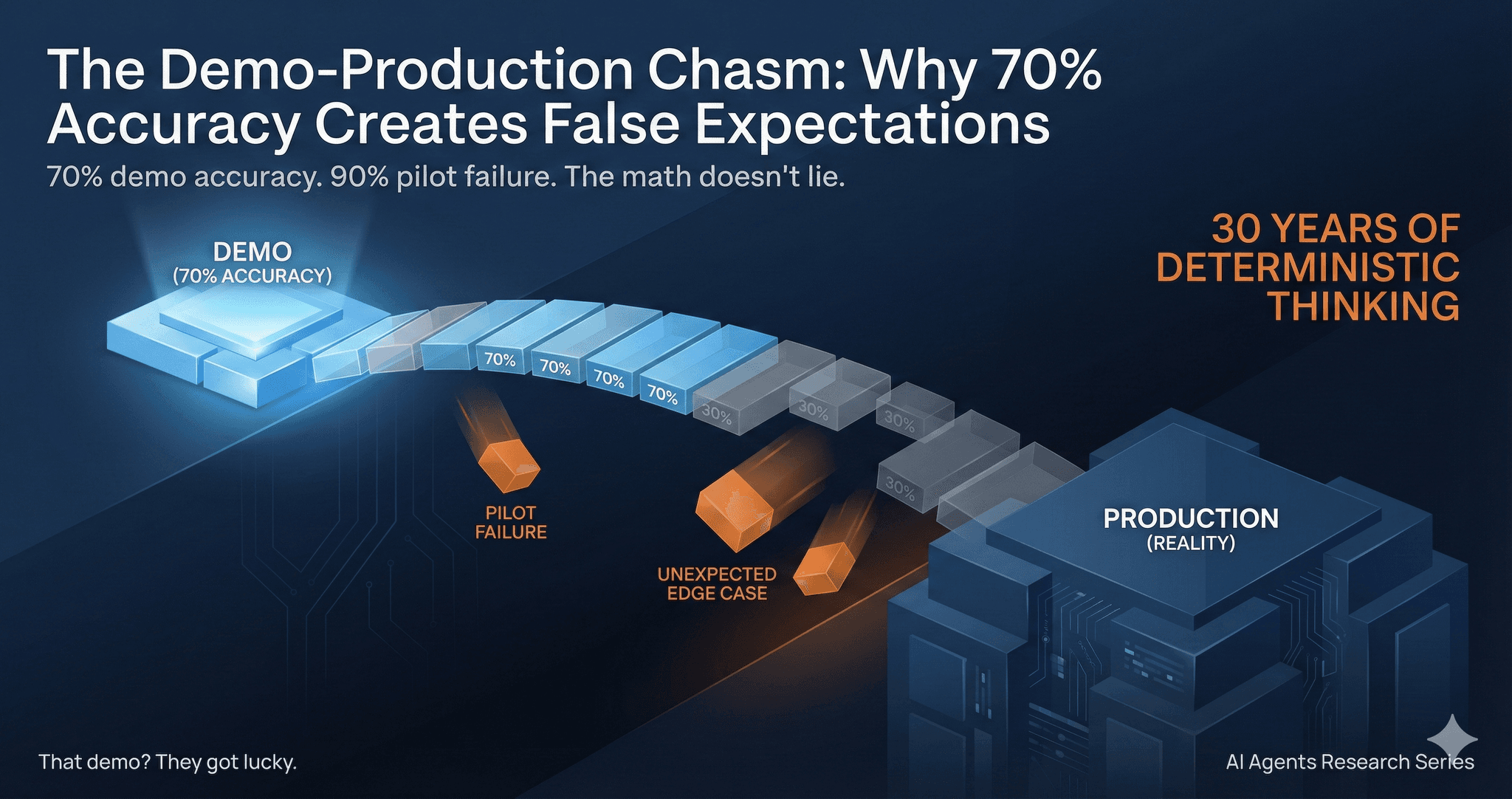
That AI agent demo you just watched? The one that flawlessly handled a complex task in thirty seconds? The person running it knows something you do not: they got lucky.
For thirty years, software engineers have operated in a deterministic world. Write code, run it, get the same result every time. Debug once, fix forever. This mental model is so deeply ingrained that most teams carry it directly into AI agent development, and it is destroying their projects. Our research across 36 expert interviews, 5 industry conferences, and 3 functional prototypes reveals a systematic failure pattern: teams build impressive demos, stakeholders get excited, and then reality hits. The agent that worked perfectly in the demo fails unpredictably in production. The 90% pilot failure rate is not a mystery once you understand why probabilistic systems demand an entirely different approach.
The 70% Demo Threshold
The demo-to-production gap has a specific, measurable origin point. As a founder of an AI infrastructure company explained during our research:
"Me demoing, I know that I just got lucky. Maybe 70 out of 100 runs of this demo, I will get lucky so I can run it, right? And when it fails, I will chuckle and go, whatever. So you can get away with it. If it works 70% of the time, you can demo it. Now, the other person on the other end, they are not used to that probabilistic nature. So they assume, oh my God, this works, I'm going to ship it." — a founder, an AI infrastructure company
This 70% threshold creates a dangerous expectation gap. The person demonstrating understands they are showing a best-case scenario. The person watching assumes they are seeing normal operation. This mismatch launches projects with fundamentally unrealistic expectations.
The problem runs deeper than simple miscommunication. As the founder continued:
"Most people that have built and deployed technology over the last, say, 30 years aren't used to probabilistic stochastic systems. They're used to deterministic things. So the expectation is if I see it working once, I expect it to work reliably from that point on." — a founder, an AI infrastructure company
Thirty years of deterministic software have trained an entire generation of engineers, product managers, and executives to expect consistent behavior. When traditional software works in a demo, it works in production. This assumption fails catastrophically with AI agents, where behavior varies with every run, context changes unpredictably, and small input variations produce wildly different outputs.
The data confirms this disconnect. According to the practitioner from an AI agent orchestration company, citing McKinsey and Bain research, "90% of all the pilots just doesn't work or stop just stop at the pilot's base and never convert into production. So there is friction. And enterprise adoption is in low single digit across the industry." The failure is not random. It follows directly from stakeholder expectations set during demos that misrepresent how probabilistic systems actually behave.
Consider what happens in a typical enterprise demo scenario. The sales engineer has rehearsed the demonstration dozens of times. They know exactly which inputs produce the most impressive outputs. They have refined prompts specifically for this use case. And critically, they run the demo multiple times before the meeting, showing only the successful attempt. The stakeholder sees a polished performance and greenlights a pilot, unaware that the underlying success rate might be 70% at best. By the time the pilot reveals the actual reliability, significant resources have been committed and expectations are already misaligned.
The expectation gap is not malicious. Demo presenters genuinely believe in their product. But their familiarity with probabilistic behavior makes them unconsciously filter for success cases while stakeholders, conditioned by decades of deterministic software, interpret successful demonstrations as proof of reliable operation.
The Doom Loop
When teams discover their agent does not work reliably in production, their instincts betray them. Engineers reach for the tools that have always worked: identify the failing scenario, fix it, ship the update. This triggers what practitioners call the doom loop.
"That's where the skill problem really starts to kind of hurt is because most people aren't used to how to make that better. They kind of go into this like doom loop almost... They'll go, oh, I see, okay, this scenario didn't work. I'll go change the prompt and the instructions and the data or whatever to make this scenario work. But then they go, oh, but the other one stopped working and they're now in this continuous loop." — a founder, an AI infrastructure company
The doom loop emerges because probabilistic systems do not respond to isolated fixes the way deterministic code does. Change a prompt to handle edge case A, and you may inadvertently break handling for edge case B. Add instructions to prevent one failure mode, and the increased context causes accuracy to drop across other scenarios. The Production Agents Summit reinforced this finding: "Too much, too little or irrelevant information in the context can cause an LLM to steer the agent away from its goal by selecting the wrong next action."
The AI lead from an AI sales intelligence company described how her team navigated this challenge by abandoning end-to-end evaluation entirely: "Almost never do we evaluate something end to end because it is pointless. So if you can evaluate a system at a time, and that is how you grow better... we built it blind after step one." This counterintuitive approach works because it focuses evaluation effort on deterministic components like retrieval rather than probabilistic pipeline outcomes.
A VC investor specializing in AI infrastructure quantified just how brittle agents can be: "The biggest challenge for us is if you have an initial prompt and a set of use cases and you want to get that to work as quickly as possible... that 5 degree variance breaks the AI generated code. It's not robust." A five-degree deviation from expected inputs breaks the system entirely. This sensitivity explains why doom loops are so persistent: each fix narrows the successful path while remaining blind to the new failures being introduced elsewhere in the probability distribution.
Traditional bug-fixing assumes you can isolate problems and fix them independently. In probabilistic systems, everything is interconnected. The fix for one scenario changes the probability distribution across all scenarios. Without systematic controls, teams chase problems in circles while stakeholder confidence erodes. The scientific method, not reactive debugging, is the only escape from this trap.
The doom loop also explains why so many agent projects stall in extended "pilot" phases. Teams keep fixing issues that were not there before, never reaching stable enough reliability to graduate to production. Each week brings new edge cases and regressions that consume development resources in an endless maintenance spiral.
Architectural Patterns That Work
If ad-hoc prompt tweaking creates doom loops, what actually works? Our prototype development and expert interviews revealed several architectural patterns that successfully manage probabilistic behavior.
State Machine Approaches
The Repo Patcher prototype demonstrated that state machines provide deterministic progression through probabilistic steps. The workflow follows explicit stages: INGEST, PLAN, PATCH, TEST, REPAIR, PR. Each transition has defined success criteria and failure handling. The AI operates within bounded contexts while the architecture ensures forward progress.
"State machine-based multi-step reliability (INGEST, PLAN, PATCH, TEST, REPAIR, PR) provides deterministic progression through complex tasks with explicit success/failure criteria and built-in error recovery." — Repo Patcher prototype architecture
This pattern transforms unreliable probabilistic operations into reliable overall outcomes by containing uncertainty within manageable steps. When PATCH fails, the system transitions to REPAIR with explicit recovery logic rather than hoping the model self-corrects. When TEST fails, the system has clear criteria for retry versus escalation. The probabilistic element remains, but it operates within a deterministic framework that guarantees forward progress or controlled failure.
Verification Phases
The Good Agents prototype implemented a plan-verify-execute pattern where a verification phase validates feasibility and safety before execution begins. This approach treats verification as a governance mechanism, not just technical validation.
"Plan-Verify-Execute orchestration pattern with verification phase as governance mechanism for managing probabilistic agent behavior." — Good Agents prototype implementation
By separating planning from execution and inserting verification between them, teams can catch errors before they compound through multi-step workflows. The verification phase can check resource availability, validate permissions, assess risk levels, and confirm alignment with user intent. This architectural choice converts what would be catastrophic failures mid-execution into recoverable issues caught during planning.
Risk-Based Human-in-the-Loop Escalation
Not all agent actions carry equal risk. Production systems succeed by routing decisions based on confidence and consequence. Low-risk, high-confidence actions proceed automatically. High-risk or low-confidence situations escalate to human review. This pattern preserves automation velocity while preventing catastrophic failures.
Multiple sources described implementations where risk thresholds trigger escalation: auto-approve routine operations, require human confirmation for anything touching sensitive data or external systems. The key insight is that HITL should be risk-based, not universal. Requiring human approval for every action defeats the purpose of automation. Requiring no human approval creates unacceptable risk. The middle path routes based on both model confidence and action consequence.
Context Management Discipline
The Production Agents Summit introduced a critical rule of thumb: "If your agent is using anything more than 40% of the context window, it's probably going to make mistakes. This is true for an agent you develop for your software. It's also true for things like Cursor." Context accumulation, not fundamental model limitations, causes most production failures. Agents typically start correctly but "take a left turn" after several iterations as context bloats.
Successful architectures implement aggressive context management: summarizing tool outputs rather than passing raw results, pruning old context aggressively, using just-in-time retrieval instead of upfront loading. A practitioner at an AI infrastructure company quantified the stakes: "When you have more than 20 MCP like 30 40, the agent totally cannot work. We were tested and some posts on Internet test that if your MCP amount exceeds 25, your LM accuracy will drop to 30%." Twenty-five tools and accuracy drops to 30%. These are not theoretical concerns but measured production failures.
Prototype Validation
Our three functional prototypes tested these patterns against real-world complexity, providing firsthand experience that validated interview findings.
The Shopping Agent confirmed framework challenges firsthand: we initially implemented using LangGraph but, due to its extensive bloat and complexity, switched mid-development to LangChain's simpler chain-based abstractions. This validated interview findings about framework overhead and demonstrated why 80-90% of teams abandon frameworks for production. The experience transformed abstract statistics into visceral understanding of why framework simplicity matters for probabilistic systems.
Repo Patcher validated state machine reliability across 20 diverse test scenarios covering imports, logic, assertions, mocks, and async operations. The explicit failure handling and recovery mechanisms proved essential for maintaining reliability as complexity increased. We achieved the target of under $0.25 per fix through architectural attention to cost, demonstrating that production viability requires deliberate optimization.
Good Agents demonstrated that observability cannot be retrofitted. The comprehensive tooling stack including OpenTelemetry, Jaeger, Langfuse, Prometheus, and Grafana was architectural from the start. Attempts to add observability later would have required significant rework. As a practitioner from an AI observability company noted in our interviews, "there's not like a standardized way of logging what are the exact actions and being able to do like really like detailed debugging and maybe even like, quote unquote, time traveling of like, why did the agent take this action at this moment in time?"
Together, these prototypes triangulate a consistent finding: architectural governance patterns provide the structure that probabilistic systems lack inherently. Teams cannot prompt-engineer their way to reliability; they must build it into the system architecture from the beginning.
Why This Matters
The probabilistic systems challenge explains much of the current AI agent market confusion. Vendors demonstrate impressive capabilities. Enterprises invest in pilots. Projects fail at production scale. Blame shifts to models, frameworks, or execution, when the actual cause is a systematic mismatch between deterministic expectations and probabilistic reality.
Understanding this pattern changes how organizations should approach agent development. The question is not whether models are capable enough. As the practitioner from an AI agent orchestration company noted, "The intelligence is really smart enough right. So it doesn't need the model to be much better to make this work in enterprise. So the real sticking point is system integration." Current models already exceed requirements for many use cases.
The co-founder of an autonomous-agent startup reinforced this perspective: "We found out actually model only maybe contributes 30 or 40% of the whole thing. And the framework, the whole system you build upon the model is much more important, you know, than the model itself." The model contributes 30-40% of production success. Architecture, evaluation, and process contribute the remaining 60-70%.
The question is whether teams have the methodologies, tooling, and organizational practices to manage non-deterministic systems at scale. Most do not. The 90% pilot failure rate is not a model problem or a framework problem. It is a process and expectation problem that begins the moment someone watches a demo and assumes reliability.
For executives, this means pilot success criteria should include reliability metrics across multiple runs, not just single demonstrations. For engineers, this means adopting scientific methodology with controlled experiments and regression testing. For product managers, this means setting appropriate stakeholder expectations before demos ever happen. The entire organization must shift its mental model from deterministic to probabilistic thinking.
What You Can Do
Reframe demos as probability demonstrations: When presenting AI agents, explicitly communicate the success rate. "This works 70% of the time" sets appropriate expectations and prevents the expectation gap that dooms pilots. Show multiple runs including failures to calibrate stakeholder understanding.
Adopt the scientific method: Replace ad-hoc prompt tweaking with controlled experiments. Establish baselines. Categorize errors by type rather than chasing individual failures. Build regression tests before making changes. This is how you escape the doom loop. As the founder explained, "People who are used to science know that you can do it with probabilistic things in the world."
Implement architectural governance: Use state machines, verification phases, and risk-based HITL escalation. Do not rely on prompt engineering alone for reliability. Architecture provides the structure that probabilistic behavior lacks inherently.
Evaluate components, not pipelines: Focus evaluation effort on deterministic steps like retrieval accuracy rather than end-to-end probabilistic outcomes. If the first step works, subsequent steps have a foundation. Build from verifiable components.
Measure handoff rate, not accuracy: Track what percentage of tasks require human intervention. This metric directly measures automation value delivered rather than intermediate technical metrics that may not correlate with business outcomes.
The Bottom Line
The demo-to-production gap in AI agents is not a mystery. It follows predictably from applying thirty years of deterministic software intuition to fundamentally probabilistic systems. The 70% demo threshold creates false expectations. Traditional bug-fixing triggers doom loops. And ad-hoc approaches cannot overcome architectural limitations.
Success requires treating agent development as scientific experimentation rather than traditional software engineering. State machines, verification phases, and risk-based escalation provide the governance structure that probabilistic behavior demands. Teams that internalize this shift will join the 10% that convert pilots to production. Those that do not will continue wondering why such impressive demos keep failing.
This post is part of my research series on AI Agent deployment, based on 36 expert interviews, 5 industry conferences, and 3 functional prototypes. Read the full research overview.
Have thoughts on AI agent deployment? Connect with me on LinkedIn or email me.