
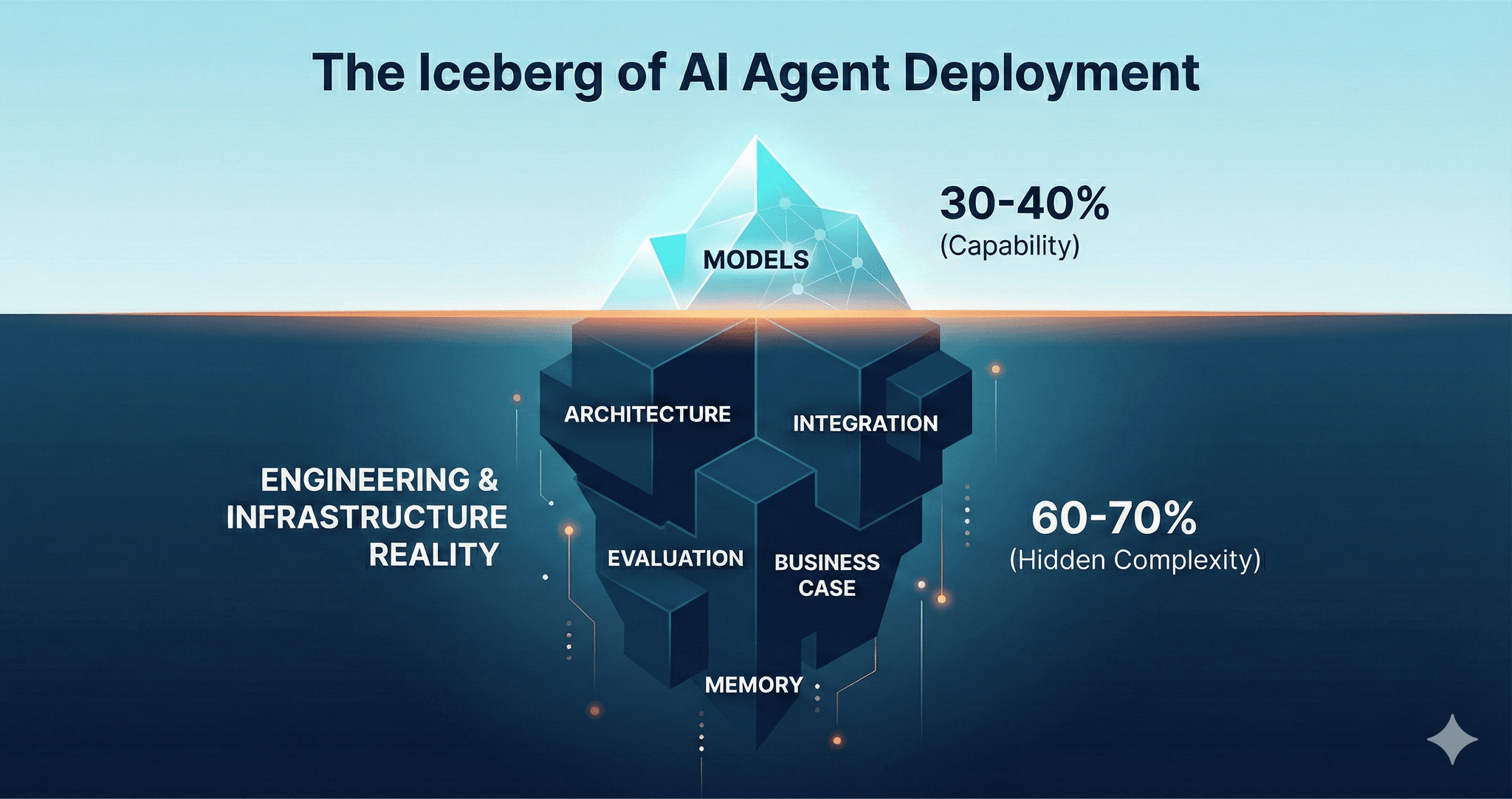
Ninety percent of enterprise AI agent pilots never convert to production. Not because the technology fails, but because organizations cannot define ROI, forecast costs, or manage stakeholder expectations around probabilistic systems. After conducting 36 expert interviews over ten weeks, I discovered that the bottleneck is not AI intelligence—it is the mundane work of integration, architecture, and business case clarity.
The Discovery
This research emerged from a simple question: What prevents AI agents from transitioning from impressive demonstrations to reliable enterprise tools? Demos impress, pilots proliferate, but production conversion rates hover around 10%. The gap seemed puzzling given the rapid advancement of foundation models.
To investigate, I conducted a systematic 10-week study as part of Stanford GSB GSBGEN 390 Individual Research during Autumn 2025. The research comprised three complementary approaches:
36 Expert Interviews with practitioners actively deploying agentic workflows—enterprise AI platform providers like an AI agent orchestration company and an AI infrastructure company, coding agent developers at an AI coding company, identity experts at major tech companies, vertical SaaS companies like an AI sales intelligence company and a CRM AI company, framework companies including a multi-agent framework company and an agent framework startup, and infrastructure providers like an AI infrastructure company.
5 Industry Conferences including the Production Agents Summit at Snowflake, a fireside chat with an autonomous-agent startup, Project Nanda, and the "Why 95% of Agentic AI Projects Fail" event—each revealing practitioner consensus and emerging patterns.
3 Functional Prototypes built to validate interview findings: a Shopping Agent testing e-commerce automation, Repo Patcher implementing state machine architecture for code fixing, and Good Agents exploring multi-agent orchestration with plan-verify-execute patterns.
What I expected to find was a technology-focused narrative where better models, improved frameworks, and maturing protocols would incrementally solve deployment challenges. What I discovered over the following ten weeks fundamentally challenged this framing.
What We Found
The 30-40% Model Revelation
The most significant finding inverted my initial assumptions. I entered this research believing model capabilities were 70% or more of the problem. The reality proved dramatically different.
"Model only contributes 30-40% of the whole thing. The framework, the whole system you build upon the model is much more important." — Co-founder of an autonomous-agent startup, fireside chat
This was not an isolated perspective. When I analyzed theme frequency across all 26 extraction documents, Model Capabilities appeared in only 62% of sources—the lowest of the six core themes. Meanwhile, System Integration appeared in 92% of sources, and Framework and Tooling Ecosystem in 85%.
The implication is profound: current models at GPT-4 capability levels are already sufficient for many enterprise use cases. The bottleneck lies in the 60-70%—framework architecture, orchestration patterns, context engineering, and evaluation infrastructure. Competitive moats come from framework engineering, not model access.
Business Case Failure Precedes Technical Failure
The very first interview, with the practitioner from an AI agent orchestration company on October 14th, immediately challenged my technical-first framing:
"Most AI agent deployments fail due to undefined ROI calculations and lack of commercial mindset, not technical limitations." — the practitioner, an AI agent orchestration company
This insight was reinforced throughout the research. Ninety percent of enterprise pilots fail not because the technology breaks, but because organizations cannot forecast costs, model usage patterns, or demonstrate clear business value. Multiple pricing models coexist—seat-based, token-based, outcome-based—with no convergence, making budget planning nearly impossible.
The economics problem runs deep. Many agent startups charge $20-30 per month while consuming $5 or more in token costs per task—a fundamentally unsustainable model at scale. Meanwhile, enterprises demonstrate willingness to pay $400-750 per month, but cost predictability does not exist. Enterprise customers of a multi-agent framework company demand guarantees: "We will save $2M in this single use case" with targets of "$100M annual savings" to justify deployment.
Business Case and ROI emerged as a top emergent theme with a perfect 5.0 relevance score—a theme that was not even in my initial research framework. It emerged entirely from the data, revealing my research blind spot.
The Framework Abandonment Pattern
LangChain has achieved a billion-dollar valuation with massive developer adoption. Yet 80-90% of production teams abandon it.
"Every company we've talked to started with LangChain as a framework to build AI agents. But once they start going into customers and into production, they realize it's full of bloat. They end up ditching that solution, and they build their own. This has been like 80, 90% of the clients we've talked to." — a co-founder at an agent framework startup
The performance gap is substantial. A practitioner from a CRM AI company reported custom frameworks achieving 3-4x faster performance than LangChain. The pattern is consistent: framework abstractions that accelerate prototyping become obstacles in production. Teams need control and performance that generic frameworks cannot provide.
My own Shopping Agent prototype validated this firsthand. Initially implemented with LangGraph, the team was forced to switch mid-development to LangChain's simpler chain-based abstractions because of LangGraph's extensive bloat and complexity. Under deadline pressure, framework abstractions became intolerable—exactly the pattern reported in interviews.
Unlike frontend frameworks where React emerged as a winner, agent frameworks will remain fragmented. Production requirements diverge fundamentally from prototyping needs. Framework bloat compounds as vendors add features for experimentation use cases that become burdensome for production deployments.
Why This Matters
The implications of these findings differ significantly based on your role.
For Engineering Teams: Stop waiting for better models. Invest in framework architecture and integration layers. Build evaluation infrastructure from day one—it cannot be retrofitted. Design for the 40% context utilization rule: quality degrades beyond this threshold regardless of window size.
For Enterprise Leaders: Define ROI and business case before technical deployment. Expect 40-50% of deployment time to be spent on integration, not AI work. Budget for custom solutions—framework abandonment is the norm, not the exception.
For Product Strategists: Treat integration complexity as competitive moat, not a problem to solve. Select use cases that favor generation over analysis—coding agents succeed while generic knowledge work struggles. Measure handoff rate (tasks passed to humans) as your north star metric, not intermediate technical metrics like token efficiency or retrieval accuracy.
| Insight | Statistic | Source |
|---|---|---|
| System integration challenges | 92% of sources | Theme Frequency Analysis |
| Pilot failure rate | 90% | an enterprise AI deployment expert |
| Framework abandonment | 80-90% | a co-founder at an agent framework startup |
| Integration time allocation | 40-50% of deployment | an enterprise AI deployment expert |
| Model contribution | 30-40% | Fireside with an autonomous-agent startup |
| Context utilization rule | 40% max | Production Agents Summit |
| MCP tool accuracy cliff | 25 tools, then 30% accuracy | a practitioner at an AI infrastructure company |
What You Can Do
Start with business case clarity: Before any technical work, define how you will measure ROI and what success looks like in economic terms. If you cannot articulate the business value, the pilot will fail regardless of technical excellence.
Invest in architecture over model selection: With models contributing only 30-40% to success, your framework design, orchestration patterns, and integration layers are where differentiation happens. Build these as core capabilities, not afterthoughts.
Measure what matters: Adopt handoff rate—the percentage of tasks requiring human intervention—as your primary success metric. This aligns engineering work with business value and avoids the trap of optimizing intermediate metrics that do not translate to automation value.
Plan for integration complexity: Budget 40-50% of deployment effort for system integration. Treat this as a core engineering challenge, not a temporary gap waiting for standards to mature.
Design for probabilistic behavior: Implement architectural patterns like state machines, verification phases, and risk-based escalation to govern probabilistic agent behavior. Do not rely on models becoming more reliable.
The Bottom Line
Production AI agents are an engineering problem, not an AI problem. The opportunity is in the 60-70% that encompasses architecture, integration, and evaluation—not in the 30-40% of model capability. The companies that succeed will be those that solve governance, economics, and measurement. They will not be those chasing better models while ignoring the infrastructure that makes agents production-ready.
This post is part of my research series on AI Agent deployment, based on 36 expert interviews, 5 industry conferences, and 3 functional prototypes. Read the full research overview.
Have thoughts on AI agent deployment? Connect with me on LinkedIn or email me.