AI Agents ResearchPart 6THEME
Why 90% of AI Agent Pilots Fail Before Hitting Technical Limits
Enterprise AI agent adoption faces a multi-layered governance crisis where business case failures, pricing confusion, and trust deficits block production deployment—not model capabilities.

On this page
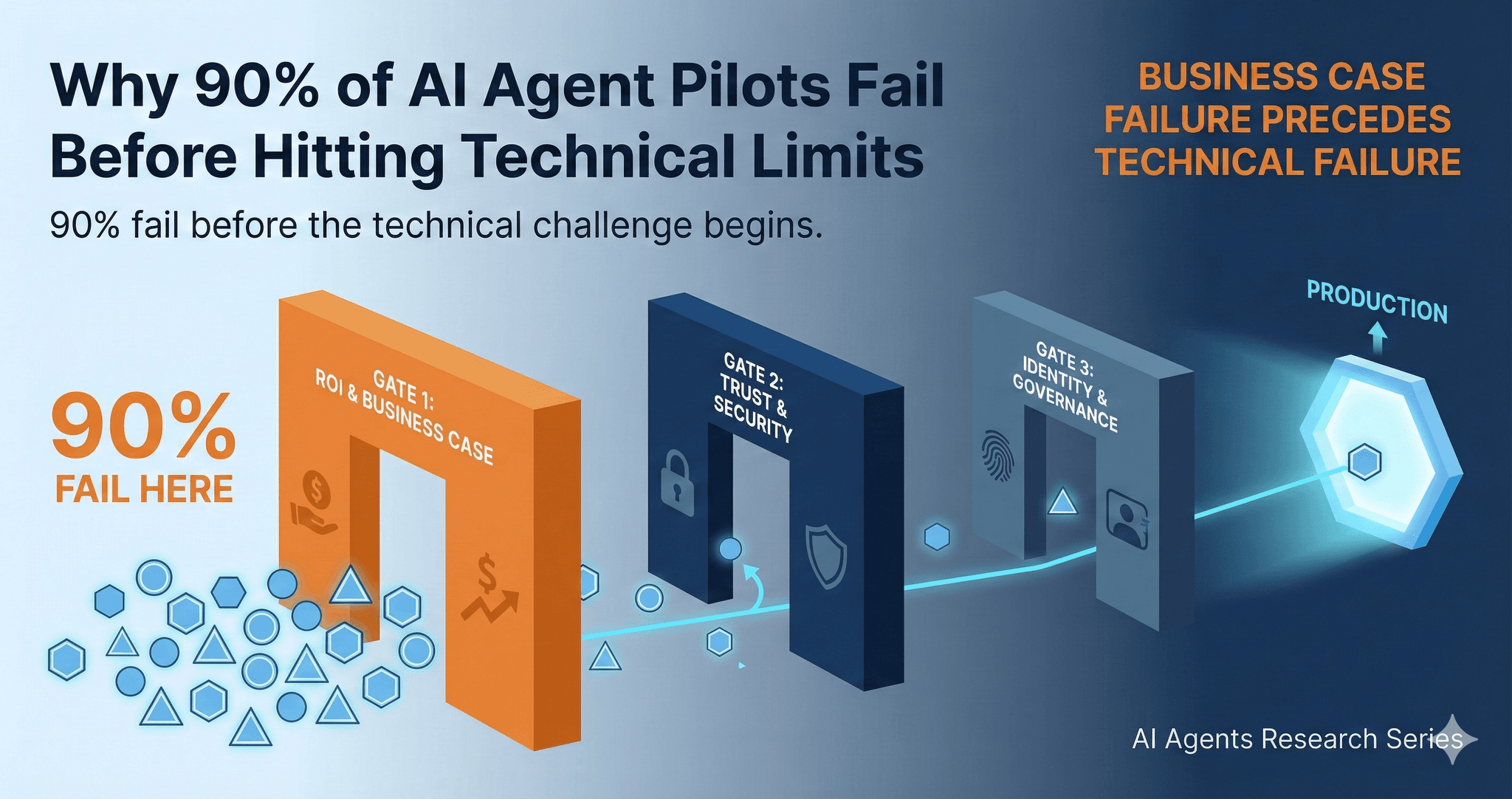
Here is a statistic that should fundamentally change how you think about AI agent deployment: 90% of enterprise AI agent pilots fail before they ever encounter a technical limitation. They do not fail because the models are inadequate. They do not fail because the technology is immature. They fail because organizations cannot articulate the business case, cannot predict costs, and cannot overcome deep-seated trust barriers that have nothing to do with model performance.
This finding emerged consistently across our research—36 expert interviews, 5 industry conferences, and 3 functional prototypes built from first principles. The pattern is unmistakable: enterprise adoption is governance-constrained, not technology-constrained. Technical feasibility exists. Companies like an AI agent orchestration company have deployed 25 production AI agents successfully. A multi-agent framework company works with Global 100 customers. The capability is proven. What is missing is the organizational, economic, and regulatory infrastructure that enables deployment at scale.
ROI as Primary Failure Mode
The single most important insight from our research challenges the prevailing narrative in enterprise AI. We have been obsessing over the wrong problem. The industry conversation fixates on model capabilities, prompt engineering, and framework selection. But these are not where pilots fail.
"Most AI agent deployments fail due to undefined ROI calculations and lack of commercial mindset, not technical limitations." — a practitioner at an AI agent orchestration company
The practitioner's experience deploying AI agents across enterprise environments reveals a consistent and troubling pattern. Companies rush to pilot AI agents because of competitive pressure and executive excitement about the technology. They spin up proof-of-concept projects. They demonstrate impressive capabilities in controlled environments. Then they try to move to production—and everything stalls.
The problem is not that the agents cannot perform the tasks. The problem is that no one defined what success looks like in business terms before starting the technical work. There is no baseline measurement of current process costs. There is no clear articulation of expected savings or revenue impact. There is no methodology for attributing outcomes to the AI system versus human contributors.
This matters enormously because enterprise procurement requires justification. Budget holders need to explain why they are spending money. Without ROI calculations, pilot projects cannot convert to production deployments, regardless of technical success.
The data supports this observation. Enterprise adoption of AI agents remains in low single digits across industries, according to research from McKinsey and Bain that the practitioner cited. This is not a lack of interest—executives are excited about AI agents. It is not a lack of capability—the demos are impressive. It is a fundamental inability to construct business cases that survive procurement scrutiny.
The implication is profound: if you are building AI agents for enterprise, you need commercial mindset before technical implementation. Define success metrics first. Establish baseline measurements. Create attribution methodology. Build the business case before you build the agent. Only then should you begin the technical work that everyone wants to jump to immediately.
Pricing Model Confusion
Even when organizations want to adopt AI agents and understand their potential value, they face a fundamental obstacle: they cannot predict what deployment will cost.
"All of these pricing like changes or type of pricing schemes is confusing to large enterprises. What we were told is they don't know how many tokens they're going to use for cross-app access... Those are things that is confusing internally to us, to a major enterprise identity company, but also confusing to enterprise because they're not used to that. They can't model their usage, they can't model their outcome." — an engineering leader, a major enterprise identity company
The AI agent market has no standard pricing model. Some vendors charge per seat, like traditional SaaS. Some charge per token, based on actual usage. Some attempt outcome-based pricing, tying costs to results achieved. Some blend multiple models. And all of these are changing constantly as vendors experiment with what the market will bear.
For enterprise procurement, this creates paralysis. Large organizations budget 12-18 months in advance. They need cost predictability. When a vendor cannot tell them what a deployment will cost—because even the vendor does not know how many tokens will be consumed—the enterprise cannot proceed through normal procurement channels.
The problem compounds because token consumption varies dramatically based on use case, prompt complexity, and agentic loops. An agent that makes 50 tool calls to complete a task consumes far more tokens than one that completes in 3 calls. But no one knows in advance how many calls will be needed. Complexity is inherently unpredictable.
Even sophisticated financial planning teams struggle with this uncertainty. Anthropic's own FP&A team reportedly missed revenue projections by 40% because consumption patterns are so unpredictable. If the model provider itself cannot forecast usage accurately, how can enterprises be expected to budget for it?
This is not a technical problem. It is a business model problem. And until the industry converges on predictable pricing—or provides tools for accurate cost modeling—enterprise adoption will remain constrained by procurement paralysis.
Trust and Identity Challenges
Beyond economic barriers, enterprises face fundamental trust deficits that block AI agent deployment. The resistance comes from exactly where you would expect: the CISO and CIO offices that control access to corporate systems.
"There is a lot of resistance in sharing data with the agentic systems, whether it's on their premise, out of premise... there is a lot of trust deficit in terms of sharing, especially with especially with out of the box models. Like OpenAI, Claude." — an engineering leader, a workforce platform
This trust deficit is particularly acute in regulated industries. Banking, financial services, insurance, and healthcare organizations face compliance requirements that make cloud-based AI systems problematic. Data residency requirements, audit trail mandates, and liability concerns create genuine barriers that no amount of technical capability can overcome.
The identity challenge compounds this problem significantly. Traditional enterprise systems authenticate humans. But AI agents are not humans. They are virtual employees that need system access, but they do not fit existing identity frameworks. An agent that accesses Salesforce, Slack, and internal databases needs credentials—but what credentials? Whose permissions should it inherit? How do you audit its actions?
A major enterprise identity company is working with Anthropic on MCP extensions for enterprise identity, representing early movement toward standards. But the SSO-equivalent moment for agents has not arrived. Until it does, enterprises must solve the identity problem case-by-case, adding friction and cost to every deployment.
"It's hard to really put agents in production because you have to be able to trust the LLM to make decisions on your behalf. And that is more of a people and processes kind of issue [not just technology]." — a practitioner interviewed in this research
This insight captures the essence of the challenge. Trust is a people and process issue, not a technology issue. Solving it requires organizational transformation—changing how people think about delegation to machines—not just technical implementation.
The Willingness-to-Pay Gap
Perhaps the most striking finding from our research is the dramatic gap between what enterprises would pay for effective AI agents and what current products cost. This gap reveals both a massive opportunity and a fundamental market immaturity.
Our research with an engineering leader from a workforce platform, who operates in the Indian market, revealed that enterprises are willing to pay $400-750 per month for agents that genuinely replace human work. Yet most current offerings cluster around $20 per month—prosumer pricing that signals the products are not production-ready.
This 20-40x gap is not irrational. It reflects the reality that current agents do not actually replace human work at production scale. They augment. They assist. They accelerate certain tasks. But they do not eliminate the need for human involvement in most enterprise workflows. The premium pricing that enterprises would willingly pay requires complete task ownership, not partial assistance.
The economics become even starker when you compare agent costs to offshore labor. For generic tasks like customer service, AI agents currently cost 3-5x more than human representatives in Manila, India, or Brazil. This is not a rounding error—it is a fundamental cost disadvantage that prevents deployment regardless of capability.
"The amount of capabilities or abilities an agent need to reach a call center representative in Manila or in India or in like Brazil are way more right now three to five times more cost than hiring a human like customer service representative." — an engineering leader, a major enterprise identity company
For AI agents to achieve mass enterprise adoption, they must beat human labor on cost—not just match it. The technology may be impressive in demos, but the economics are not yet compelling for generic tasks. This creates a strategic imperative: focus on high-value domains where agents demonstrably outperform humans economically, such as coding and specialized knowledge work, rather than competing on cost for commoditized labor.
Why This Matters
The implications of these findings extend far beyond individual deployment decisions. They reshape how we should think about the AI agent market and where value will ultimately accrue.
First, the technical moat is overrated. If 90% of failures are non-technical, then technical excellence alone cannot win the market. The winners will be those who solve the business case, pricing, and trust problems—not those with marginally better models or more sophisticated architectures.
Second, enterprise-focused AI agent companies need fundamentally different capabilities than consumer-focused ones. They need change management expertise. They need pricing innovation. They need security certifications and compliance frameworks. Engineering talent is necessary but not sufficient. Organizations that expect to convert technical demos into enterprise deployments without these capabilities will join the 90% failure rate.
Third, the 90% failure rate creates opportunity for those who understand it. If you can help enterprises define ROI before pilots begin, you remove the primary blocker. If you can provide predictable pricing, you enable budgeting. If you can solve identity and trust at the infrastructure layer, you clear the path for the entire market.
The market is not waiting for better models. The models work. It is waiting for the governance infrastructure that makes production deployment possible at scale. The companies that build this infrastructure—or help enterprises navigate it—will capture disproportionate value in the emerging AI agent economy.
What You Can Do
Based on our research, here are five actionable recommendations for organizations attempting AI agent deployment:
Define business metrics before technical pilots: Establish baseline measurements, success criteria, and attribution methodology before writing a single line of code. The ROI conversation must happen first, not after the demo impresses executives.
Demand predictable pricing or build cost models: If your vendor cannot tell you what deployment will cost within a reasonable range, either negotiate fixed pricing or build your own consumption models based on pilot data before committing to production.
Engage security and compliance teams from day one: The CISO and CIO will eventually review any production deployment. Bring them in early to identify blockers while you can still address them architecturally rather than as last-minute patches.
Solve identity and access management explicitly: Do not assume existing IAM frameworks will work for agents. Define agent identity, permissions, and audit trails as first-class requirements, not implementation details.
Calculate total cost of ownership against human alternatives: If your agent costs more than the human labor it replaces—including offshore options—you need either a different use case or a different architecture. Be honest about the economics.
The Bottom Line
Enterprise AI agent adoption is not blocked by model capabilities. The models work. What is missing is the organizational, economic, and governance infrastructure that enables production deployment at scale.
The 90% pilot failure rate is not a technology problem to be solved with better prompts or more capable models. It is a business problem requiring ROI frameworks, predictable pricing, trust infrastructure, and identity standards. Until these pieces fall into place, enterprise adoption will remain in low single digits—no matter how impressive the demos become.
The organizations that recognize this shift—from technical challenges to governance challenges—will capture the enterprise AI agent market. The rest will keep building impressive pilots that never reach production.
Quotes from recorded sessions are lightly edited for clarity.
This post is part of my research series on AI Agent deployment, based on 36 expert interviews, 5 industry conferences, and 3 functional prototypes. Read the full research overview.
Have thoughts on AI agent deployment? Connect with me on LinkedIn or email me.