AI Agents ResearchPart 8EMERGENT
The 30-40% Model Myth: Why Framework Architecture Matters More Than Model Capability
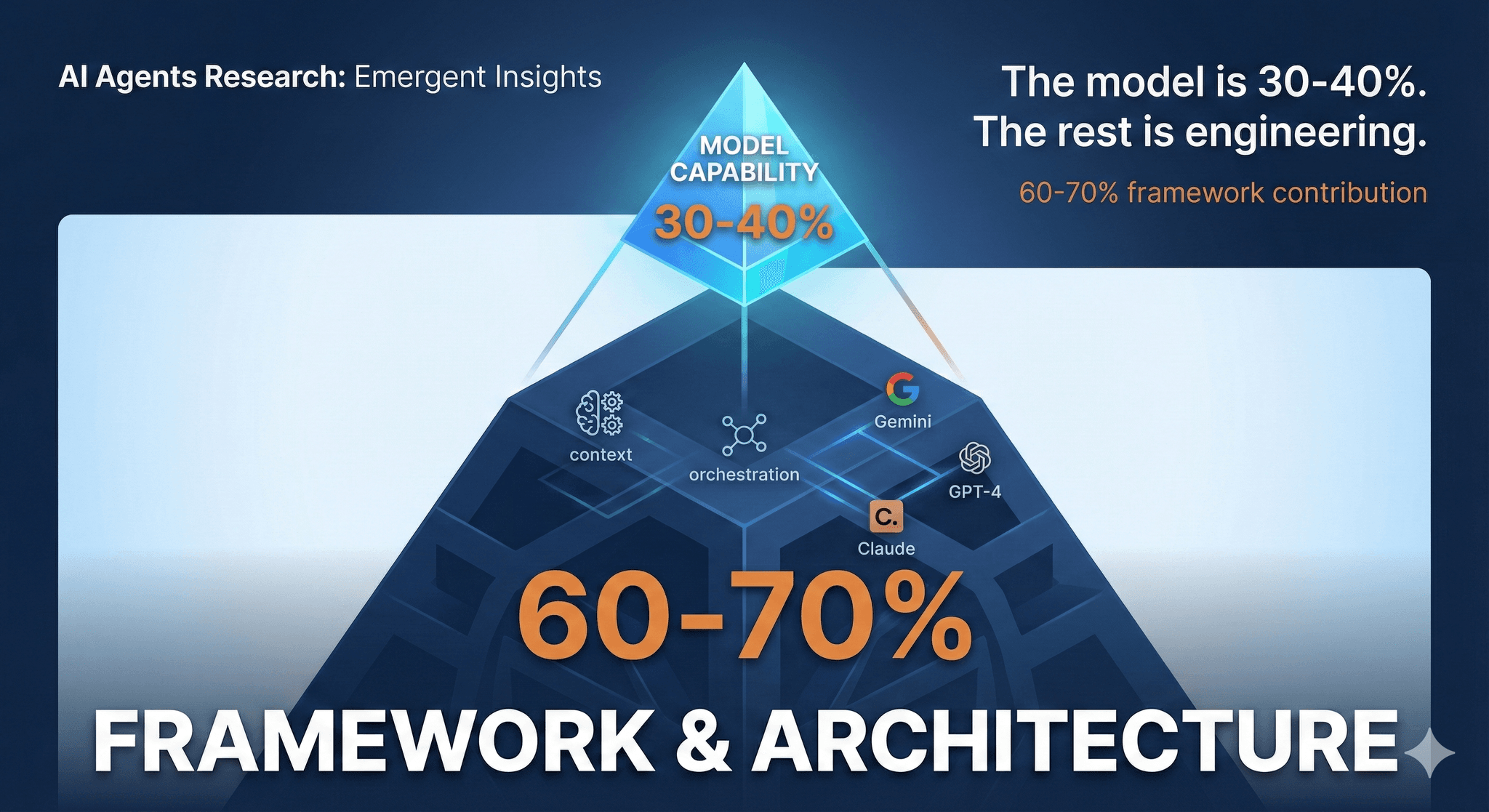
The counterintuitive discovery that models contribute 30-40% while framework/architecture contributes 60-70% to agent success

On this page
Everyone is chasing the next frontier model. OpenAI announces GPT-5, Anthropic releases Claude 4, and the industry collectively holds its breath, convinced that better models will finally unlock production AI agents. But what if the entire industry is optimizing for the wrong variable?
After conducting 36 expert interviews and studying production AI systems across five industry conferences, I discovered a counterintuitive truth that should reshape how organizations approach AI investment. The model you select matters far less than the system you build around it. This is not speculation. It is a finding validated by the teams achieving production success with AI agents today.
The Discovery
During our research into AI agent deployment challenges, we attended industry events ranging from intimate firesides with leading AI startups to major conferences featuring practitioners from Fortune 500 companies. Most conversations focused on expected topics: context window limitations, hallucination rates, and the need for better reasoning capabilities. Everyone assumed that better models would unlock the production reliability that has eluded the industry.
Then came a fireside event with a leading autonomous-agent startup that fundamentally changed our understanding of what actually matters.
The startup, builder of one of the most capable general-purpose AI agents, had achieved what many considered impossible: a system that could reliably execute complex multi-step tasks across web browsers, code editors, and file systems. Their agent could research topics, write and execute code, manage files, and deliver polished outputs. Everyone assumed their secret was early access to the best models or some proprietary fine-tuning magic.
The truth was far more counterintuitive and carries profound implications for anyone building or investing in AI agents.
What We Found
The Fireside Revelation
"We found out actually model only maybe contributes 30 or 40% of the whole thing. And the framework, the whole system you build upon the model is much more important, you know, than the model itself." — Co-founder of the autonomous-agent startup
This single statement inverted our understanding of what matters for AI agent success. After months of assuming that model capability was 70% or more of the equation, we discovered the actual breakdown: models contribute 30-40%, while framework and architecture contribute 60-70%.
This was not a casual observation. It came from a team that had achieved production-level reliability with AI agents, backed by the operational data to prove it.
Validation Across Sources
The fireside revelation did not exist in isolation. Our first interview with the practitioner at an AI agent orchestration company, conducted weeks before the fireside event, had already planted seeds of doubt about the model-centric worldview:
"The intelligence is really smart enough right. So it doesn't need the model to be much better to make this work in enterprise. The real sticking point is system integration." — The practitioner, an AI agent orchestration company
The practitioner's assertion that GPT-4 level models were already "good enough" for many enterprise use cases seemed bold at the time. After the fireside revelation, it made perfect sense. The bottleneck was never raw intelligence.
The practitioner went further, quantifying exactly where deployment effort actually goes:
"A lot of people think oh AI has to be like 70, 80%, 90% is about prompt engineering and about training the AI workforce, actual coding, about where to call API to get intelligence. So that's only around 40% of the work. 40 to 50% of the work, max. The rest of the time I spent on system integration." — The practitioner, an AI agent orchestration company
This 40-50% integration time finding aligns precisely with the startup's 60-70% framework contribution. The numbers tell the same story from different angles: the work that matters most happens outside the model.
The Multi-Model Reality
One of the most practical implications of the 60-70% framework contribution is the rise of multi-model orchestration. Rather than relying on a single frontier model for all tasks, production teams are composing systems from multiple specialized models:
"For some task the first phase will be gather information on Internet. And for that phase we will use Gemini Pro... And the second phase may be like writing some Python scripts to analyze the data... we will use like GPT-4... And in the third phase... we will use Claude because Claude is the best model to generate a very structured and a very beautiful layout HTML." — Co-founder of the autonomous-agent startup
This multi-model orchestration strategy is only possible when you accept that individual model selection is secondary to the orchestration architecture. The framework that decides which model to invoke, manages context flow between stages, and handles error recovery is the true differentiator.
Prototype Validation
Our hands-on experience building three AI agent prototypes validated this finding repeatedly:
Shopping Agent: Initially built with LangGraph, we were forced to switch frameworks mid-development due to "extensive bloat and complexity." The agent's core reasoning remained unchanged across frameworks, but the surrounding architecture determined whether it could reliably complete tasks.
Repo Patcher: The state machine architecture (INGEST to PLAN to PATCH to TEST to REPAIR to PR) provided deterministic governance over probabilistic agent behavior. Model selection mattered far less than the state management patterns that ensured reliable progression through complex workflows.
Good Agents: The Plan-Verify-Execute pattern was the critical success factor, not the underlying model. Verification phases that validated feasibility before execution prevented cascading failures regardless of which model powered the reasoning.
Cost Implications
The framework-first approach has dramatic economic implications. The startup demonstrated 8x inference cost reduction through architectural optimization. This was not about waiting for cheaper models or negotiating better API rates. It came from intelligent context management, strategic pruning, and efficient task decomposition.
When the framework contributes 60-70% of success, architectural optimization delivers exponentially higher returns than model upgrades.
Why This Matters
For Investment Decisions
The venture capital focus on model companies may be fundamentally misaligned with value creation. If models contribute only 30-40%, the majority of economic value lies in the framework and orchestration layers. This suggests that:
- Pure model API wrappers face existential risk as models commoditize
- Framework and infrastructure companies may be systematically undervalued
- Custom integration capabilities represent sustainable competitive moats
The implication is profound: as frontier models converge in capability and the major labs race toward parity, the competitive landscape will increasingly favor companies that excel at the 60-70% rather than the 30-40%. The infrastructure play may ultimately prove more valuable than the model play.
For Engineering Teams
The 30-40% model contribution reframes how teams should allocate engineering effort:
- Context engineering becomes more valuable than prompt engineering
- Orchestration patterns deserve more investment than model fine-tuning
- Integration infrastructure is the primary differentiator, not model access
Teams chasing the latest model releases may be optimizing for less than half the problem. Consider how your engineering hours break down: if the majority of effort goes toward prompt refinement and model selection while integration and framework development remain afterthoughts, you are likely inverting the value equation.
The 40% context utilization rule discovered at the Production Agents Summit reinforces this point. It does not matter how advanced your model is if your context management pushes the system beyond the 40% threshold where quality degrades. Architecture trumps raw capability.
For Strategic Planning
If GPT-4 level models are already "good enough" for many use cases, the strategic question shifts from "when will models be capable enough" to "how do we build the surrounding infrastructure." This fundamentally changes:
- Build versus buy decisions for AI capabilities
- Timeline expectations for production deployment
- Competitive positioning and moat construction
The 90% pilot failure rate that the practitioner at an AI agent orchestration company documented is not primarily a model capability problem. It is an infrastructure, integration, and expectation management problem. Organizations waiting for better models before investing in framework architecture are waiting for the wrong breakthrough.
What You Can Do
Based on our research findings, here are concrete actions for teams building AI agents:
Audit your effort allocation: If more than 40% of engineering time goes to prompt engineering and model selection, rebalance toward framework architecture and integration infrastructure. The math is clear: you should invest at least 60% of effort on the components that deliver 60-70% of value.
Implement multi-model orchestration: Rather than betting on a single model provider, design systems that can route tasks to specialized models. The startup's approach of using Gemini for search, GPT-4 for code, and Claude for structured output provides both performance optimization and vendor independence. Build abstraction layers that enable this flexibility.
Invest in context management: The 40% context utilization rule from the Production Agents Summit combines with the 60-70% framework contribution to make context engineering the highest-leverage investment. Build summarization pipelines, implement just-in-time retrieval, and design sub-agent patterns that compress context before passing to orchestrators.
Build observability first: Comprehensive logging, tracing, and debugging infrastructure cannot be retrofitted. Design for observability from day one to enable the iterative improvement that framework-centric systems require. You cannot optimize what you cannot measure, and framework optimization requires deep visibility into system behavior.
Treat integration as moat: Custom integration layers that connect heterogeneous enterprise systems are competitive advantages, not temporary gaps waiting for standards. The 40-50% of deployment time the practitioner spends on integration represents knowledge that cannot be purchased or replicated quickly. Invest accordingly.
Measure beyond model performance: Track context utilization rates, integration reliability, orchestration latency, and end-to-end task completion alongside model accuracy. These metrics reveal where actual improvement opportunities exist within the 60-70% that drives success.
The Bottom Line
The industry narrative that better models will unlock production AI agents is a myth. Models contribute 30-40% to agent success. The remaining 60-70% comes from framework design, system integration, context engineering, and orchestration patterns. The 40-50% of deployment time spent on integration is not overhead to minimize. It is value creation to optimize.
The teams winning in production AI agents are not those with exclusive model access. They are the ones who recognized that intelligence was "good enough" years ago and invested in the infrastructure that makes that intelligence useful. They built multi-model orchestration before it was trendy. They treated integration depth as competitive moat. They designed for observability when others were chasing prompt engineering tricks.
The real question is not whether GPT-5 or Claude 4 will be transformative. It is whether your framework architecture is ready to leverage whatever models become available. The 30-40% will improve incrementally. The 60-70% is where breakthrough performance awaits those willing to do the unglamorous work of building robust systems.
This post is part of my research series on AI Agent deployment, based on 36 expert interviews, 5 industry conferences, and 3 functional prototypes. Read the full research overview.
Have thoughts on AI agent deployment? Connect with me on LinkedIn or email me.