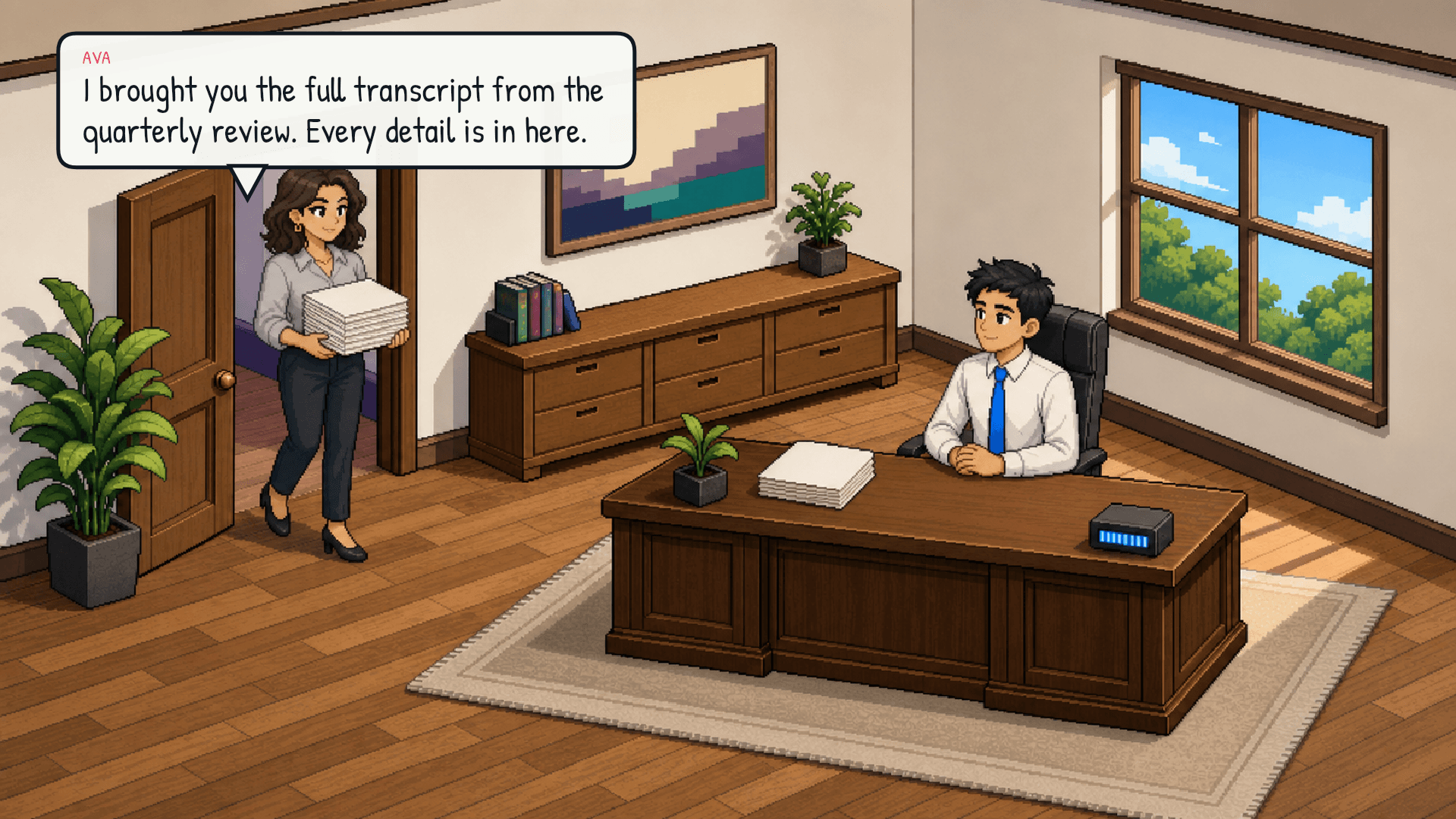
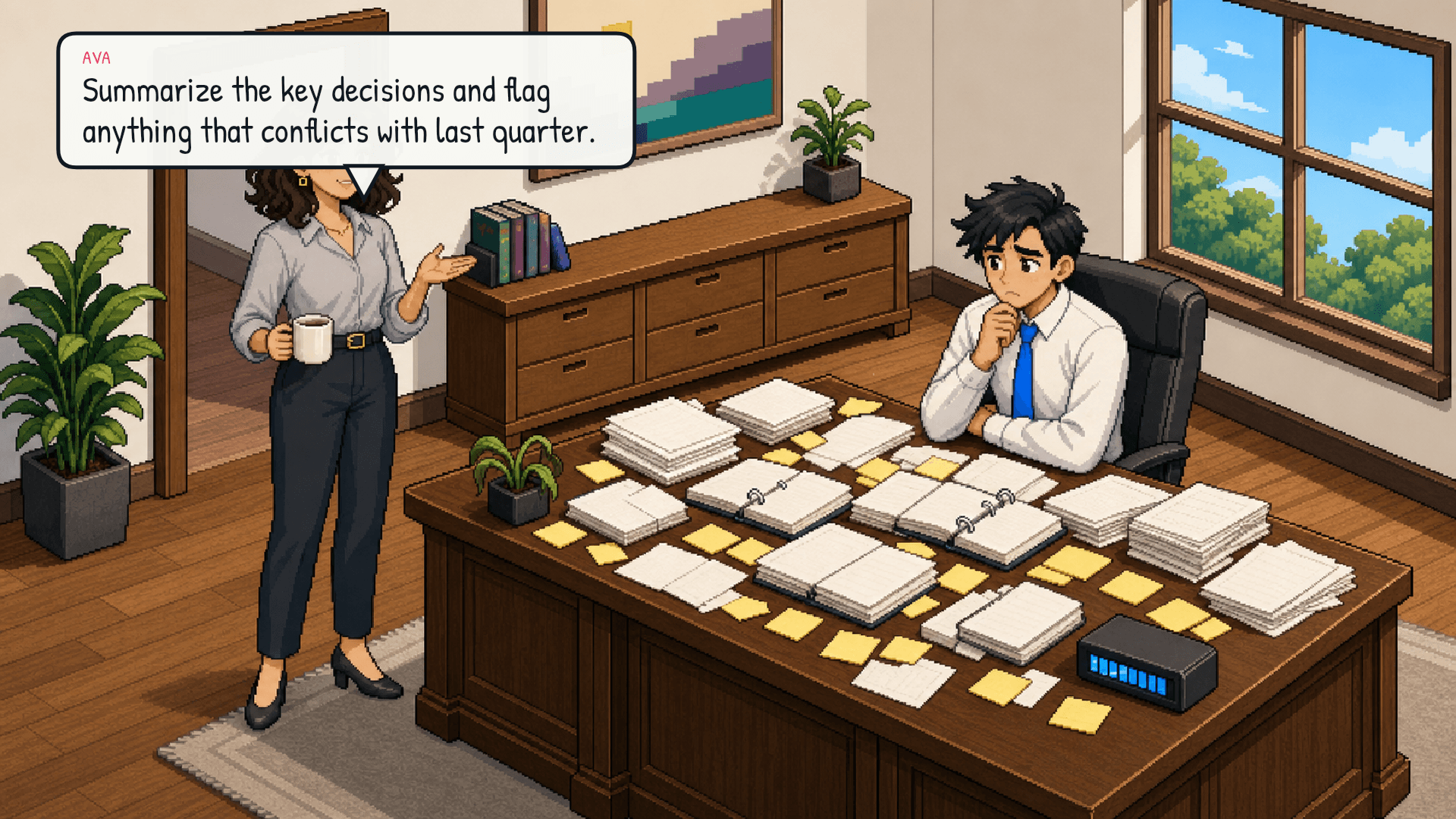
Ava drops a full meeting transcript onto Lex's desk, expecting a better answer from more context. The request still fits, but a budget decision disappears among repeated and low-value pages.
The token budget is the application's working allocation for assembled input and allowed output. Context window limits are the model and service boundaries around that allocation.

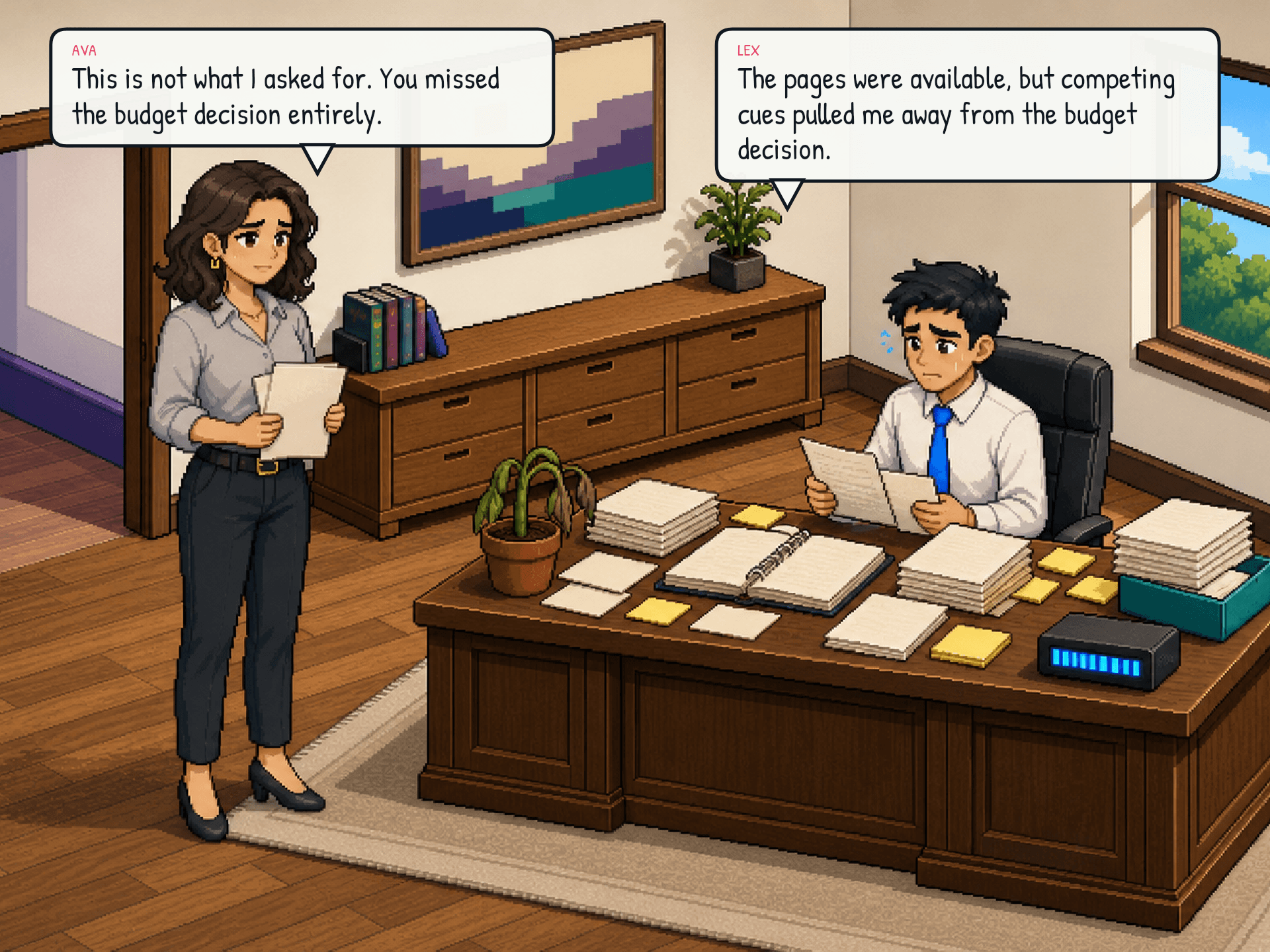
Problem: Ava assumed more context would produce a better answer. Instead, the sheer volume of low-signal content drowned out the useful parts.
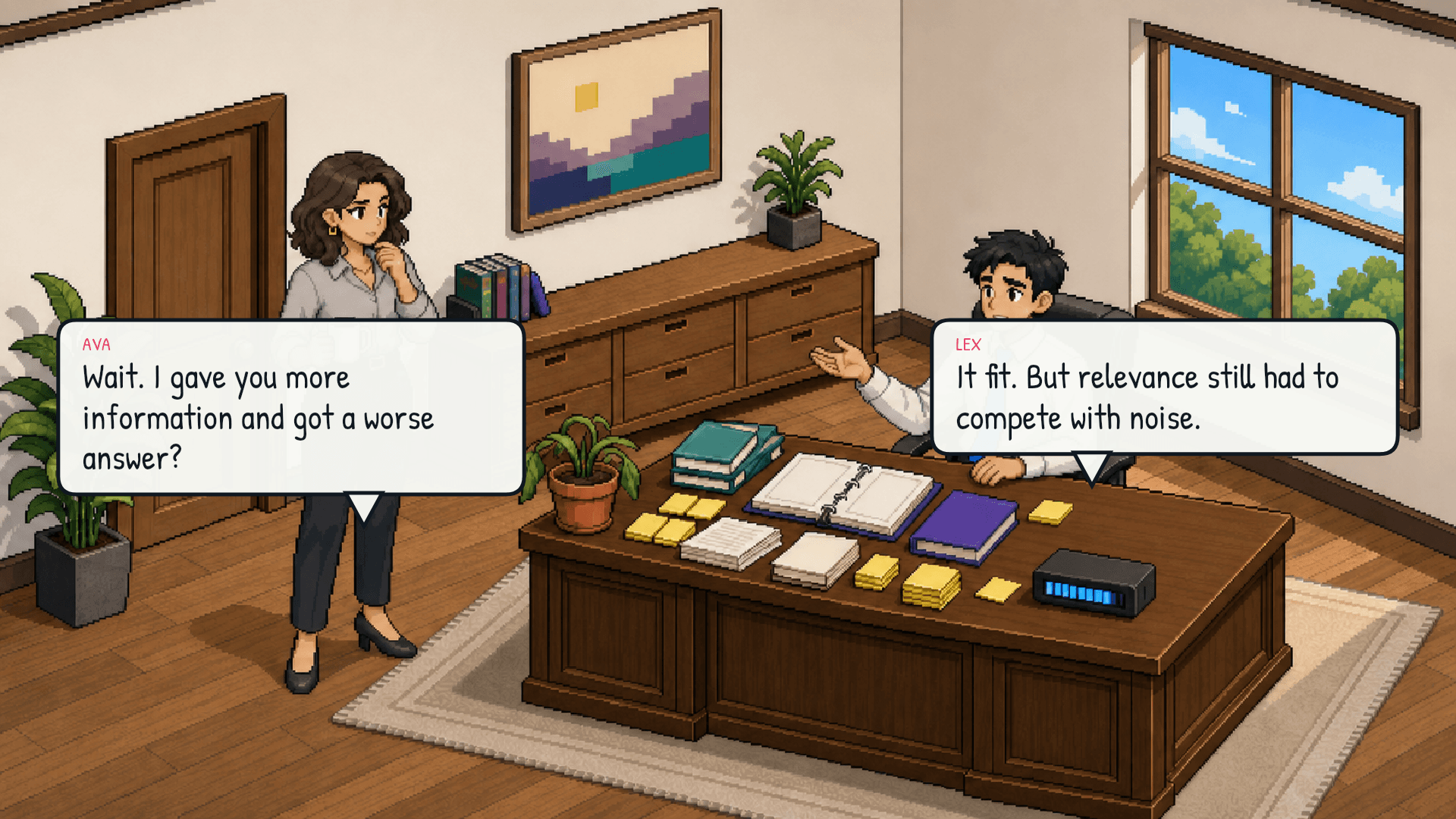
Resolution: The reader sees that capacity and relevance are separate. More relevant evidence can help. More redundant, irrelevant, or conflicting material can make a task less reliable.
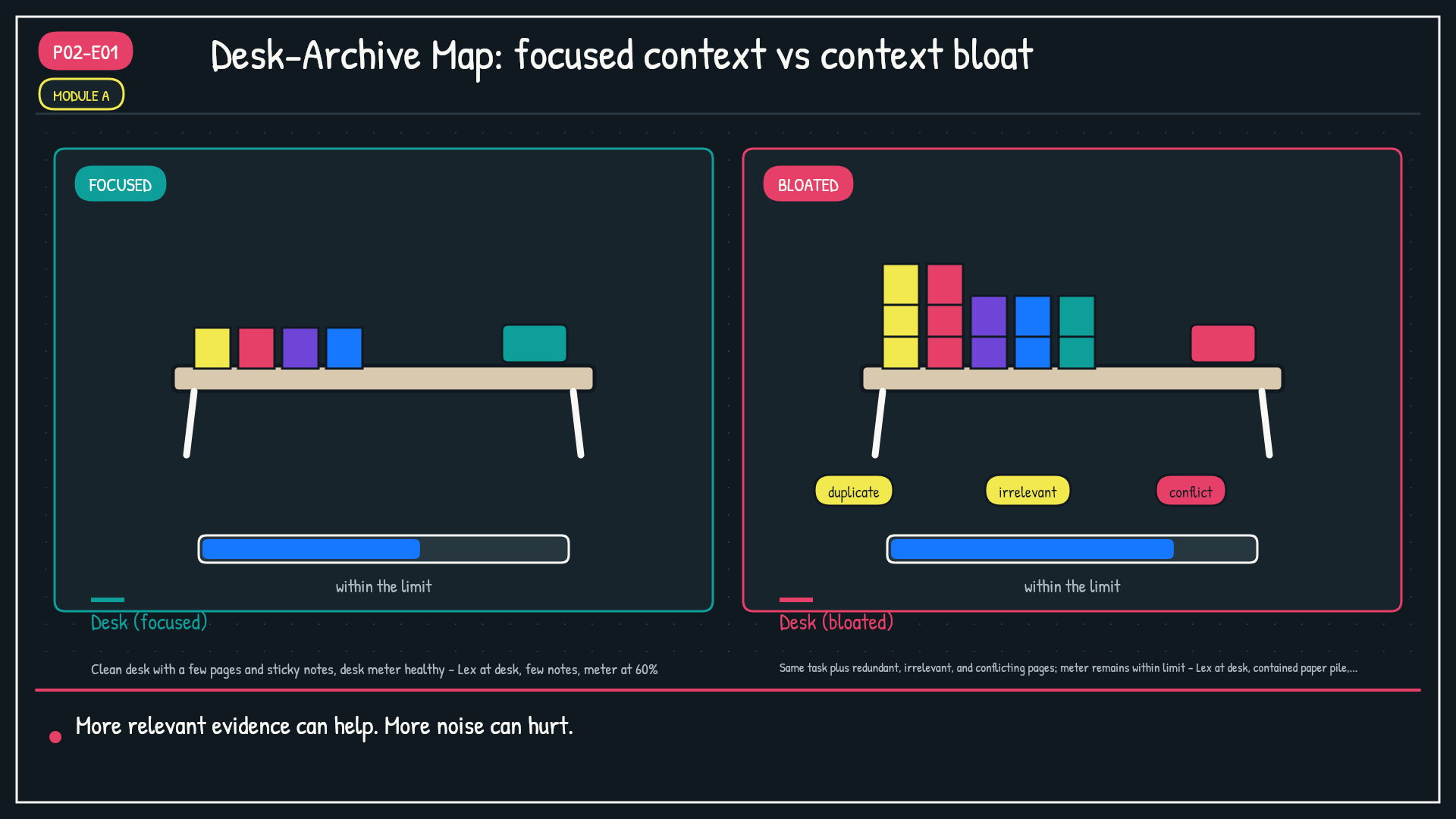
More context is not automatically better: relevant evidence can help, while unnecessary or contradictory material can make the answer less reliable.
Section 1: More is not always better
Every model call has an active workspace, the desk from P01-E01. Its text is represented as tokens, the sticky notes from P01-E02, and the application assembles those tokens within the limits introduced in P01-E03. Running out of space is one problem. Supplying a noisy set that still fits is another.
Even when everything technically fits, low-value, repeated, or contradictory material can make the relevant parts harder to use reliably. Imagine three pages that support the answer surrounded by fifty pages of tangents. All supplied pages can affect the response, but the patterns the model follows may not match the priority in your head unless the task and evidence are made clear.
This is context bloat: the desk turns into a pile, and the pile can bury the signal. The workspace is not necessarily full in the overflow sense. It is cluttered with competing cues.
Section 2: Long prompts and desk confetti
A long prompt is like dropping a tall stack of papers onto the desk all at once. Meeting transcripts, full email threads, entire documents pasted into the conversation. Each page takes up space. If the content is focused and relevant, that is fine. A detailed prompt with clear context can produce an excellent response. The problem starts when the paste includes filler: greetings, off-topic tangents, repeated information, formatting boilerplate.
Those filler pages sit alongside the important ones. The model does not treat every cue as equally important. Which connections it emphasizes depends on the words, their order, and the surrounding material. That emphasis is not guaranteed to match your intent, especially when the pile contains repeated, conflicting, or misleading cues.
The result may be a vague summary, a missed constraint, or confidence in the wrong passage. You asked for key decisions, but the transcript also contains small talk, calendar logistics, repeated proposals, and an obsolete decision that was later reversed. Those cues can compete with the final decision.
Section 3: The desk has a signal problem
The context window is not just a size problem. It is also a selection and signal problem. Attention helps the model connect parts of the request, but those connections are not a reliable ranking of which page is current, authoritative, or important to you. Position, wording, repetition, contradictions, and the task instruction can all affect which cues become influential.
This means a request can be well within the token budget and still fail because the signal is buried or ambiguous. A smaller focused prompt can outperform a larger unfocused paste, although no fixed token count or outcome is guaranteed. The improvement comes from making the task, evidence, and conflicts easier to distinguish.
This is the core insight of context bloat: the desk can be within its size limit and still produce a bad result. A larger window does not replace selection. Clean the input, label authoritative evidence, remove superseded material, and state the decision you need.
Glossary
- Context bloat
- A request containing enough redundant, irrelevant, or conflicting material that the useful evidence becomes harder to use reliably, even when it fits. | Office analogy: The desk turns into a pile of desk confetti. | Example: Pasting an entire meeting transcript, including superseded proposals, when you need the final action items.
- Long prompts
- A large amount of text dropped into the conversation at once, like a tall stack of papers placed on the desk. Long prompts are not inherently bad, but they become a problem when they contain a lot of filler alongside a small amount of useful content. | Office analogy: A tall stack of papers dropped on Lex's desk at once. | Example: Copying a full email thread including all the "sounds good" replies instead of just the decision points.
- Context window
- The active token workspace assembled for one model call. | (origin: P01-E01)
- Token budget
- The application's working allocation for assembled input and allowed output within current limits. | (origin: P01-E03)
- Context window limits
- The model and service boundaries within which the application assembles a request. | (origin: P01-E03)
Try it yourself
- Take a recent long prompt you have sent to an AI. Count roughly how much of it was filler versus actual question or relevant context. Try resending with only the relevant parts and compare the response quality.
- Paste a full document into a chat, then ask a specific question about one section. Notice whether the answer pulls from the right section or gets distracted by other parts.
- Try the same question twice: once with a clean, focused prompt, and once with the same question buried inside a large block of unrelated text. Compare the results.