AI Agents ResearchPart 3THEME
The 40% Rule: Why Larger Context Windows Won't Save Your AI Agent
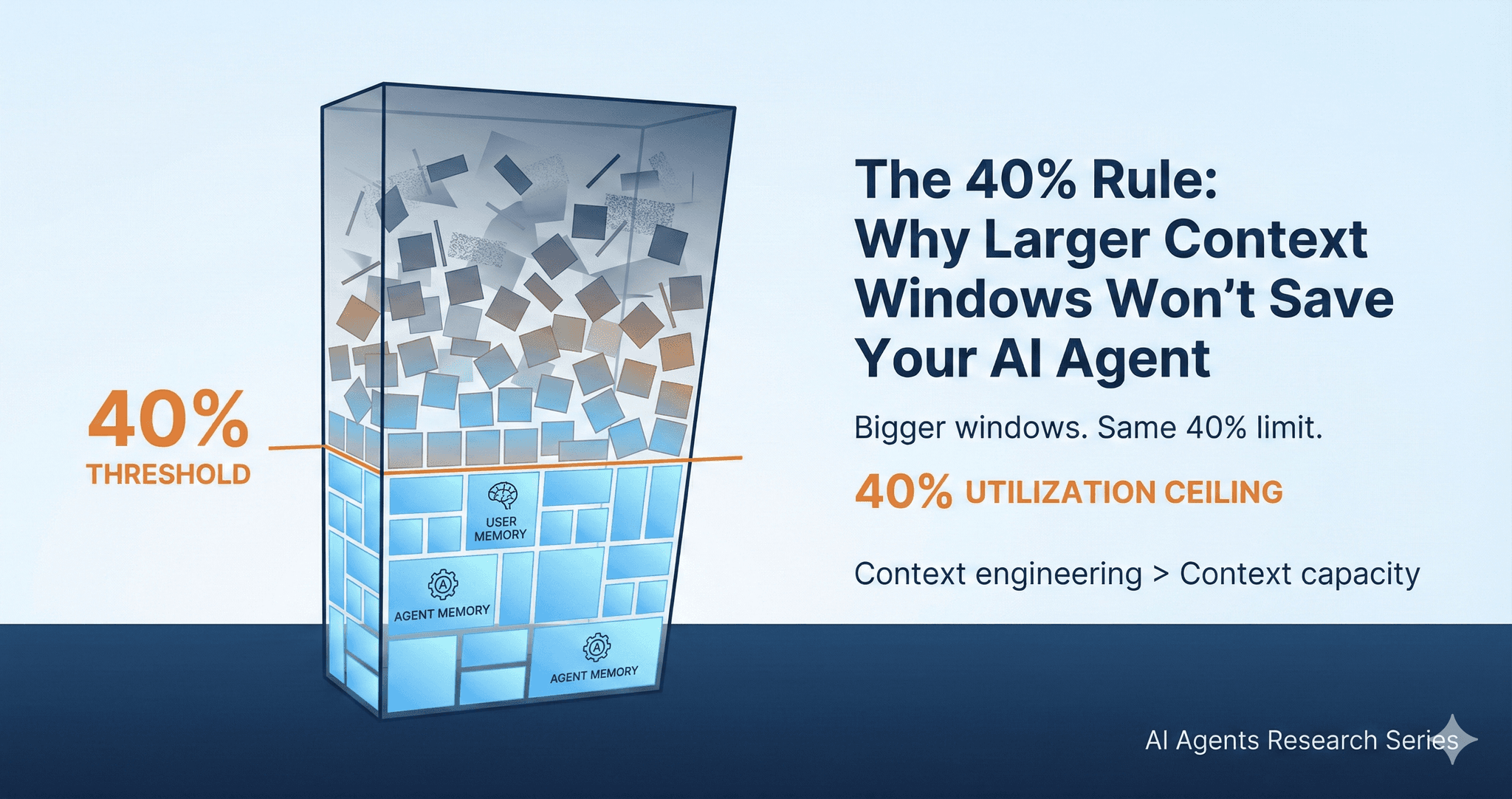
The counterintuitive finding that quality degrades at 40% utilization regardless of window size. Context engineering matters more than context capacity.

On this page
LLM providers market massive context windows as the solution to agent memory problems. Gemini offers 2 million tokens. Claude stretches to 200,000. GPT-4 Turbo provides 128,000. The race to infinity suggests that capacity solves complexity. But production practitioners discovered a counterintuitive truth: using more than 40% of any context window degrades output quality. The problem is not capacity. It is architecture.
The Discovery
This insight emerged from conversations at the Production Agents Summit, where practitioners who deploy agents at scale compared notes on reliability patterns. The finding was consistent across organizations: agent accuracy degrades predictably as context utilization increases, regardless of total window size. Engineers from companies running agents in production environments shared the same experience. Their agents would work reliably at lower context utilization, then exhibit unpredictable failures as conversations lengthened or tool sets expanded.
During my research project spanning 36 expert interviews, 5 industry conferences, and 3 functional prototypes, context management emerged as a core theme discussed by 69% of sources (18 out of 26). What struck me was how consistently practitioners rejected the premise that larger windows would solve their problems. When I asked about context limitations, nobody said they were waiting for bigger windows. Instead, they described architectural patterns they had developed to work within existing constraints. Enterprises betting on upcoming model releases with bigger contexts are solving the wrong problem. The data suggests the solution requires engineering infrastructure, not waiting for the next model.
What We Found
Context management is an architectural challenge, not a model limitation. The field incorrectly framed this as waiting for larger windows when the solution requires engineering infrastructure. Three key areas emerged from the research: the utilization rule, context engineering strategies, and dual memory architecture.
The 40% Utilization Rule
"If your agent is using anything more than 40% of the context window, it's probably going to make mistakes. This is true for an agent you develop for your software. It's also true for things like cursor." — A conference speaker, Production Agents Summit
This creates a hard ceiling on agentic complexity that is unrelated to model improvements. Even with million-token windows, the practical limit remains 40% of capacity. Why? Models appear to lose focus when processing bloated contexts. Relevant information gets diluted by irrelevant tokens. The attention mechanism struggles to identify what matters when everything competes for attention.
The problem compounds with tool definitions. When agents integrate with external systems through protocols like MCP (Model Context Protocol), each tool definition consumes context. Conversation history consumes more. Both accumulate over agent lifecycles.
"When you have more than 20 MCP like 30 40, the agent totally cannot work. We were tested and some posts on Internet test that if your MCP amount exceeds 25, your LM accuracy will drop to 30%. So that's totally cannot use in production for enterprise usage." — A practitioner at an AI infrastructure company
The MCP accuracy cliff illustrates the broader context utilization problem. Tool definitions alone can push agents past the 40% threshold before any actual work begins. This is why enterprise deployments struggle with agents that work perfectly in demos with 5 tools but fail spectacularly when connected to 30 production systems.
Context Engineering Strategies
Practitioners developed production-validated strategies to stay within the 40% threshold. These are architectural patterns, not prompt tricks.
Notes Summarization
"Instead of keeping full conversation history, agents periodically summarize to bullet points and discard original - maintains goal alignment while reducing tokens" — Production Agents Summit
The notes summarization pattern involves periodic compression of conversation history into bullet points. Rather than maintaining verbatim transcripts, agents extract key decisions, goals, and context. This maintains goal alignment while reducing token consumption by 60-80%. The tradeoff is losing nuance in favor of relevance.
Just-in-Time Retrieval
"Track file path references instead of file contents in context, provide retrieval tool for LLM to fetch on-demand - popularized by Claude Code" — Production Agents Summit
Just-in-time retrieval stores references rather than content, fetching on demand only when needed. This contrasts sharply with upfront RAG implementations that load everything into context hoping the model figures out what matters. Claude Code popularized this pattern by tracking file paths rather than file contents, fetching specific files only when the agent determines they are relevant to the current task.
Parallel Sub-Agents
The sub-agent pattern uses specialized agents with internal iteration loops that compress context before passing results to the orchestrator. Each sub-agent operates within its own bounded context. A research sub-agent might process 50 documents internally but return only a 500-token summary to the orchestrator. This reduces orchestrator burden and keeps the central coordination context lean.
The parallel execution model also provides natural isolation. If one sub-agent fails or gets confused by its context, it does not contaminate the orchestrator's state. The orchestrator simply receives a failure signal and can route to an alternative sub-agent or request human intervention. This resilience pattern emerged repeatedly in our interviews with practitioners managing complex multi-agent systems.
Dual Memory Architecture
"Memory as Two Distinct Problems: user memory (preferences, past interactions) versus memory for improving agent performance (which tools work best, problem-solving patterns). Most vendors conflate these." — A practitioner at an AI observability company
The dual memory insight from an AI observability company reframes how we should architect agent memory. User memory and agent memory are architecturally distinct problems that require different solutions.
User memory encompasses preferences, interaction history, cross-session persistence, and PII governance requirements. It answers questions like: What does this user prefer? What have they done before? What should we remember across sessions?
Agent memory encompasses tool selection patterns, problem-solving approaches, and performance improvement data. It answers questions like: Which tools work best for this type of problem? What approaches have succeeded or failed?
Most vendors conflate these, creating one-size-fits-all solutions that fail both use cases. Enterprise memory systems face governance blockers (PII leakage, data sovereignty, cross-user contamination) more than technical ones. The architectural separation enables appropriate governance for each type.
This distinction matters for enterprise deployments. User memory requires encryption, access controls, geographic data residency, and deletion policies aligned with privacy regulations. Agent memory has different requirements: it needs to be shareable across users, quickly accessible for real-time decisions, and optimized for pattern matching rather than precise recall. Treating these as one system means either over-governing agent memory (slowing performance) or under-governing user memory (creating compliance risks).
The Scale Challenge
"For any specific company you would typically have like 60 million data points. For any specific deal you would have at least like 500, 600k data points. And using all of this you're supposed to... a lot of the AI and the agents that we use are in service of figuring out how to make these 600k data points go to like the 20 data points that are actually relevant to answering that question." — The AI lead at a sales intelligence company
This compression challenge at an AI sales-intelligence company illustrates why context windows are the wrong abstraction. Enterprise data scales to millions of data points per company, hundreds of thousands per deal. The goal is reducing 600,000 data points to the 20 that actually matter for a given question. This is not a context window problem. It is a retrieval and relevance problem. First-step retrieval quality determines downstream success. As the AI lead noted in our conversation, they "built it blind after step one" because getting retrieval right cascades through everything else.
Why This Matters
Investment misdirection: Enterprises waiting for larger context windows are solving the wrong problem. The 40% rule means doubling your context window only increases usable capacity by 40% of the delta. A 2 million token window gives you 800,000 usable tokens. A 200,000 token window gives you 80,000 usable tokens. The 10x difference in capacity translates to 10x in usable space, but neither is infinite. Context engineering infrastructure matters more than context capacity for most production use cases.
Architectural imperative: Production systems require purpose-built solutions. This includes hierarchical memory systems that separate concerns, strategic context pruning that discards irrelevant history, external state management that moves data outside the context window, and first-step retrieval optimization that ensures the right information enters the context at the right time.
Competitive moat opportunity: Context engineering is defensible. Companies like an AI sales intelligence company position their proprietary context management as moats, not the models they use. The ability to reduce 60 million data points to 20 relevant ones is not something competitors can replicate by switching to a larger model. This architectural advantage compounds over time as the system learns which data matters for which questions.
Unsolved frontier: Cross-session memory persistence remains the largest unsolved problem. Current solutions suffer from static staleness (memory not updating), multi-modal limitations (text-only memory in a multi-modal world), and PII leakage risks (agents accidentally revealing one user's data to another). The dual memory architecture provides a framework, but production-ready implementations remain scarce.
What You Can Do
Four strategies to implement context-aware agent architecture:
Monitor context utilization: Track what percentage of your context window agents consume in production. If exceeding 40%, implement compression strategies before scaling further. This is your canary metric. When context utilization correlates with error rates, you have validated the rule for your use case.
Implement notes summarization: Replace full conversation history with periodic bullet-point summaries. Maintain goal alignment while reducing token consumption by 60-80%. Experiment with summarization frequency to find the right balance between compression and context loss for your domain.
Adopt just-in-time retrieval: Store references, not content. Provide tools for on-demand fetching rather than loading everything upfront. This pattern scales with complexity because context grows with relevance, not with system scope.
Separate user and agent memory: Design distinct systems for user preferences (cross-session, PII-governed) and agent performance data (tool patterns, problem-solving approaches). Do not conflate these concerns. Different governance requirements demand different architectures.
The Bottom Line
The solution to context challenges is not waiting for larger windows. It is building smarter architectures that compress, curate, and strategically retrieve. The 40% rule is not a limitation to overcome. It is a design constraint to build around. Companies that invest in context engineering today will have architectural advantages that larger models cannot erase.
The practitioners I interviewed were clear: they stopped waiting for model improvements to solve their context problems. Instead, they built infrastructure that works within known constraints. That infrastructure becomes more valuable as models improve, not less. Better models make well-architected context management more effective. They do not eliminate the need for it.
This post is part of my research series on AI Agent deployment, based on 36 expert interviews, 5 industry conferences, and 3 functional prototypes. Read the full research overview.
Have thoughts on AI agent deployment? Connect with me on LinkedIn or email me.