AI Agents ResearchPart 4THEME
The 92% Problem: Why System Integration Breaks AI Agent Deployments
Ninety-two percent of AI agent sources cite system integration as their primary challenge. Here is what 36 expert interviews revealed about the hidden complexity that derails enterprise deployments.

On this page
When we started researching AI agent deployments, we expected to find debates about model capabilities, prompt engineering, and evaluation frameworks. What we found instead was something far more fundamental: the integration problem.
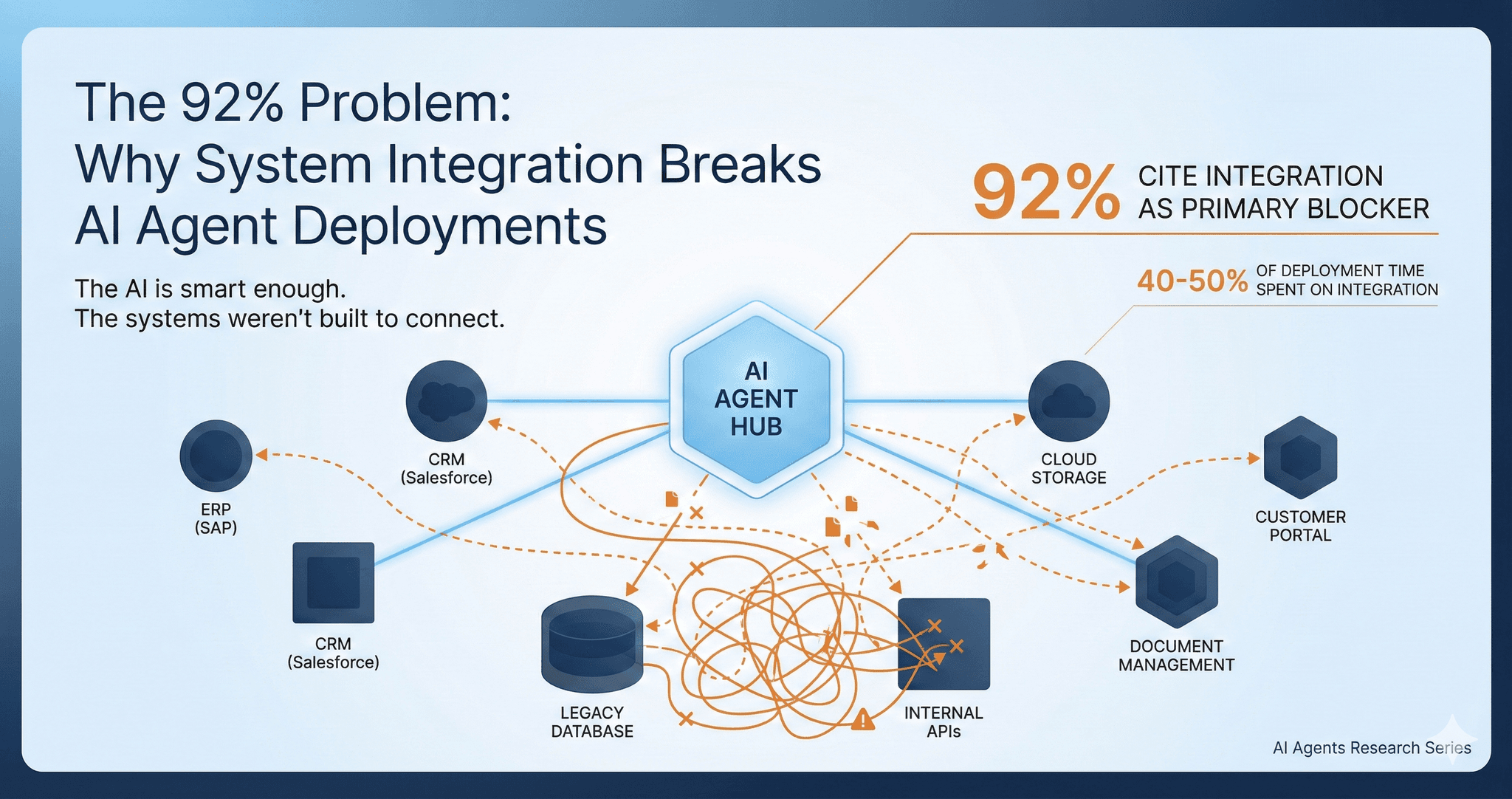
Across 36 expert interviews, 5 industry conferences, and 3 functional prototypes, one theme emerged with startling consistency. Ninety-two percent of our sources identified system integration as the primary barrier to production AI agents. Not model performance. Not hallucinations. Not cost. Integration.
This is the story of why the hardest part of building AI agents has nothing to do with AI.
The 40-50% Time Problem
The conventional wisdom about AI agent development focuses on the intelligence layer: training, prompting, and fine-tuning. But practitioners tell a different story.
"A lot of the time, so a lot of people think oh AI has to be like 7, 80%, 90% is about prompt engineering and about training the AI workforce, actual coding, about where to call API to get intelligence. So that's only around 40% of the work. 40 to 50% of the work, max. The rest of the time I spent on system integration." — An enterprise AI deployment expert
This revelation reshapes how we should think about AI agent projects. If integration consumes half of deployment effort, then the most important decisions are not about which model to use or how to structure prompts. They are about how to connect disparate systems that were never designed to work together.
The challenge runs deeper than many anticipate. Enterprise environments are not clean, unified platforms. They are decades of accumulated technology decisions, acquisitions, and workarounds layered on top of each other.
"The intelligence is really smart enough right. So so it doesn't doesn't need the model to be much better to make this work in enterprise. So the real sticking point is system integration which has to do with all this you know system that doesn't have never talked to each other. SAP and Salesforce has never talked to each other." — An enterprise AI deployment expert
This is the heterogeneous stack problem. Large enterprises do not operate on unified platforms. They run on SAP for ERP, Salesforce for CRM, custom core banking systems, legacy ticketing platforms, and acquired company tech stacks that have never been properly integrated. AI agents must navigate all of these simultaneously.
The result is that teams building production AI agents spend more time on connectors, authentication handlers, and data transformation pipelines than on the agent logic itself. This is not a bug in the deployment process. It is the fundamental nature of enterprise software integration.
MCP: Promise Versus Reality
When Anthropic introduced the Model Context Protocol (MCP), many hoped it would solve the integration challenge. MCP promised to be the "USB for AI agents": a standardized way for agents to connect to any data source or tool. The reality has proven more complicated.
"When you have more than 20 MCP like 30 40, the agent totally cannot work. We were tested and some posts on Internet test that if your MCP amount exceeds 25, your LM accuracy will drop to 30%. So that's totally cannot use in production for enterprise usage." — A practitioner at an AI infrastructure company
This 25-tool threshold represents a critical limit that is rarely discussed. As agents gain access to more capabilities through MCP, their ability to use any of those capabilities correctly degrades rapidly. At 30% accuracy, the agent becomes effectively unusable for any production workload.
The problem stems from context bloat. Each MCP tool definition consumes context window space. Verbose tool descriptions, parameter specifications, and usage examples accumulate across multi-step conversations. Before long, the agent is spending more capacity managing its tool inventory than doing useful work.
Conference speakers at the "Why 95% Fail" event echoed these concerns:
"MC just creates new problems. Too much context cost, the accuracy drops a lot and the round trips a lot goes up. And with a lot of tokens our cost goes up." — A conference speaker, "Why 95% Fail" event
MCP also suffers from a specificity problem. Generic MCP servers expose too many operations without use-case context. They provide the grammar of integration without the intelligence of knowing which operations matter when.
"There was a lot of talk around MCP kind of solving for everybody. We quickly learned that it didn't work out of the box for us. A, there were just deployment challenges. Like the MCP ecosystem was very immature at the time. And then also the MCPs that either companies are putting up themselves or frankly at the time there was a lot of like open source third party MCP servers... they had way too much like way too many operations specified. There is no specificity." — A practitioner at an AI observability company
This does not mean MCP will not eventually succeed. Enterprise-grade extensions are emerging, including a major enterprise identity company's cross-app access extension for identity management. But the current state requires custom wrappers around MCP servers for any serious deployment. Teams should plan for a 12-18 month maturation period before relying on MCP for production critical paths.
Custom Integration as Competitive Moat
If standardized protocols struggle with enterprise complexity, what works? Our research reveals a counterintuitive answer: the most successful agent deployments treat integration difficulty as a feature, not a bug.
Consider the perspective from a multi-agent framework company, working with Fortune 500 clients:
"The hardest part of agent deployment isn't the AI itself but navigating 40-country presence, 100,000+ employees, multiple acquired companies with different tech stacks (HubSpot vs. Salesforce), and varied legislation. This operational knowledge creates defensibility that can't be solved by throwing money at the problem." — A co-founder at a multi-agent framework company
This framing inverts the common narrative. Integration complexity is not a problem to be solved by better standards. It is an opportunity to build competitive advantage. Companies that develop deep expertise in navigating specific enterprise topologies create moats that generic platforms cannot cross.
The pattern extends to technical frameworks. Our research found that 80-90% of production teams abandon generic frameworks like LangChain in favor of custom solutions. The teams that succeed build proprietary integration layers that encode domain-specific knowledge about which operations matter, which edge cases exist, and how to handle the exceptions that generic tools miss.
Custom frameworks also deliver measurable performance advantages. A CRM AI company reported building their own framework on top of foundation model SDKs that runs 3-4x faster than LangChain equivalents. When every API call costs money and latency impacts user experience, these differences compound into significant competitive edges.
Prototype Validation
Our findings are not purely theoretical. We validated them through three functional prototypes that encountered the same integration challenges our interview subjects described.
The Shopping Agent prototype required multi-platform tool integration across Violet, eBay, and Shopify. Despite MCP's promise of standardized connections, the team mocked MCP servers rather than using real integrations. This practical decision signals that the protocol is not yet production-ready for complex multi-platform scenarios. The five-phase roadmap, with only Phase 1 complete, quantifies the demo-to-production gap our interviewees described.
The Good Agents orchestration prototype confirmed MCP integration complexity through hands-on implementation. The protocol structure did not eliminate integration work. It provided a framework that still required substantial engineering effort. Interview reports of "doesn't work out of the box" were confirmed through direct build experience.
Across all three prototypes, a consistent pattern emerged: integration proved harder than core AI functionality. For Good Agents, MCP integration was more complex than orchestration logic. For the Shopping Agent, multi-platform connectors presented the primary challenge rather than agent reasoning. For Repo Patcher, GitHub and CI/CD integration demanded substantial effort compared to code generation itself.
Why This Matters
The dominance of integration challenges reshapes how we should evaluate AI agent opportunities.
First, it explains the 90% pilot failure rate that an enterprise AI deployment expert reported. Pilots typically demonstrate agent intelligence in controlled environments with clean data and pre-configured integrations. Production deployments must work across messy, heterogeneous enterprise systems. This gap is not about AI capability but about integration readiness.
Second, it suggests that the most valuable AI agent companies may look more like integration consultancies than technology vendors. The ability to navigate specific enterprise topologies, understand legacy system quirks, and build reliable connectors may matter more than model selection or prompt engineering sophistication.
Third, it implies that standardization efforts like MCP are necessary but not sufficient. Protocols provide scaffolding. Competitive advantage comes from the domain-specific knowledge built on top of that scaffolding. The winners in this market will combine protocol fluency with deep integration expertise in targeted verticals.
What You Can Do
Audit your integration landscape before starting any AI agent project. Map every system the agent must touch, identify authentication requirements, and catalog API limitations. This assessment should happen before any agent development begins.
Budget 40-50% of project time for integration work. If your project plan allocates 80% to AI development and 20% to integration, you will run out of time before reaching production.
Test MCP scalability limits early. If your use case requires more than 20-25 tools, plan for custom integration layers from the start rather than discovering this limit in production.
Treat integration expertise as a hiring priority. Teams with strong API development backgrounds may outperform those with pure ML expertise when building production agents.
Consider integration complexity as a strategic asset. If your enterprise has particularly complex systems, the cost of navigating that complexity becomes a barrier to entry for competitors who lack your institutional knowledge.
The Bottom Line
The 92% finding tells a clear story: AI agent success depends more on integration engineering than on AI engineering. The model is already smart enough. The protocols are improving. But the fundamental challenge of connecting systems that were never designed to work together remains the primary blocker.
Companies that recognize this reality early and invest accordingly will reach production while others are still debugging their connectors.
Quotes from recorded sessions are lightly edited for clarity.
This post is part of my research series on AI Agent deployment, based on 36 expert interviews, 5 industry conferences, and 3 functional prototypes. Read the full research overview.
Have thoughts on AI agent deployment? Connect with me on LinkedIn or email me.