AI Agents ResearchPart 2THEME
The Coding Agent Exception: Why AI Works for Code but Struggles Everywhere Else
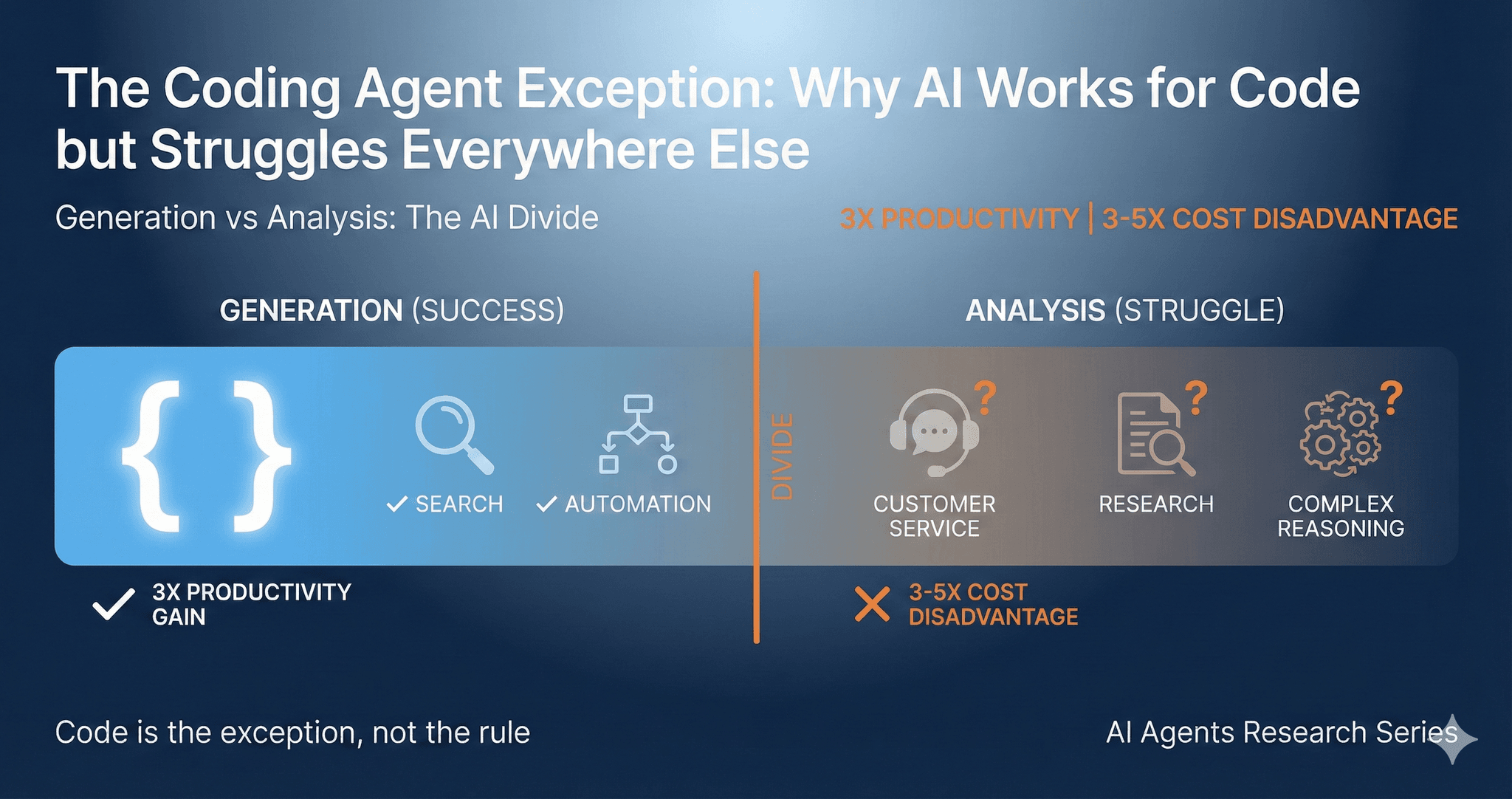
AI coding assistants deliver 3x productivity gains while generic AI agents cost 3-5x more than human labor. Research reveals why the generation vs analysis gap makes coding the exceptional use case.

On this page
The success of Cursor, GitHub Copilot, and Windsurf has created a dangerous misconception: that AI agents are ready to transform all knowledge work. They are not. After interviewing 36 practitioners and attending 5 industry conferences, I discovered a stark divide. Coding agents deliver measurable productivity gains of 3x or more. Meanwhile, generic AI agents attempting customer service, research, or complex analysis cost 3-5 times more than the human workers they aim to replace. This is not a temporary gap waiting for better models. It reflects a fundamental asymmetry in what large language models do well versus what most enterprise work requires.
Understanding where AI agents actually succeed versus where they struggle is essential for any organization planning AI investments. The hype cycle does not distinguish between proven applications and speculative ones. This research does.
Only Two Killer Apps
When I asked a developer, founder of an AI coding company, about the state of AI agents, his answer was immediate and categorical.
"I've only seen two killer apps on top of LLM right now. One is search and one is coding agents... developers have said very clearly that okay, I'm able to ship faster, I'm able to ship more stuff." — a developer, an AI coding company
This observation aligns with what I heard across dozens of conversations. Search and coding share a critical characteristic that distinguishes them from other AI applications: structured output with immediate verification.
When a coding agent generates code, the output can be tested. Unit tests pass or fail. The program compiles or it does not. Syntax errors reveal themselves instantly. This creates a tight feedback loop where the AI can iterate toward correctness without human judgment at every step.
Similarly, search provides ranked results that users can quickly evaluate. You click or you scroll past. The feedback is immediate and unambiguous.
Contrast this with asking an AI to analyze a complex business situation, summarize customer sentiment, or make strategic recommendations. How do you verify the output? You cannot run a test suite against business judgment. There is no compiler for strategic thinking.
A practitioner reinforced this point directly: "Outside of coding agents, there's not a lot of agents that I see being put into production or even being used at all right now."
The pattern that makes search and coding work involves four elements. First, generation-heavy tasks rather than analysis. Second, structured outputs that follow predictable formats. Third, immediate verification mechanisms that do not require human judgment. Fourth, bounded scope that keeps context manageable. Coding agents hit all four. Most enterprise workflows hit none.
This is why the venture capital flowing into "AI agents for X" often yields disappointing results. The coding agent success story cannot be transplanted into domains that lack these four characteristics.
Generation vs Analysis: The Fundamental Asymmetry
The gap between coding agents and other AI applications stems from a fundamental capability mismatch. Large language models excel at generation. They struggle with analysis.
"Even in our product we build multiple agents because we realize researching about the problem is complicated enough... LLMs excel at generation tasks but struggle with analysis and decision-making." — a developer, an AI coding company
Consider how a coding agent operates. A developer describes what they want built. The agent generates code. Tests run. If tests fail, the agent examines errors and generates new code. The cycle continues until tests pass.
This workflow plays to every strength of current models. Generation is the core competency. The structured nature of code provides clear success criteria. The iterative loop compensates for imperfect initial output.
Now consider a different scenario: an AI agent handling customer inquiries. The agent must understand nuanced context from previous interactions. It needs to exercise judgment about escalation timing. It must navigate ambiguous situations where multiple responses could be appropriate. There is no test suite. There is no compiler. Success requires deep analysis that current models cannot reliably perform.
The team at an autonomous-agent startup discovered this asymmetry firsthand. Their co-founder explained:
"We found out actually model only maybe contributes 30 or 40% of the whole thing. And the framework, the whole system you build upon the model is much more important, you know, than the model itself." — Co-founder, an autonomous-agent startup
This 30-40% model contribution reveals a critical insight. For generation tasks like coding, the model does most of the heavy lifting. For analysis tasks, the model needs extensive scaffolding, retrieval systems, and guardrails that make up the other 60-70% of value.
The productivity numbers reflect this asymmetry starkly. An engineering leader at a major enterprise identity company described their experience with coding agents:
"Our team in India has a target of 50 integrations they can build with Windsurf... We're 3X... So it's not like we're cutting off or laying off anybody. We're just saying well now we can do 150 integrations." — an engineering leader, a major enterprise identity company
Three times productivity. Measurable and consistent. Teams that once built 50 integrations now build 150 with the same headcount. The autonomous-agent company's team reported even more dramatic shifts: their AI-generated code went from 20% to 80% within a single year.
But when the engineering leader described attempts to automate customer service with AI agents, the economics inverted entirely.
The Cost Disadvantage Reality
The narrative around AI automation assumes that replacing human workers reduces costs. For coding tasks, this holds true. For most other enterprise functions, the mathematics tell a different story.
"If you want to have the same capabilities [as human customer service reps], which is hard, which I doubt they can do all... the amount of capabilities or abilities an agent need to reach a call center representative in Manila or in India or in like Brazil are way more right now three to five times more cost than hiring a human." — an engineering leader, a major enterprise identity company
Three to five times more expensive than offshore labor. Not slightly more expensive. Not break-even with efficiency gains. Dramatically more costly.
This cost disadvantage compounds at scale. Customer service agents need to handle edge cases, understand cultural nuances, manage emotional situations, and exercise judgment about when to escalate. Each capability requires additional engineering, testing, and maintenance. The token costs accumulate with every conversation turn. Long conversations that extend beyond 30-40 minutes see latency increase as context windows fill.
The willingness-to-pay gap further illustrates the disconnect. An engineering leader at a workforce platform noted that enterprises would pay $400-750 per month for AI solutions that actually worked. Current offerings charge $20 per month. That gap of 20 to 37 times exists because vendors cannot deliver sufficient value at higher price points. The technology does not yet justify enterprise pricing for analysis-heavy workflows.
Meanwhile, coding agents charge premium prices and deliver measurable ROI. Cursor, GitHub Copilot Enterprise, and similar tools command subscription fees that teams happily pay because the productivity gains are undeniable and directly measurable.
The economic equation comes down to this: if a task requires primarily generation with clear verification, AI often beats human labor costs. If a task requires analysis, judgment, and context integration, AI remains expensive and unreliable.
Why Analysis Remains Hard
The analysis challenge goes deeper than current model limitations. It reflects how information flows in different types of work.
The AI lead at an AI sales intelligence company explained the scale of the problem:
"For any specific company you would typically have like 60 million data points. For any specific deal you would have at least like 500, 600k data points." — the AI lead, an AI sales intelligence company
Sixty million data points per company. Six hundred thousand per deal. Analysis tasks require synthesizing massive context into actionable insights. Current models degrade significantly when using more than 40% of their context window, regardless of how large that window is.
The 40% context utilization rule emerged consistently across my research. Models advertise million-token context windows, but practitioners report quality degradation well before hitting those limits. Context engineering becomes more valuable than raw window size.
A practitioner at an AI agent orchestration company summarized the current state of model intelligence:
"The intelligence is really smart enough right. So it doesn't need the model to be much better to make this work in enterprise. So the real sticking point is system integration." — the practitioner, an AI agent orchestration company
This observation reveals a key nuance. The models themselves may be capable enough for many tasks. But making that intelligence work in real enterprise environments requires integration with data sources, context management systems, and verification mechanisms that simply do not exist for most analysis workflows.
Coding tasks sidestep this constraint. A function has bounded scope. A module has clear boundaries. The relevant context fits comfortably within model limitations. Test suites provide automatic verification. Analysis tasks rarely offer such convenient boundaries or verification mechanisms.
Tool calling presents additional challenges for analysis-heavy work. A practitioner at an AI infrastructure company documented a critical threshold: "When you have more than 20 MCP like 30 40, the agent totally cannot work... if your MCP amount exceeds 25, your LM accuracy will drop to 30%." Analysis tasks often require accessing many data sources simultaneously, pushing agents past this accuracy cliff.
Why This Matters
The coding agent exception is not a temporary situation awaiting model improvements. It reflects architectural realities about how AI systems interact with different types of work.
Understanding this distinction matters for three reasons.
First, it prevents wasted investment. Organizations pouring resources into AI-powered customer service, research automation, or strategic analysis tools should expect economics that look nothing like coding agent success stories. The 90% pilot failure rate that the practitioner at an AI agent orchestration company documented is not coincidence. It reflects the fundamental mismatch between model capabilities and analysis requirements.
Second, it clarifies where AI investment will generate returns today. Engineering organizations should absolutely adopt coding assistants. The productivity gains are real, substantial, and well-documented. Marketing teams generating content may see similar benefits. Other departments attempting to automate analysis-heavy workflows should be more cautious and budget for human-in-loop designs.
Third, it suggests where future breakthroughs need to occur. The gap is not processing speed or context window size. The gap is the fundamental capability to analyze rather than generate. Until that changes, the coding agent exception will persist. Companies building for the long term should monitor advances in reasoning capabilities, not just parameter counts.
What You Can Do
Audit your AI initiatives against the generation vs analysis framework. Projects that rely on AI generation with clear verification will likely succeed. Projects requiring AI analysis need much more scrutiny, realistic timelines, and larger budgets.
Adopt coding assistants aggressively. The evidence supports 2-3x productivity gains across multiple organizations. If your engineering team has not fully embraced these tools, you are leaving substantial value on the table.
Set realistic expectations for non-coding AI applications. Do not expect customer service, research, or analysis AI to match coding agent economics. Plan for costs that may exceed human labor by 3-5x, and design for human oversight.
Measure handoff rates, not automation rates. The real metric is how often AI systems punt decisions back to humans. High handoff rates indicate the agent is not actually reducing workload. Track this number and optimize for it.
Build human-in-loop by design for analysis-heavy workflows. Rather than pursuing full automation, design systems that augment human judgment. This aligns with what current AI can reliably deliver and protects against costly failures.
The Bottom Line
Coding agents represent the exception, not the rule, for AI agent deployment. They succeed because code generation aligns with model strengths: structured output, immediate verification, and generation-heavy tasks. The models contribute 30-40% of value in most AI applications, but for coding that percentage translates into dramatic productivity gains because the surrounding infrastructure of compilers, test suites, and type checkers provides the other 60-70%.
Until AI systems develop genuine analytical capabilities that can match human judgment in ambiguous situations, the 3x productivity gains of coding will coexist with the 3-5x cost disadvantages of everything else. Organizations that understand this distinction will invest wisely. Those that chase the coding agent dream for all knowledge work will learn expensive lessons.
The question is not whether AI will transform knowledge work. It is which knowledge work, and when. For coding, the answer is now. For analysis, the answer remains uncertain.
Quotes from recorded sessions are lightly edited for clarity.
This post is part of my research series on AI Agent deployment, based on 36 expert interviews, 5 industry conferences, and 3 functional prototypes. Read the full research overview.
Have thoughts on AI agent deployment? Connect with me on LinkedIn or email me.