AI Agents ResearchPart 10EMERGENT
MCP Reality Check: The 25-Tool Accuracy Cliff No One Talks About
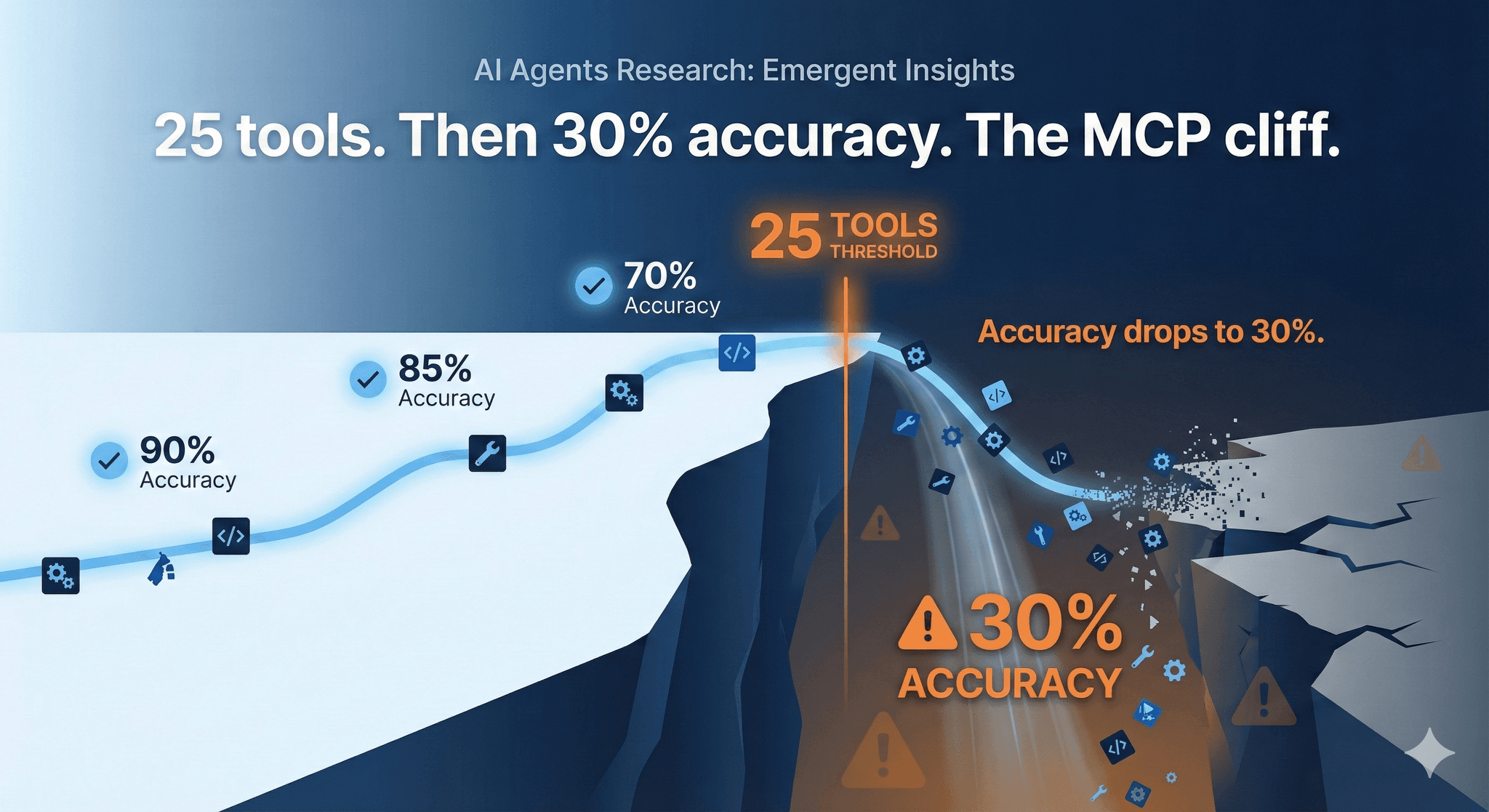
Why Model Context Protocol accuracy drops to 30% beyond 25 tools and what this means for enterprise integration strategies.

On this page
- The Discovery
- What We Found
- The 25-Tool Threshold
- Why Accuracy Drops: The Context Bloat Problem
- Convergent Skepticism Across Sources
- Mitigation Strategies
- Dynamic Tool Loading via SLM Fine-tuning
- Use-Case-Specific Tool Bundles
- Native Function Calling for Critical Paths
- Protocol-Aware Architecture Design
- Why This Matters
- What You Can Do
- The Bottom Line
MCP was supposed to be the USB for AI agents. Anthropic's Model Context Protocol promised standardized tool integration, an end to the fragmented mess of custom connectors, and a path toward seamless enterprise deployment. The industry embraced it with enthusiasm. Developers built ecosystems around it. Companies announced MCP server support. The narrative was compelling: connect your agent to any tool through a universal protocol, and watch the magic happen. But what happens when you actually deploy MCP at enterprise scale, where agents need to orchestrate dozens of integrations across legacy systems? The answer reveals a critical limitation that no one is publicly discussing: beyond 25 tools, accuracy plummets to just 30 percent. This is the MCP cliff, and it is reshaping how production teams think about agent architecture.
The Discovery
During a research project spanning 36 expert interviews, 5 industry conferences, and 3 functional prototypes, a consistent pattern emerged. While MCP received enthusiastic coverage in developer communities and tech publications, practitioners building production AI agents told a starkly different story. The disconnect between marketing narratives and deployment reality became impossible to ignore.
The CEO and co-founder of an AI infrastructure company provided the most quantified articulation of the problem. The company builds enterprise agent infrastructure and has extensive experience deploying agents at scale. When asked about MCP's viability for enterprise scenarios, the response was unambiguous: the protocol breaks down at precisely the scale where enterprises need it most.
This finding did not emerge in isolation. Across multiple interviews and conferences, practitioners expressed skepticism about MCP's production readiness. The pattern was clear: MCP works adequately for simple applications with a handful of tools, but the promise of universal integration collides with harsh reality once tool counts approach enterprise requirements.
What We Found
The core finding is both specific and alarming: MCP accuracy degrades catastrophically when tool definitions exceed a threshold that most enterprise deployments would easily surpass.
The 25-Tool Threshold
"When you have more than 20 MCP like 30 40, the agent totally cannot work. We were tested and some posts on Internet test that if your MCP amount exceeds 25, your LM accuracy will drop to 30%. So that's totally cannot use in production for enterprise usage." — the CEO and co-founder, an AI infrastructure company
Consider what 30 percent accuracy means in practice. For every ten tool selections your agent attempts, seven will be incorrect. In an enterprise context where an agent needs to coordinate between Salesforce, SAP, a ticketing system, email, calendar, document management, and a dozen internal APIs, this accuracy rate renders the system unusable. The agent becomes more likely to make mistakes than to complete tasks correctly.
The 25-tool threshold is particularly problematic because enterprise scenarios routinely exceed it. A customer service agent might need access to CRM records, order management, shipping status, payment processing, knowledge bases, communication channels, and escalation systems. A back-office automation agent could require connections to ERP, accounting, HR systems, compliance databases, reporting tools, and document repositories. These are not edge cases. They represent the standard complexity of enterprise operations that AI agents are supposed to streamline.
Why Accuracy Drops: The Context Bloat Problem
The accuracy cliff does not emerge from a single cause. It results from compounding architectural pressures that MCP's design exacerbates rather than mitigates.
Tool Definition Verbosity: Every MCP tool requires JSON schema definitions that consume context window tokens. These definitions include parameter specifications, type information, descriptions, and example usage. When an agent has access to 30 or 40 tools, the tool definitions alone can consume thousands of tokens before any actual task reasoning begins.
The Production Agents Summit articulated a critical constraint that illuminates why this matters:
"If your agent is using anything more than 40% of the context window, it's probably going to make mistakes. This is true for an agent you develop for your software. It's also true for things like cursor." — a conference speaker, Production Agents Summit
With verbose tool definitions consuming substantial context, multi-step agent conversations quickly violate this 40 percent rule. Each turn accumulates more context, each tool call adds output, and the agent's reasoning quality degrades as the window fills.
Decision Paralysis from Tool Abundance: More tools do not simply add context overhead; they fundamentally degrade decision quality. When an agent must choose among 40 possible actions, the probability of selecting the optimal tool decreases while the probability of hallucinating incorrect tool calls increases. The CEO drew an illuminating historical parallel:
"We have to put all of our business logics into the client code. So client will be very, very complicated... Compared this concept like 20 years ago in the Windows time desktop application we always discussed should we build a fat application or thin application." — the CEO, an AI infrastructure company
MCP creates what the CEO calls a "fat client" architecture, where the agent must internalize and reason about all possible operations. This mirrors the fat client versus thin client debates from the Windows desktop era, except now the complexity is measured in LLM decision quality rather than application performance. The industry learned two decades ago that pushing too much logic to clients creates unmaintainable systems. MCP risks repeating that architectural mistake.
The Specificity Gap: Beyond technical limitations, MCP suffers from a fundamental design tension. Generic MCP servers expose many operations without encoding domain-specific knowledge about when each operation matters.
"There was a lot of talk around MCP kind of solving for everybody. We quickly learned that it didn't work out of the box for us... the MCPs that either companies are putting up themselves or frankly at the time there was a lot of like open source third party MCP servers... they had way too much like way too many operations specified. There is no specificity." — a practitioner, an AI observability company
A generic Salesforce MCP server might expose hundreds of operations. But for a specific workflow like updating lead status after qualification, only a handful of those operations are relevant. The agent must reason through the entire operation space to select the correct subset, wasting both tokens and decision capacity. This specificity gap means that even well-implemented MCP servers often hinder rather than help agent performance.
Convergent Skepticism Across Sources
The skepticism about MCP's production viability extended beyond individual interviews. At a panel on agent failure rates, speakers explicitly identified MCP as creating new problems rather than solving existing ones:
"MCP just creates new problems. Too much context cost, the accuracy drops a lot and the round trips a lot goes up. And with a lot of tokens our cost goes up." — a panel speaker
A developer from an AI coding company offered a practitioner perspective on how MCP affects agent behavior:
"MCP's sort of abstracted out that whole idea of tool calling... And it works, but it doesn't work that well. In fact, it sort of confuses the agent a lot of times than really helping." — a developer, an AI coding company
The convergence across these sources reveals a significant gap between MCP's marketing position and its production reality. While MCP may represent important progress toward standardization, current implementations fall short of enterprise requirements.
Mitigation Strategies
Successful production teams have developed several strategies to work within MCP's limitations while preserving integration flexibility.
Dynamic Tool Loading via SLM Fine-tuning
Rather than exposing all tools simultaneously, advanced teams use small language models (SLMs) to pre-filter which tools should be loaded for each task. The CEO described the approach:
"I think about 50. Okay, 50 is okay. And you have to record the user usage and the all the usage logs because you have to fine tune by RM returns the two call response..." — the CEO, an AI infrastructure company
The process involves fine-tuning a small model with approximately 50 examples to learn which tool subsets are relevant for different task types. Before invoking the main LLM, this routing model selects a limited tool palette. This approach keeps active tool count below the accuracy threshold while maintaining access to a broader tool ecosystem.
Use-Case-Specific Tool Bundles
Instead of generic MCP servers that expose everything, production teams create task-specific tool bundles that encode workflow knowledge. A customer service bundle might include only the CRM lookup, ticket creation, and escalation tools relevant to support workflows. A sales bundle would focus on pipeline management, proposal generation, and communication tools.
This bundling approach trades flexibility for reliability. Agents operate within constrained tool spaces where every available option is relevant to the task at hand. The cost is additional engineering to define and maintain bundles, but the benefit is significantly improved accuracy.
Native Function Calling for Critical Paths
For operations where reliability is non-negotiable, teams increasingly bypass MCP entirely and use native function calling through TypeScript definitions or direct API integration. Native function calling maintains accuracy better than MCP as tool count increases because the definitions are compiled rather than dynamically interpreted.
This creates a hybrid architecture: MCP for experimental integrations and non-critical workflows, native implementations for production-critical paths. The tradeoff involves more development effort but ensures that core business processes are not subject to MCP's accuracy limitations.
Protocol-Aware Architecture Design
Teams building for production incorporate MCP's constraints into their architecture from the start. This means designing agent systems around the 25-tool limit rather than fighting against it. Sub-agent patterns decompose complex workflows into specialized agents, each with a focused tool set. An orchestrator routes tasks to appropriate sub-agents, keeping each agent's tool count manageable.
The Shopping Agent prototype in our research validated this approach. Rather than exposing a comprehensive MCP server to a single agent, the team mocked MCP for initial development and planned multi-platform tool integration through specialized connectors. This decision acknowledged that protocol maturity did not match production requirements.
Why This Matters
The MCP accuracy cliff carries implications that extend beyond technical architecture decisions.
For Startups Building Agent Products: Do not assume MCP solves your integration story. If your product roadmap depends on agents orchestrating more than 20 tools, you need mitigation strategies from day one. Building architecture around current MCP capabilities without accounting for the accuracy cliff risks significant technical debt.
For Enterprises Evaluating Agent Solutions: Treat vendor claims about MCP integration with appropriate skepticism. Ask specific questions about tool count limits and accuracy benchmarks. If a vendor cannot articulate how their system maintains performance beyond 25 tools, their enterprise offering may not be as mature as marketing suggests.
For the Ecosystem: Integration remains the primary enterprise blocker for AI agents. A practitioner from an AI agent orchestration company noted that 40 to 50 percent of deployment time goes to system integration rather than AI work. MCP was supposed to reduce this friction. Instead, current limitations mean enterprises must still invest heavily in custom integration layers.
For Investment Theses: Favor companies that treat integration complexity as a competitive moat rather than expecting standardization to solve the problem. As the co-founder from a multi-agent framework company observed, enterprise topology complexity creates defensibility that cannot be solved by throwing money at the problem. The 25-tool cliff reinforces this view: standardization alone will not bridge the gap between agent capability and enterprise requirements.
Standards mature through production feedback, not vendor announcements. MCP will likely improve, and extensions like a major enterprise identity company's cross-app access extension to MCP suggest the ecosystem is evolving toward enterprise requirements. But current adoption should account for an 18-24 month maturation timeline before MCP can reliably support enterprise-scale deployments.
What You Can Do
Audit Your Tool Count: Map your current and planned MCP integrations. If you are approaching 25 tools or will exceed that threshold within your product roadmap, begin planning mitigation strategies now rather than discovering accuracy problems in production.
Implement Tool Selection Logic: Invest in routing mechanisms that select relevant tool subsets before LLM invocation. This can be as simple as task-type classification or as sophisticated as fine-tuned selection models. Treat tool selection as a first-class engineering concern, not an afterthought.
Create Specificity Wrappers: Even when third-party MCP servers exist, build use-case-specific wrappers that expose only relevant operations. The engineering cost is modest compared to the accuracy improvements from reducing tool count.
Establish Hybrid Architectures: Use MCP for flexibility and experimentation while implementing native function calling for production-critical workflows. Accept that standardization and reliability may require different approaches for different parts of your system.
Build Sub-Agent Patterns: Design agent systems where specialized sub-agents handle focused tool sets and an orchestrator coordinates between them. This keeps individual agent tool counts manageable while maintaining overall system capability.
The Bottom Line
MCP represents meaningful progress toward AI agent integration standards. But the 25-tool accuracy cliff reveals that the protocol's current state does not match enterprise requirements. Successful production deployments will treat this constraint as an architecture input rather than an obstacle to ignore. The gap between protocol promise and deployment reality demands mitigation strategies, not blind faith in standardization. For teams building production agents today, understanding MCP's limitations is as important as understanding its capabilities.
This post is part of my research series on AI Agent deployment, based on 36 expert interviews, 5 industry conferences, and 3 functional prototypes. Read the full research overview.
Have thoughts on AI agent deployment? Connect with me on LinkedIn or email me.