AI Agents ResearchPart 11PRACTITIONER
Handoff Rate: The North Star Metric for AI Agent Success
Why measuring the percentage of tasks passed back to humans trumps accuracy, latency, and token efficiency metrics when evaluating AI agent effectiveness.

On this page
Your AI agent achieves 95% accuracy on benchmarks. Response latency is under 200 milliseconds. Token costs are optimized to the penny. And yet, your team still spends most of their day doing the same work they did before you deployed the agent. What went wrong?
After interviewing 36 experts building production AI agents and attending 5 major industry conferences, one insight emerged that reframed how I think about agent success: we have been measuring the wrong things. The metric that actually matters is not how smart your agent is, but whether it genuinely reduces the work humans have to do.
"The question is no longer is the agent smart. The real question is does it actually reduce the handoff to humans." — Co-founder & CEO of an AI infrastructure company
The Discovery
This insight crystallized at a conference provocatively titled "Why 95% of Agentic AI Projects Fail." The title alone was a wake-up call, but the discussion that followed transformed my understanding of AI agent evaluation.
Throughout the research, I kept encountering teams obsessing over technical benchmarks. They would celebrate accuracy improvements from 89% to 94%, optimize latency by shaving off milliseconds, and build elaborate dashboards tracking token consumption. But when I asked about business impact, the answers were consistently vague. "We're still figuring that out" or "the team is still getting used to the system" or simply silence.
The problem was not that these metrics were wrong. Accuracy, latency, and cost all matter. The problem was that they were intermediate measures disconnected from the outcome that actually matters: does the AI agent reduce human workload, or does it just add a sophisticated layer of indirection?
The conference speakers had a name for this outcome metric: handoff rate.
What We Found
What Handoff Rate Actually Measures
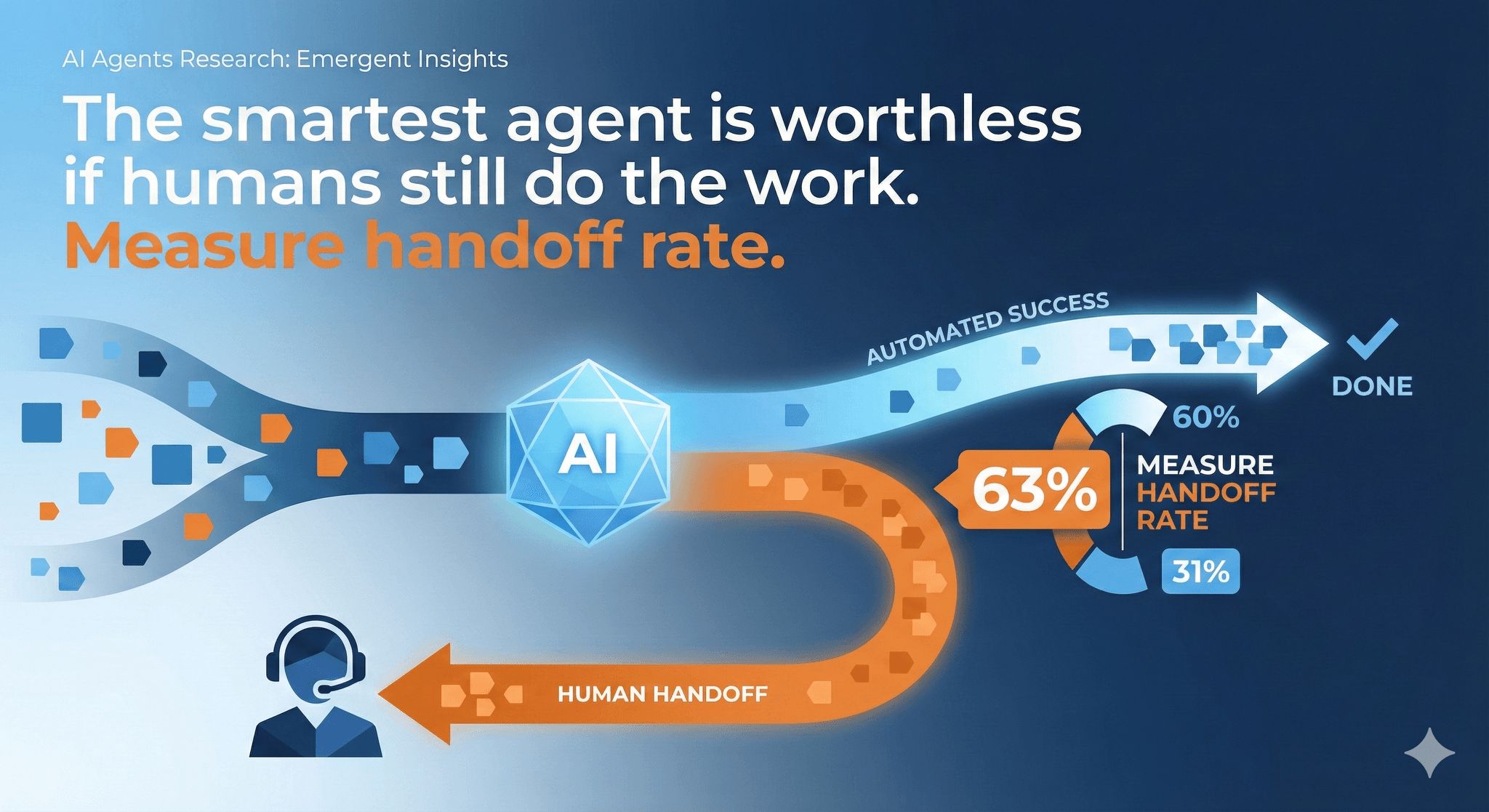
Handoff rate is deceptively simple: it measures the percentage of tasks that your AI agent passes back to humans for completion. A high handoff rate means humans are still doing most of the work. A low handoff rate means the agent is genuinely completing tasks autonomously.
"Of the percentage of tasks that it passes back to human, and in most companies this number is still very high. So instead of chasing models or new frameworks, we could measure outcomes." — Co-founder & CEO of an AI infrastructure company
The insight cuts through the complexity of AI agent evaluation by asking a single question: when a task enters your system, does a human have to finish it? Every time the answer is yes, that is a handoff. Every handoff represents incomplete automation.
What makes this metric powerful is that it captures the "last mile" problem that plagues most AI deployments. Many organizations have built what the conference speakers called "smart FAQs" - systems that can answer questions impressively but cannot actually complete the actions those answers imply.
"The chatbot only answers but never acts. It doesn't create pages, it doesn't update Salesforce. It doesn't send emails or invoices. It just talks. So what happens? Your employees still handle the last mile. The actual result is simple: high cost, no delivery, just a smart FAQ." — Co-founder & CEO of an AI infrastructure company
This is the RAG chatbot trap in action. You build an intelligent system that knows everything about your business, but knowing is not doing. The employee still has to open Jira, still has to create the ticket, still has to update the CRM. The AI made them more informed while doing the same work.
Key Insight 1: Accuracy Without Action Is Incomplete
Consider a customer service agent with 95% accuracy in understanding customer intent. Impressive benchmark. But if the agent cannot actually resolve the issue - cannot process the refund, cannot update the shipping address, cannot escalate to the right team with full context - then accuracy is just a vanity metric.
The customer still ends up talking to a human. The human still has to do the resolution work. You have added latency (the AI interaction) without removing labor (the human resolution). Handoff rate would immediately reveal this: if 80% of conversations get handed to humans for resolution, your 95% accuracy means nothing for operational efficiency.
This is why so many pilot projects fail to convert to production deployments. According to our research, 90% of enterprise AI agent pilots never reach production. The pilots look impressive in demos because demos measure the wrong things. They measure whether the agent can respond intelligently, not whether it can complete tasks autonomously.
Key Insight 2: The Meta-Metric That Encompasses All Others
The conference speakers identified three core technical metrics for AI agents: accuracy (which drives trust), latency (which affects productivity), and cost (which determines ROI). These are not wrong metrics - they matter.
But handoff rate is the meta-metric that reveals whether the others are actually delivering value.
If your handoff rate is 70%, it does not matter that accuracy is 95%. The accuracy is not translating into autonomous completion. If your handoff rate is 70%, latency optimization is meaningless because humans are still bottlenecking the process. If your handoff rate is 70%, cost savings from token optimization are irrelevant because you are still paying for human labor.
Conversely, if handoff rate drops from 70% to 30%, you know something real has changed. Accuracy, latency, and cost improvements may have contributed, but the outcome is verified: 40% more tasks now complete without human intervention.
This reframing explains why seven YC companies building AI evaluation tools have seen effectively zero adoption among AI builders. They are measuring technical characteristics rather than business outcomes. Handoff rate provides the bridge between engineering work and business value that those tools are missing.
Key Insight 3: Forcing Honest Assessment of Automation Boundaries
One of the most valuable aspects of handoff rate is how it forces honest conversations about what AI can and cannot do today.
"We've had a lot of failed projects where the success bar is like it needs to be 100% accurate for anyone to trust it. And you know, that is right now outside the range of a lot of LLMs." — Staff software engineer at a legal-AI company
If your handoff rate stays stubbornly high despite multiple optimization cycles, you might be trying to automate the wrong things. Some tasks require judgment, context, or accuracy levels that current AI systems cannot reliably deliver.
This is not failure - it is clarity. Handoff rate reveals model-problem fit issues early, before you invest years into a capability that is outside current LLM range. It forces the question: is this task actually automatable with today's technology, or are we chasing something that will require fundamental model advances?
The 90% pilot failure rate I encountered across interviews stems largely from misaligned expectations. Teams promise stakeholders full automation, build agents that work 70% of the time, then spend months in what one interviewee called the "doom loop" - fixing one scenario while breaking another. Handoff rate would have revealed immediately that they were targeting an unrealistic bar.
Why This Matters
Adopting handoff rate as your primary success metric creates several important shifts in how you approach AI agent development.
First, it reframes success from technical sophistication to business outcomes. Your engineering team and business stakeholders can finally speak the same language. Instead of translating accuracy percentages into vague productivity claims, you have a direct measure of automation completeness.
Second, it enables honest ROI calculations. Our research consistently found that undefined ROI is the primary failure mode for enterprise AI deployments, even ahead of technical limitations. When you measure handoff rate, ROI becomes calculable: if handoff rate drops from 70% to 40%, you have reduced human labor by approximately 30% for that task category. That is a number finance can work with.
Third, it reveals which workflows are truly automatable versus aspirationally automatable. Not every process should be targeted for AI agents. Some require human judgment, some require accountability, some are simply outside current model capabilities. Handoff rate helps you allocate resources to high-impact, achievable automation rather than technically impressive dead ends.
Finally, it explains why the evaluation tooling market has struggled to gain traction. When your metrics do not connect to outcomes, the tools measuring those metrics feel disconnected from business value. Handoff rate creates a North Star that evaluation tools can orient around.
What You Can Do
If you are ready to make handoff rate your primary success metric, here are four concrete steps to implement it:
Define Handoff Events: Audit your agent workflows and identify every point where work passes back to humans. This includes explicit escalations, error fallbacks, edge cases requiring approval, low-confidence situations, and tasks the agent cannot complete. You may discover handoffs you did not know existed.
Baseline Your Current Rate: Before any optimization, measure your current handoff percentage across different task types. Most teams discover their rate is higher than expected - often dramatically so. In most companies, this number remains very high even after significant AI investment.
Prioritize by Handoff Reduction: Instead of optimizing accuracy or latency uniformly, focus your efforts on the specific failure modes causing the most handoffs. A 5% accuracy improvement in a low-volume scenario matters less than reducing handoffs in your highest-volume workflow by 10%.
Set Outcome-Based Targets: Replace technical goals like "improve accuracy to 95%" with outcome goals like "reduce handoff rate from 60% to 40%." This forces your team to solve for actual task completion rather than intermediate benchmarks.
The Bottom Line
The smartest agent is worthless if humans still do the work. After hundreds of hours of research into AI agent deployment, this is the simplest and most important truth I can share.
Technical metrics like accuracy, latency, and cost are necessary but not sufficient. They measure characteristics of your agent without measuring outcomes for your business. Handoff rate cuts through that complexity to answer the question that actually matters: does your AI agent genuinely reduce human workload, or does it just add a sophisticated layer of indirection before the same person does the same job?
If you take nothing else from this research, take this: start measuring handoff rate today.
This post is part of my research series on AI Agent deployment, based on 36 expert interviews, 5 industry conferences, and 3 functional prototypes. Read the full research overview.
Have thoughts on AI agent deployment? Connect with me on LinkedIn or email me.