AI Agents ResearchPart 23CONFERENCE
Why 95% of Agentic AI Projects Fail: Key Takeaways from the Conference Everyone's Talking About
Four common traps doom most AI agent projects before they reach production. A recent industry conference revealed the patterns - and introduced a game-changing metric for measuring real success.

On this page
Ninety-five percent of agentic AI projects fail. That stark statistic headlined a recent industry conference that brought together founders, engineers, and practitioners who have learned these lessons the hard way. What emerged was not just a catalog of failures, but a clear taxonomy of the traps that catch most teams - and a surprisingly simple metric that separates agents that work from expensive demos that never ship. If you are building AI agents, these insights might save you months of wasted effort.
The Discovery
The conference assembled an unusual cross-section of the AI agent ecosystem: the co-founder and CEO of an AI infrastructure company whose platform powers production agent deployments; the founder of a YC S25 agent startup; a staff software engineer at a legal-AI company; and a growth strategist who has watched countless agent projects succeed and fail.
What made this conversation different from typical AI conference content was the hard-won pragmatism. These were not researchers discussing theoretical capabilities or vendors pitching solutions. These were practitioners who had shipped production agents, watched projects fail, and distilled patterns from both outcomes.
The central question they addressed cuts to the heart of the AI agent hype cycle: why do so many projects that demo brilliantly never reach production? And more importantly, how do you know if your project is actually on track versus heading toward the same graveyard?
What We Found
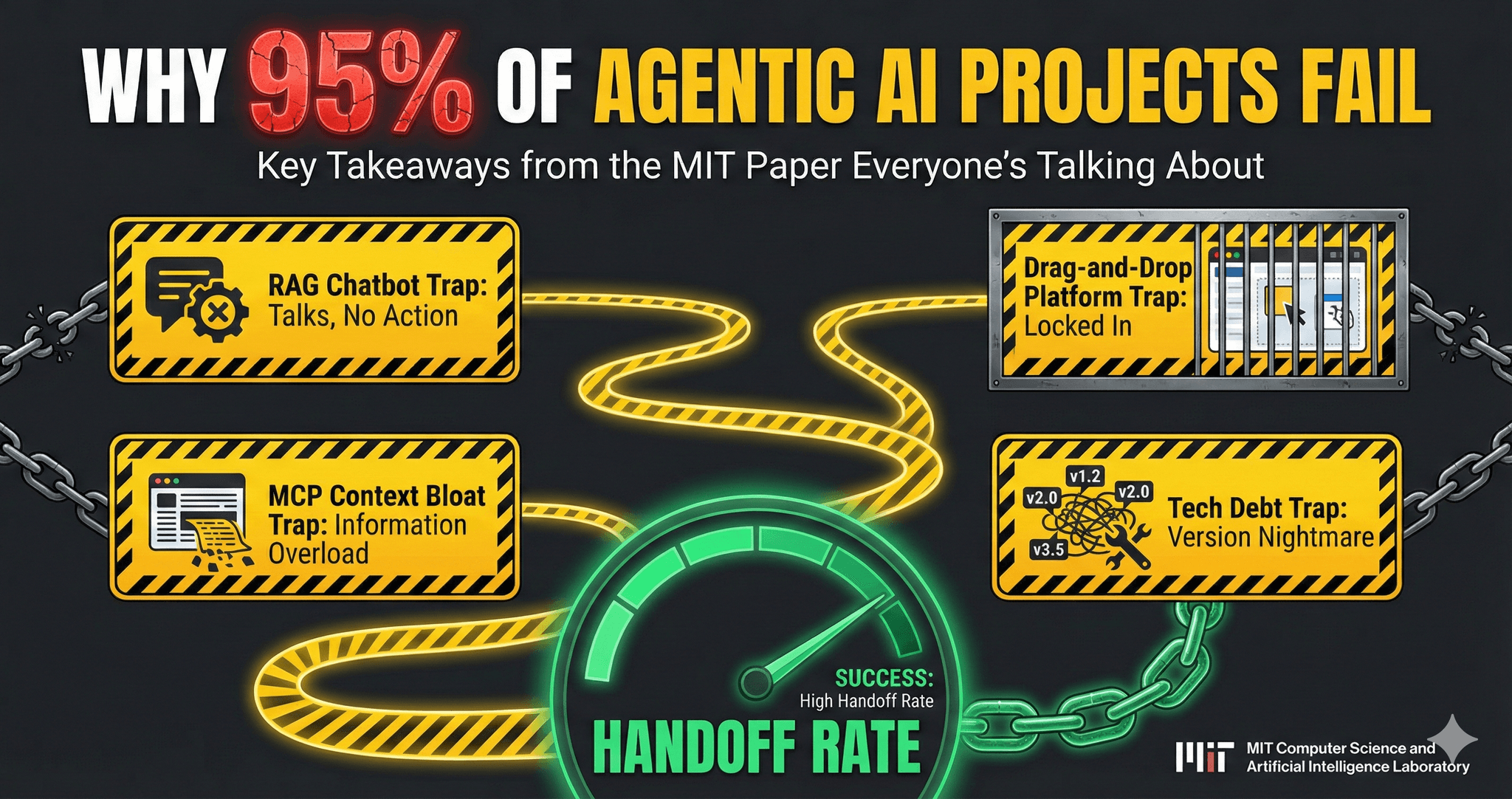
The Four Traps of Agent Development
The conference crystallized a taxonomy of failure patterns that trap most agent development teams. Understanding these traps is the first step to avoiding them.
Trap 1: The RAG Chatbot Trap
The first trap is the most common: building a chatbot that only answers but never acts.
"Over the past year, everyone feels the write chat box on top of the internal knowledge base which is that your tablets are very smart, know everything. But there is a problem. The chatbot only answers but never acts. It doesn't create pages, it doesn't update every salesforce hotspot. It doesn't send emails, invoices. It's just talks. So what happens your employees still to handle last mile they have to open Jira CP4 and to actual result is simple high hopes, no delivery, just a smart FAQ." — Co-founder and CEO of an AI infrastructure company
The pattern is familiar: you build a RAG system that ingests your knowledge base, add a chat interface, and declare victory. But it only talks. The "last mile" - actually taking action in the systems where work gets done - remains manual. Employees still open Jira, navigate Salesforce, and compose emails themselves. The agent provides information but not execution. The result: high expectations, no delivery.
True agents follow the ReAct pattern - Reason plus Act. They call tools, APIs, and services to complete the task end-to-end.
Trap 2: The Drag-and-Drop Platform Trap
The second trap catches teams seeking rapid deployment. Visual agent builders and no-code platforms promise quick results, but deliver platform lock-in without production viability.
These platforms are genuinely useful for prototyping - you can wire together LLM calls and tool integrations in hours. Demos come together quickly. Stakeholders get excited.
The problem emerges when you try to move beyond the demo. The simplistic logic cannot handle real-world edge cases. The visual abstraction hides complexity that you eventually need to control. Most critically, you are locked into a platform that may not support production customizations. What accelerates early development becomes an obstacle at scale.
Trap 3: The MCP Context Bloat Trap
Model Context Protocol (MCP) was supposed to solve the integration problem - a standardized way for agents to connect to tools and data sources. But the reality has proven more complex.
"MC just creates new problems. Too much context cost, the accuracy drops a lot and the round trips a lot goes up. And with a lot of tokens our cost goes up. So the real question for agent users is not how do I build the agent quickly? I think the the real question we should care about is how. How do I iterate my agent faster? That's the problem MC connected tools but it doesn't help you narrower improve or evolve and agents over time." — Co-founder and CEO of an AI infrastructure company
MCP connects tools, but it does not help you iterate or evolve agents over time. The protocol introduces excessive context that degrades accuracy and drives up token costs. Our research found that when agents have access to more than 25 MCP tools, accuracy drops to around 30%.
The deeper issue: MCP solves the wrong problem. Teams do not struggle to connect tools quickly; they struggle to iterate their agents once connected. MCP addresses initial integration while ignoring continuous improvement.
Trap 4: The Tech Debt Trap
The fourth trap is the most insidious because it does not manifest immediately. As models update - from GPT-4 to GPT-4.1 to GPT-5 - agents break in unexpected ways.
"You have to decouple all AI stuff from your current apps. That's very important because those alarms grow fast. We see a lot of AI agents change that model from GPT-4.1 to GPT-5. We got the AI agent accuracy drops a lot. Yeah. Because we have to react a lot of things... Every time you improve how to review all your client code and release a new iOS app that's not good because the maintenance cost is very high." — Co-founder and CEO of an AI infrastructure company
When AI logic is tightly coupled with application code, every model update requires reviewing and potentially rewriting client applications. The maintenance burden compounds over time.
The solution: decouple AI components from application logic. Treat the AI layer as a module that can be updated independently. This upfront investment pays dividends every time the underlying models change.
The Handoff Rate: The Metric That Matters
Perhaps the most important insight from the conference was a simple reframing of how to measure agent success.
"The question is no longer is the agent small the real question is does it actually reduce the handoff to humans we call this handoff rate. Of the percentage of tasks that it passes back to human and in most companies this number is still very high. So instead of chasing models or new frameworks we could measure outcomes if you have if your kind of grid head drops still have your AI isn't transforming your business." — Co-founder and CEO of an AI infrastructure company
Handoff rate - the percentage of tasks that get passed back to humans - cuts through the noise of agent evaluation. It does not matter how sophisticated your model is, how elegant your framework is, or how impressive your demo looks. What matters is whether the agent actually completes tasks or punts them back to people.
In most companies deploying agents, this number remains very high. Agents handle the easy cases and escalate everything else. The promised automation never materializes because the edge cases where humans get involved represent the bulk of real work.
This metric reorients agent development. Instead of chasing the latest models or newest frameworks, teams should measure outcomes. If your handoff rate is not dropping, your AI investment is not transforming your business - regardless of the underlying technology.
The Three Core Metrics for Production Agents
Beyond handoff rate, the conference identified three fundamental metrics that determine real-world adoption:
Accuracy (Trust): Does the agent produce correct outputs? Users who encounter errors stop trusting the system, and distrust is difficult to rebuild.
Latency (Productivity): Is the agent fast enough to be useful? An agent that takes 30 seconds per task will not be used for work that users currently complete in 10 seconds.
Cost (Efficiency/ROI): Can you afford to run the agent at scale? Token costs that seem reasonable during prototyping can become prohibitive at production volume.
These three metrics form a triangle of constraints. Improvements on one axis often trade off against the others. Production readiness requires acceptable performance on all three - which is why demo agents that optimize for impressiveness fail when efficiency matters.
Why This Matters
The Model-Problem Fit Reality
The staff engineer at the legal-AI company offered a framework that explains many agent failures:
"What is the intersection of like what problem are you trying to solve, how hard is it? And then what are the capabilities of the model that or models that you're working with. What data sets do you have?... We've had a lot of failed projects where the success, you know, the bar for success is like it needs to be 100% accurate for anyone to trust it to use it. And you know, that is right now outside the range of like a lot of LLMs." — Staff software engineer at a legal-AI company
Many projects fail because the success bar is outside the current range of LLM capabilities. When 100% accuracy is required for adoption and 95% is the best achievable, no amount of engineering will close that gap. The problem is model-problem fit, not implementation quality.
Start with honest assessment: what accuracy does your use case require? What can current models achieve? If there is a fundamental gap, no framework or prompt engineering will bridge it.
Enterprise Requirements Are Non-Negotiable
The conference also enumerated enterprise blockers that many agent projects underestimate:
"For enterprise I think there are three important things. First is you have to make authentication carefully because AI agents may be present, someone may be praising users, maybe just virtual employees. They have their own identity that the tools can access every system. But they have to follow the rules of the express authentication system... Second is the agent. I mean like two weeks ago us is one. Right. Most of systems have set services down. But if your agent is down, people will find oh so much because users they use the agents in their work... The third is when our agents access the sensitive data. We have to build a failure inside our customers internal network. Especially like for PII information and the financial aid." — Co-founder and CEO of an AI infrastructure company
Authentication and Identity: AI agents operate as "virtual employees" accessing systems with their own identities. They must follow enterprise authentication rules, and the identity management alone can take months.
Reliability and Geo-Distribution: When AWS goes down for 35 minutes, agents go down. Production agents need geographic distribution and redundancy that most prototypes lack.
Data Privacy and Sovereignty: Agents accessing sensitive data must operate within customer networks, especially for PII and financial information. Data sovereignty requirements can force complete architecture redesigns.
What You Can Do
Based on the conference insights and our broader research, here are actionable steps to avoid the 95% failure rate:
Build agents that act, not just answer: Every agent project should identify the last-mile actions users currently perform manually and design the agent to complete those actions, not just inform them.
Measure handoff rate from day one: Implement tracking for how many tasks complete fully versus escalate to humans. Set targets for handoff rate reduction and use it as your primary success metric.
Decouple AI from application logic: Treat your AI components as independent modules that can be updated, swapped, or improved without touching application code. The upfront architecture investment prevents accumulating tech debt.
Validate model-problem fit before building: Honestly assess whether current model capabilities can achieve the accuracy your use case requires. If not, either adjust expectations or wait for better models.
Plan for enterprise requirements early: Authentication, reliability, and data sovereignty are not features to add later. They often require fundamental architecture decisions that should inform initial design.
The Bottom Line
The 95% failure rate for agentic AI projects is not random bad luck - it follows predictable patterns. Teams fall into the RAG chatbot trap, get locked into drag-and-drop platforms, struggle with MCP complexity, and accumulate crushing tech debt. The antidote is clear-eyed focus on outcomes over technology.
The handoff rate metric cuts through the noise: does your agent actually reduce the tasks that get passed to humans? If not, it is not transforming your business - it is just expensive infrastructure. The teams that beat the 95% focus relentlessly on completing the last mile, measuring what matters, and architecting for the long term.
Quotes from recorded sessions are lightly edited for clarity.
This post is part of my research series on AI Agent deployment, based on 36 expert interviews, 5 industry conferences, and 3 functional prototypes. Read the full research overview.
Have thoughts on AI agent deployment? Connect with me on LinkedIn or email me.