AI Agents ResearchPart 18EMERGENT
The Framework Paradox: Why 80-90% of Teams Abandon LangChain for Production
LangChain achieved a billion-dollar valuation, yet most production teams abandon it. Our research reveals the performance gaps, debugging challenges, and abstraction traps driving this exodus.

On this page
LangChain is worth $1.3 billion. LangGraph powers thousands of agent prototypes. Yet when I asked production teams about their framework choices, the same pattern emerged again and again: they started with these tools, built impressive demos, and then quietly rebuilt everything from scratch.
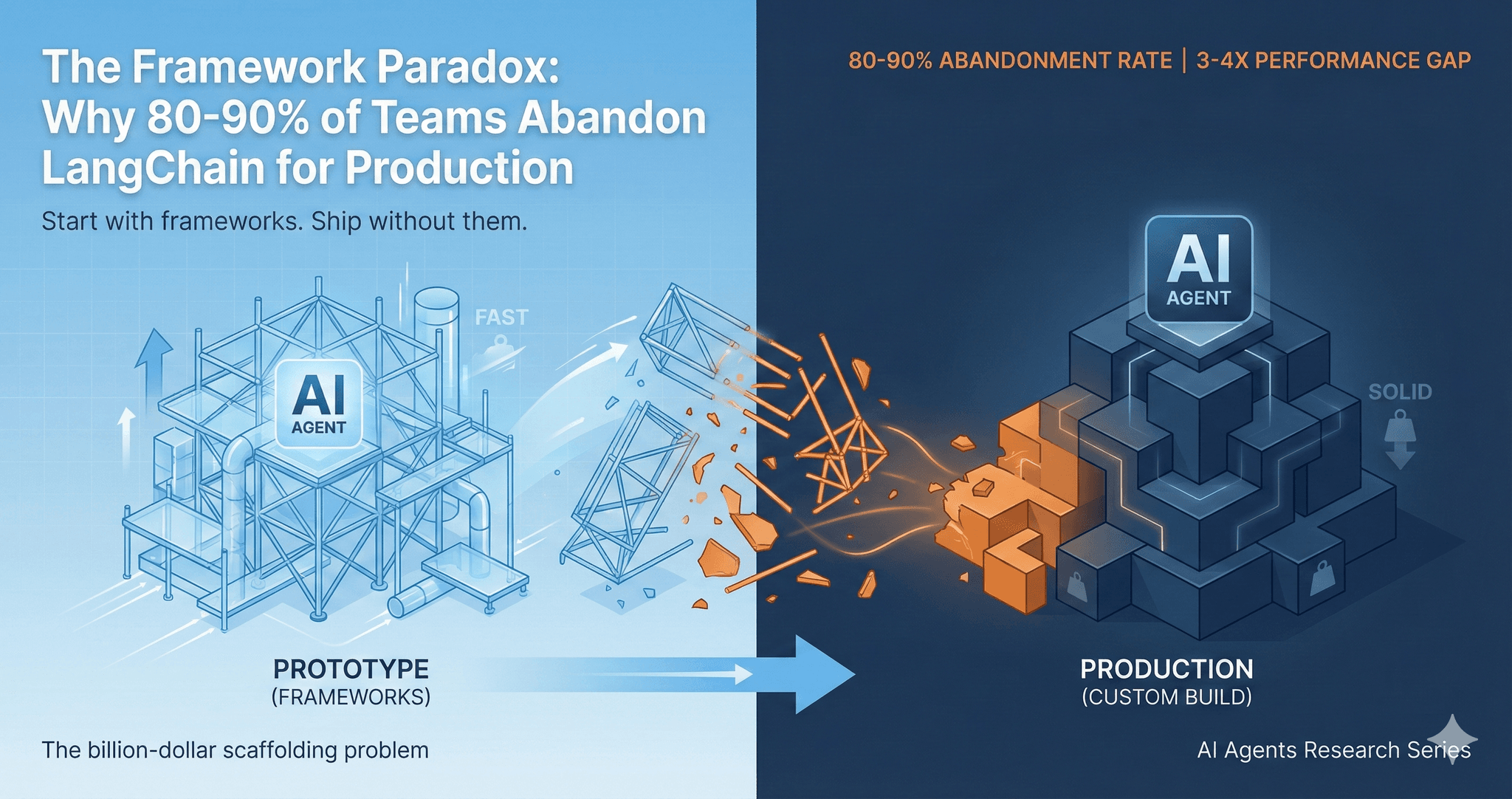
This is the framework paradox that nobody talks about publicly. Venture capital pours billions into agent infrastructure based on adoption metrics, while production teams discover that the abstractions enabling rapid prototyping become insurmountable obstacles at scale. Across 36 expert interviews, 5 industry conferences, and 3 hands-on prototypes, we uncovered a consistent 80-90% abandonment rate for popular frameworks when teams transition from demo to deployment. The gap between what frameworks promise and what production demands is not a minor inconvenience. It is the central challenge of the current AI agent ecosystem.
The Abandonment Pattern
The framework abandonment pattern follows a predictable trajectory. Teams adopt LangChain or LangGraph for rapid prototyping, achieve impressive demo results within days, and then spend months fighting the same tools during production deployment.
"Every company we've talked to, they stop. They started with LangChain as a framework to build AI agents. But once they start going into customers and into production, they realize, like, oh, no. It's full of bloat. Like, it has a lot of unnecessary things. They end up ditching the solution, and they build their own. This has been, like, 80, 90% of the clients we've talked to." — a co-founder at an agent framework startup
This observation reflects what happens when prototyping tools meet production requirements. Frameworks excel at hiding complexity during the demo phase, when speed matters more than control. They provide convenient abstractions for chaining prompts, managing state, and orchestrating tool calls. But production environments demand something different: predictability, debuggability, and performance optimization at every layer.
The abstraction trap works like this: frameworks provide high-level interfaces that accelerate initial development, but those same abstractions obscure what happens under the hood. When a production system fails, engineers cannot easily trace the problem through layers of framework code. When performance degrades, they cannot optimize components they do not directly control.
This is not simply about developer preference or technical ideology. Production requirements expose fundamental mismatches between framework design assumptions and real-world constraints. Frameworks assume general-purpose patterns. Production systems require specific optimizations. Frameworks prioritize developer experience during building. Production demands operational visibility during running. Frameworks abstract away implementation details. Production debugging requires those details to be immediately accessible.
The Performance Gap
The performance implications of framework choices extend beyond abstract concerns about control. Production teams report measurable, significant differences between framework-based and custom implementations.
"I think they're really bad. My opinion. But there's a couple, some very obvious gaps there between context management and all of that. They're very generic solutions. So what we have done is built our own framework on top of the OpenAI SDK. And we are like, three to four times faster than LangChain." — a practitioner, a CRM AI company
Three to four times faster represents the difference between viable and unviable for many production use cases. When agents process thousands of requests per hour, a 4x performance penalty translates directly into infrastructure costs, response latencies, and user experience degradation.
The bloat problem stems from framework generality. LangChain and similar tools must support every possible use case: every LLM provider, every tool calling pattern, every orchestration style. This comprehensiveness creates overhead for any specific implementation. Production teams, by contrast, know exactly which providers they use, which patterns they need, and which edge cases matter for their domain.
The control versus convenience tradeoff becomes stark in production environments. Framework convenience accelerates the path to a working demo. But that convenience comes at the cost of control over context management, token optimization, error handling, and caching strategies. Production systems require precisely this control to achieve acceptable performance, reliability, and cost profiles.
Custom implementations eliminate unused abstractions, optimize for specific access patterns, and enable fine-grained instrumentation. Teams building their own orchestration layers report not just faster execution, but better observability, simpler debugging, and more predictable behavior under load.
Shopping Agent Case Study
Our research included building functional agent prototypes to validate interview findings through direct experience. The shopping agent prototype provided firsthand evidence of framework challenges under realistic development conditions.
We initially implemented the shopping agent using LangGraph, attracted by its state management capabilities and documented patterns for complex agent workflows. The framework promised clean abstractions for multi-step tasks involving product search, comparison, and purchase recommendation. Initial progress was rapid. Within days, we had a working prototype that could search products, compare options, and generate recommendations.
Under deadline pressure from SF Tech Week, the framework's limitations became intolerable. LangGraph's abstractions, helpful during initial exploration, created friction when we needed to customize behavior, debug unexpected outputs, or optimize for demonstration reliability. Simple changes required understanding multiple layers of framework internals. Error messages pointed to framework code rather than application logic.
"During development, we initially implemented the agent using LangGraph but switched to LangChain due to LangGraph's extensive bloat and complexity." — Shopping Agent Prototype Documentation
The mid-development framework switch, despite its costs, proved necessary. We lost days to refactoring that could have been spent on features. This experience validated what interview subjects described: frameworks that accelerate early development can actively impede progress as systems mature and requirements become more specific.
Key lessons emerged from this hands-on validation. First, framework bloat is real, not merely perception or preference. The overhead manifests in slower execution, larger codebases, and more complex debugging. Second, time pressure amplifies framework issues because debugging through abstraction layers consumes disproportionate effort. When deadlines loom, framework opacity becomes a critical liability. Third, even moving between related frameworks (LangGraph to LangChain) required significant refactoring, suggesting that any production deployment would demand even more substantial changes. The promised portability of framework-based code does not survive contact with real requirements.
Why Frameworks Fail Production
Framework failures in production cluster around three interconnected problems: debugging opacity, version compatibility, and customization constraints.
Debugging opacity represents the most immediate pain point. When an agent produces unexpected output, engineers must trace execution through framework abstractions to understand what happened.
"I think a lot of companies that are doing agents, there's not like a standardized way of logging what are the exact actions and being able to do like really like detailed debugging and maybe even like, quote unquote, time traveling of like, why did the agent take this action at this moment in time?" — a practitioner, an AI observability company
Frameworks typically provide their own logging and tracing, but these tools reflect the framework's model of execution rather than the application's semantic concerns. Production teams need to understand why their specific agent made a specific decision, not how the framework processed a generic callback chain.
Version compatibility creates ongoing maintenance burden. LLM providers release new models and API versions continuously. Frameworks must adapt to these changes, and framework updates often introduce breaking changes to accommodate provider updates. Production systems pinned to specific framework versions eventually fall behind on model capabilities or security patches.
Customization constraints emerge when production requirements exceed framework assumptions. Most frameworks assume relatively simple tool calling patterns, moderate context windows, and synchronous execution flows. Production agents may require complex tool orchestration, aggressive context compression, or sophisticated caching strategies that framework abstractions actively obstruct.
"The instinct is to at least start it in house just to build the intuition... I feel like A, they [frameworks] weren't giving us the amount of control we wanted and B, it was hard for the team to just build intuition of, like, how should we be thinking about agentic systems?" — a practitioner, an AI observability company
Building intuition requires visibility into agent behavior. Frameworks that hide implementation details prevent teams from developing the understanding necessary for production operation.
The Model Contribution Reality
Framework discussions often assume that orchestration infrastructure is secondary to model capabilities. Production experience reveals the opposite relationship.
"We found out actually model only maybe contributes 30 or 40% of the whole thing. And the framework, the whole system you build upon the model is much more important, you know, than the model itself." — Fireside chat with an autonomous-agent startup
If models contribute only 30-40% to agent success, then the remaining 60-70% comes from system architecture, context management, tool integration, and orchestration logic. This distribution explains why framework choices matter so much: they determine the quality of the majority contribution to agent performance.
Teams that accept framework-imposed constraints on this 60-70% sacrifice control over the primary determinant of their agent's effectiveness. Custom implementations, despite their development costs, enable optimization across the entire stack.
The skeptics articulate this position clearly:
"I wouldn't build an agent and put it into production with LangChain or any of the existing frameworks." — a practitioner
This is not reflexive contrarianism. It reflects practical experience with the gap between framework promises and production requirements.
Why This Matters
The framework abandonment pattern has implications beyond individual team decisions. It reveals a structural problem in the current AI agent ecosystem that affects how capital flows, how products get built, and how the industry evolves.
Venture capital evaluates developer tools primarily on adoption metrics: developer signups, GitHub stars, prototype deployments. These metrics capture the beginning of the developer journey, not its destination. The result is massive valuations for tools that most production teams eventually abandon. LangChain's $1.3 billion valuation reflects initial adoption patterns, not production retention.
This measurement dysfunction creates misaligned incentives. Framework developers optimize for initial adoption rather than production retention. Features that accelerate demos take priority over capabilities that enable operations. The ecosystem invests in making things easy to start rather than possible to finish. Marketing emphasizes speed-to-demo while obscuring the hidden costs that emerge at scale.
For practitioners, understanding the framework abandonment pattern enables more informed initial decisions. Teams that anticipate eventual migration can structure early prototypes to minimize future refactoring costs. They can isolate framework dependencies, document decision rationales, and design interfaces that survive framework replacement. Teams that recognize framework limitations can allocate appropriate time for custom development during production transition rather than discovering the need too late.
The pattern also suggests where ecosystem investment should flow. The gap between demo-ready frameworks and production-ready infrastructure represents substantial opportunity for tools that prioritize operational concerns without sacrificing developer experience. The next generation of agent infrastructure will need to solve for both initial velocity and sustainable operation.
What You Can Do
Based on our research findings, here are five actionable recommendations for teams navigating framework decisions:
Prototype with frameworks, plan for custom: Use LangChain or LangGraph to validate concepts quickly, but budget time and resources for custom implementation during production transition. Treat framework code as throwaway scaffolding, not production foundation.
Build observability from day one: Do not rely on framework logging for production visibility. Implement comprehensive tracing (OpenTelemetry), LLM-specific analytics (Langfuse), and custom instrumentation from the beginning. Retrofitting observability is significantly harder than building it in.
Measure production metrics early: Track performance, cost, and reliability from initial prototypes. The 3-4x performance gap between frameworks and custom implementations only becomes visible with actual measurement.
Invest in team intuition: Resist the temptation to hide complexity behind framework abstractions indefinitely. Teams that understand their agent's behavior at every layer can debug, optimize, and extend more effectively than teams dependent on framework magic.
Evaluate frameworks on production criteria: When choosing infrastructure, prioritize debuggability, version stability, and customization flexibility over demo speed. The hours saved during prototyping matter less than the weeks spent fighting production constraints.
The Bottom Line
The framework paradox captures a fundamental tension in the current AI agent ecosystem. Tools optimized for rapid prototyping systematically fail production requirements, yet adoption metrics continue driving investment toward these same tools. Teams that recognize this pattern can make more informed decisions about when to leverage frameworks and when to invest in custom implementations.
The 80-90% abandonment rate is not a reflection of developer fickleness or framework quality. It reveals the genuine difficulty of building production-grade AI agent infrastructure. Frameworks that succeed in this space will be those that prioritize operational concerns alongside developer experience, providing not just rapid paths to demos but sustainable paths to deployment.
This post is part of my research series on AI Agent deployment, based on 36 expert interviews, 5 industry conferences, and 3 functional prototypes. Read the full research overview.
Have thoughts on AI agent deployment? Connect with me on LinkedIn or email me.