AI Agents ResearchPart 13EMERGENT
Dual Memory Architecture: The Distinction Most AI Companies Miss
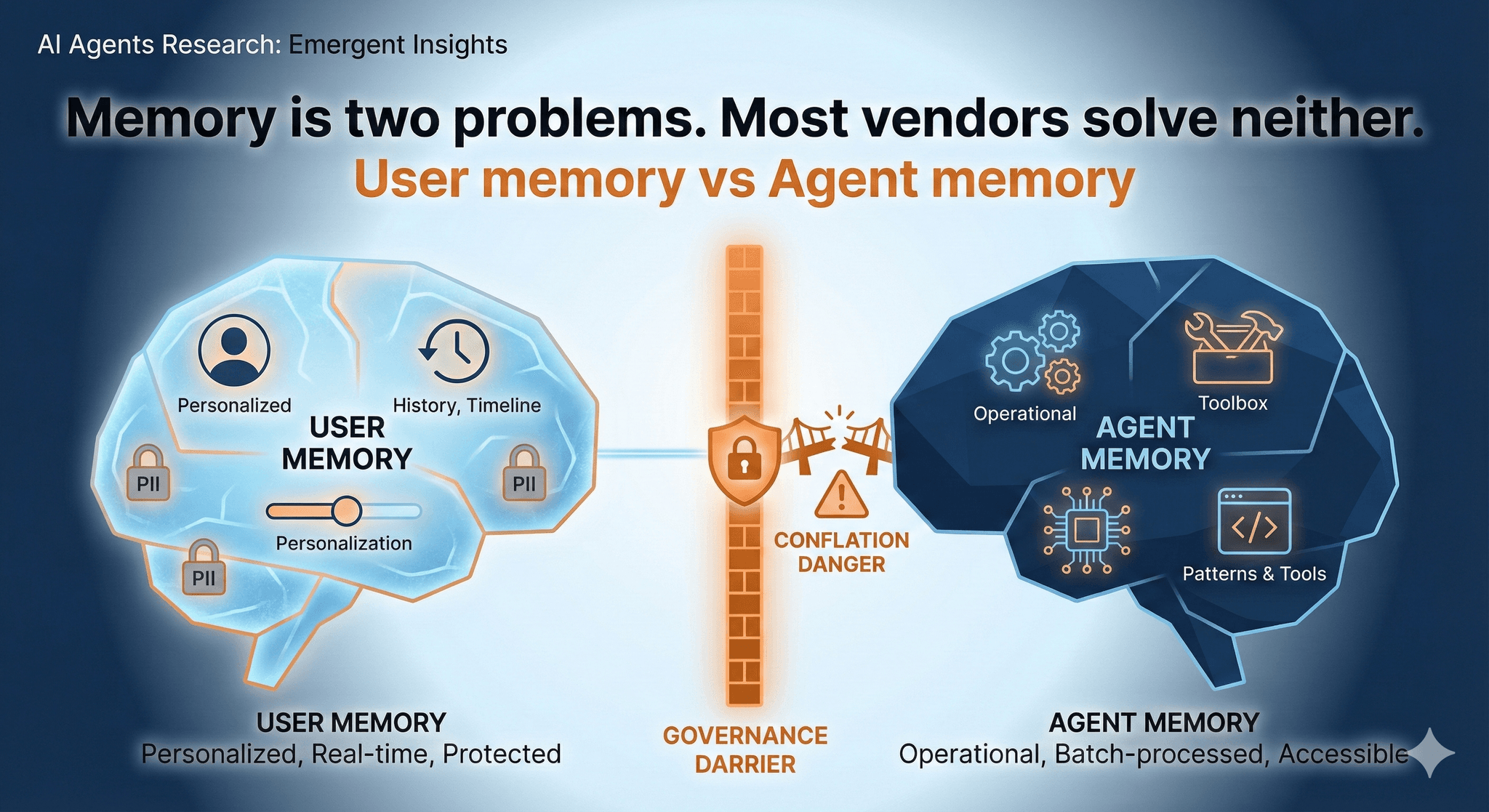
User memory and agent memory are architecturally distinct problems requiring separate solutions. Most vendors conflate them, creating systems that fail both use cases.

On this page
- The Discovery
- What We Found
- User Memory: Serving the End User
- Agent Memory: Improving Agent Performance
- The Fundamental Differences
- Why Conflation Fails
- The Single-System Trap
- Governance Conflicts
- Update Cycle Mismatches
- Architectural Implications
- Separate Storage, Separate Governance
- Different Retrieval Patterns
- Evaluation Differences
- Why This Matters
- What You Can Do
- The Bottom Line
Most AI memory vendors are solving the wrong problem. Or rather, they are solving two fundamentally different problems as if they were one.
When I began researching production AI agent deployments, I expected the conversation about memory to center on technical challenges: vector database selection, retrieval accuracy, context window optimization. Instead, practitioners kept circling back to a more fundamental issue. The systems they were building needed to remember two completely different things for two completely different stakeholders. And the solutions on the market kept conflating them.
"Memory as Two Distinct Problems: user memory (preferences, past interactions) versus memory for improving agent performance (which tools work best, problem-solving patterns). Most vendors conflate these." — A practitioner at an AI observability company
This distinction, which emerged repeatedly across 36 expert interviews, represents one of the most underexploited architectural insights in the AI agent space. Teams investing heavily in unified memory infrastructure are building systems destined to fail both use cases.
The Discovery
The insight crystallized during conversations with practitioners building production SRE agents, customer support systems, and enterprise knowledge assistants. Each team had independently arrived at the same conclusion: their memory requirements split cleanly into two categories with almost nothing in common.
The first category concerned remembering things about users: their preferences, their past tickets, the context of their previous conversations. The second category concerned remembering things about how the agent itself should operate: which tools worked best for certain queries, successful problem-solving patterns, error recovery approaches that had proven effective.
Initially, teams assumed these were variations of the same problem. Build a memory system, store everything, retrieve what is relevant. But the more they built, the more the differences became apparent. The stakeholders were different. The governance requirements were different. The update cycles were different. The failure modes were completely different.
What We Found
User Memory: Serving the End User
User memory exists to personalize the agent experience. It stores preferences, interaction history, and contextual information about the human being served. The stakeholder is the end user themselves, whether a customer seeking support, an employee using internal tools, or a citizen interacting with government services.
The requirements for user memory are demanding. It must persist across sessions, sometimes for months or years. It must respect strict PII governance, with compliance requirements varying by geography and industry. It must support selective disclosure, where certain information is available in some contexts but not others.
The challenges compound quickly. Voice conversations spanning 30-40 minutes require real-time memory pruning to prevent latency degradation. When conversations span multiple channels (phone, email, chat), retrieval systems struggle with multi-modal content.
"If you look at the voice conversation, especially, there are there is nothing out of the box that I can quickly integrate and get started with... you can't really have long conversations. Do it for ten minutes, fifteen minutes. But if you wanna do it for thirty, forty minutes, with AI... the latency will keep increasing because fundamentally, the context keep increasing." — An engineering leader at a workforce platform
Customer support agents face the additional challenge of determining memory scope boundaries. Some context is ticket-specific and should expire when the issue is resolved. Other context is customer-wide and should persist indefinitely. Making this determination correctly is itself a non-trivial problem.
Agent Memory: Improving Agent Performance
Agent memory serves a completely different purpose. It stores information about how the agent should operate: which tools work best for certain query types, successful patterns for breaking down complex tasks, error recovery strategies that have proven effective. The stakeholder is not the end user but the engineering team building and improving the agent.
The requirements are architecturally distinct. Agent memory does not require real-time updates during conversations. It can be batch-processed at the end of sessions or during dedicated evaluation cycles. It is not subject to PII governance because it stores operational patterns rather than personal information. Engineering teams need direct access for debugging and optimization, which would be inappropriate for user memory containing sensitive information.
One team described their approach to building agent memory:
"Using LLM judges to extract observations at end of investigations, stored in vector DB for future retrieval." — A practitioner at an AI observability company, on Cross-Session Memory V0 Approaches
This approach makes sense for agent memory but would be inadequate for user memory. Extracting observations at the end of sessions is too slow for personalization that needs to happen mid-conversation. The tradeoffs acceptable for one category are unacceptable for the other.
The static staleness problem illustrates this further. Current batch-based memory systems create stale observations because old investigations cannot benefit from improved prompts without expensive reprocessing. This is tolerable for agent memory because engineering teams can schedule reprocessing during maintenance windows. For user memory, where outdated preferences could damage customer experience, this staleness would be unacceptable.
The Fundamental Differences
The distinctions extend across every dimension:
Purpose: User memory enables personalization for the human being served. Agent memory enables performance improvement for the system itself.
Stakeholder: User memory serves end users who expect their preferences to be remembered. Agent memory serves engineering teams optimizing system behavior.
Governance: User memory requires PII compliance, data sovereignty controls, and audit logging. Agent memory is internal and faces fewer restrictions.
Update Frequency: User memory needs real-time updates as conversations progress. Agent memory can be updated in batches during evaluation cycles.
Staleness Tolerance: User memory has low tolerance for outdated information that could harm personalization. Agent memory has higher tolerance since patterns can be reprocessed.
Access Patterns: User memory is retrieved at request time for personalization. Agent memory is retrieved in background for planning and tool selection.
Why Conflation Fails
The Single-System Trap
The AI memory market is filled with vendors offering unified solutions: Letta, MEM0, Cogni, and others promise to handle memory for your agent. The pitch is compelling. Why build two systems when one could suffice?
The problem is that one-size-fits-all architectures create tradeoffs that harm both use cases. Applying PII governance to agent memory adds unnecessary friction to engineering workflows. Applying agent memory update patterns to user data creates compliance risks as preferences become stale during batch processing.
"I think their [Letta's] approach takes away too much control. I think our team would personally find that like we want more control over our management system... I would want some sort of solution that's like not that hands off because I think that a system I don't have as much configurability into." — A practitioner at an AI observability company
Teams consistently report that unified solutions take away too much control. The configurability needed for one memory type conflicts with the configurability needed for the other. Engineering teams want direct access to agent memory for debugging, which would create security concerns if applied to user memory containing PII.
Governance Conflicts
Enterprise adoption of memory systems has been blocked more by governance concerns than technical limitations.
"In enterprise scenario most of them failed because currently they cannot... Well with the PII information that's for privacy... Enterprise afraid of built the memory system because they afraid the RM told another user said tax shipment address is la la la." — A practitioner at an AI infrastructure company
When user memory and agent memory share infrastructure, governance requirements for user memory must be applied to everything. This means agent memory, which should be freely accessible to engineering teams, becomes locked behind compliance controls. Debugging becomes slower. Optimization becomes harder. And the enterprise still worries about PII leakage because the systems are not cleanly separated.
Separating the two memory types resolves this tension. User memory can live in strictly governed infrastructure with encryption, access controls, and audit logging. Agent memory can live in engineering-accessible infrastructure optimized for performance analysis. Neither system compromises the requirements of the other.
Update Cycle Mismatches
User memory must be updated in real-time as conversations progress. If a customer mentions they prefer email over phone, that preference should be available immediately, not after the next batch processing run. Personalization that lags behind the conversation feels broken.
Agent memory operates on different timelines. Observations about tool effectiveness can be extracted at the end of sessions. Improvements to problem-solving patterns can be refined during evaluation cycles. There is no urgency to update agent memory mid-conversation because it serves engineering optimization, not real-time personalization.
Unified systems must choose one update pattern or the other. Real-time updates for everything add unnecessary load when processing agent memory. Batch updates for everything create staleness in user memory that damages personalization. Neither compromise serves both use cases well.
Architectural Implications
Separate Storage, Separate Governance
The clearest implication is that user memory and agent memory should live in separate storage systems with separate governance policies.
User memory requires stricter access controls. Encryption should be mandatory. Audit logging should capture every access. Geographic restrictions may apply based on data sovereignty requirements. Only systems directly serving users should have retrieval access.
Agent memory can be optimized for engineering accessibility. Debugging tools should have direct access. Performance analysis should be straightforward. The overhead of compliance controls is unnecessary because the data is operational rather than personal.
Some teams take this further with three-database architectures: vector databases for semantic retrieval, graph databases for structured relationships, and standard databases for transactional data. The key insight is that different access patterns require different infrastructure, and conflating user and agent memory prevents this optimization.
Different Retrieval Patterns
User memory retrieval happens at request time. When a conversation begins, the system retrieves relevant preferences and history to personalize responses. This is just-in-time retrieval with strict latency requirements. Users notice if personalization is slow.
Agent memory retrieval happens in the background. During planning phases, the system retrieves hints about which tools work best for similar queries. This can be asynchronous. Slight delays do not damage user experience because the retrieval is invisible to end users.
The sub-agent pattern, recently popularized by Anthropic and implemented by teams like an AI observability company, provides a concrete approach:
"An AI observability company is implementing Anthropic's recently published pattern of using sub-agents with internal tool loops (like Claude Code) to avoid context bloat, specifically for log analysis." — A practitioner at an AI observability company
Sub-agents with internal iteration loops can query agent memory extensively during their tool loops without bloating the main context window. This pattern works well for agent memory but would be inappropriate for user memory, which needs to be immediately available to the primary agent for personalization.
Evaluation Differences
The metrics for success differ between memory types.
User memory success is measured by personalization quality. Are user preferences being applied correctly? Are past interactions being referenced appropriately? User satisfaction surveys and personalization accuracy metrics are the relevant measures.
Agent memory success is measured by system performance improvement. Are task success rates increasing? Are error rates decreasing? Is the agent selecting the right tools more often? Engineering metrics and evaluation suite results are the relevant measures.
The first-step retrieval philosophy, developed by teams like an AI sales intelligence company, applies differently to each:
"Almost never do we evaluate something end to end because it is pointless... the only thing that we continuously tested for is that it gets the first step right. The first step typically ends up being retrieval." — The AI lead, an AI sales intelligence company
For user memory, first-step retrieval success means the right preferences and history are available when the conversation begins. For agent memory, it means the right tool selection hints and problem-solving patterns are available when planning begins. The principle is the same but the implementation differs.
Why This Matters
The implications extend beyond architecture into strategy and competitive positioning.
Memory infrastructure investment should go into separation rather than bigger unified systems. Teams building one memory system that handles everything are building something that handles nothing well.
Vendor evaluation should explicitly probe how vendors distinguish user memory from agent memory. If the answer is that they do not, the solution will likely require significant customization or eventual replacement.
Enterprise adoption becomes possible when governance requirements can be cleanly applied to user memory without affecting engineering access to agent memory. Separation removes the compliance blockers that have stalled enterprise memory adoption.
Competitive moats emerge from custom context engineering. Companies like an AI sales intelligence company and an AI observability company position their proprietary memory architectures as differentiation precisely because they have built separate systems optimized for different purposes. This is not a build versus buy decision for generic infrastructure; it is a strategic investment in defensible architecture.
The 40% context utilization rule from the Production Agents Summit reinforces why this matters:
"If your agent is using anything more than 40% of the context window, it's probably going to make mistakes." — A conference speaker, Production Agents Summit
With strict limits on how much context can be utilized effectively, every piece of memory must earn its place. Conflated systems that retrieve user and agent memory together waste precious context budget on information irrelevant to the current need. Separated systems can be more selective, retrieving only what is needed for the task at hand.
What You Can Do
Audit current memory systems: Identify where user memory (preferences, history, PII) and agent memory (tool patterns, problem-solving approaches) are conflated. Map which data serves personalization versus which serves system optimization.
Separate governance policies: Apply PII controls, encryption, and audit logging to user memory. Allow engineering-accessible infrastructure for agent memory with less restrictive controls.
Implement dual retrieval patterns: User memory should be retrieved at request time with strict latency requirements. Agent memory can be retrieved asynchronously during planning phases.
Measure separately: Track personalization quality metrics for user memory (preference accuracy, user satisfaction). Track system performance metrics for agent memory (task success rate, error reduction, tool selection accuracy).
Evaluate vendors on this distinction: Ask memory solution vendors how they handle the difference between user and agent memory. If they conflate them, understand the tradeoffs you are accepting.
The Bottom Line
Memory is not one problem; it is two. User memory serves end users seeking personalization. Agent memory serves engineering teams seeking performance improvement. These are architecturally distinct challenges with different stakeholders, different governance requirements, and different success metrics.
Vendors conflating them fail both use cases. Teams building unified systems struggle with governance conflicts, update cycle mismatches, and retrieval pattern compromises. The most successful production agents separate these concerns cleanly, enabling better governance for user data and better optimization for agent data.
This distinction is underexploited and represents significant opportunity. For startups building memory infrastructure, explicit separation is a competitive advantage. For enterprises evaluating memory solutions, demanding this separation removes the governance blockers that have stalled adoption. For engineering teams building agents, understanding this split is the first step toward memory systems that actually work.
This post is part of my research series on AI Agent deployment, based on 36 expert interviews, 5 industry conferences, and 3 functional prototypes. Read the full research overview.
Have thoughts on AI agent deployment? Connect with me on LinkedIn or email me.