
comicMemoriPhase 4 — Vectors and Semantic SearchEpisode 10 of 37
Vectors, coordinates on the meaning map
A vector is an ordered list of numbers. Direction and magnitude help describe it, while a model and metric determine how those numbers are used.

On this page
Ria lays the wrong keyword match beside the map drawer, then replaces labels with a coordinate card. The scene introduces vectors without pretending that numbers contain meaning on their own.
Relevance scoring ranks retrieved candidates under a chosen signal. The score is evidence, not a guarantee of correctness.


Problem: Keyword overlap returned the budget when Ava asked for the brief, and the team needs a numeric representation that can support a different kind of comparison.
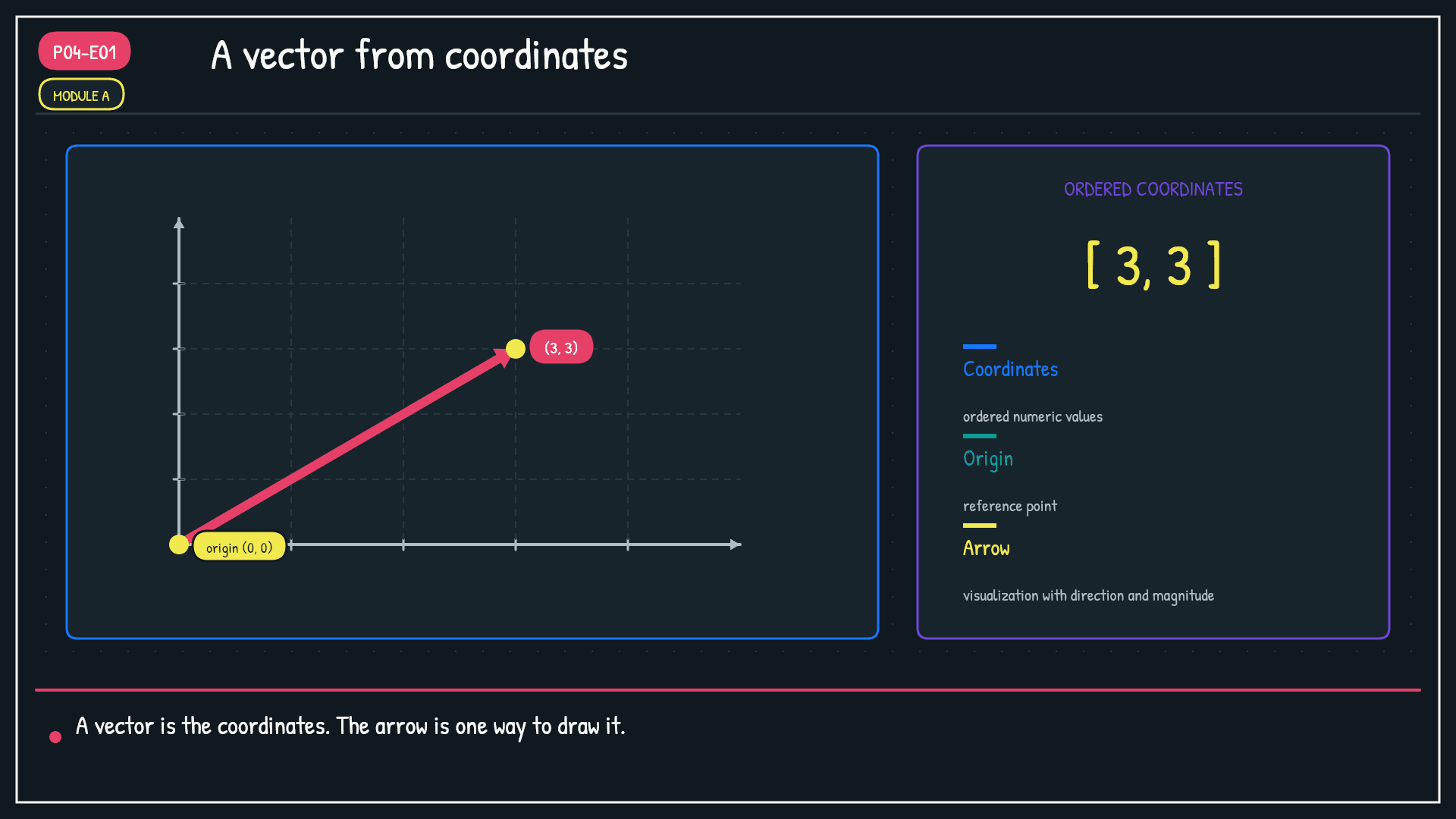
Resolution: The reader learns that a vector is an ordered list of numeric coordinates. An arrow from the origin is a picture of one vector. Direction and magnitude are properties, not the definition.
Coordinates before arrows
A vector can be written as an ordered list such as [0.72, -0.18, 0.44]. Each position is a coordinate along one dimension. On a flat grid, Ria can draw an arrow from the origin to the point described by two coordinates. That arrow has a direction and a length, but neither property is the definition of a vector.
Order matters. The vectors [3, 4] and [4, 3] contain the same two numbers but describe different points because the first and second positions name different dimensions. A system that produces the coordinates must keep that convention stable. Swapping positions silently would change every comparison that follows.
Vectors also support ordinary mathematical operations. A system can add them, scale them, measure their length, or compare them with a chosen metric. Which operations are useful depends on what the coordinates represent. The arithmetic is general. The interpretation comes from the representation and task.
Numbers need a representation
A vector is a mathematical container. It does not carry language meaning automatically. A model must produce vectors whose geometry is useful for a task, and a comparison rule must say what counts as close or aligned. That is why this episode stops short of saying that direction is meaning.
Imagine two teams both store the coordinate [0.2, 0.8]. One team uses the first slot for urgency and the second for confidence. The other uses them for image brightness and contrast. The numbers match, but the records do not mean the same thing. A vector becomes useful only with the rule that produced it and the system that consumes it.
This distinction protects the rest of the phase from a common shortcut. A vector can represent position, color, inventory, or learned features. Semantic behavior is one designed use, not a property every numeric list receives automatically.
The map is a sketch
The drawer shows two dimensions because people can see two dimensions. Vectors used for language comparison normally use many coordinates. Any flat drawing leaves information out, so the picture explains the operation without claiming to reproduce the full space.
Flattening can move apparent neighbors. Two cards that look close on Ria's visible map may be farther apart when all coordinates are considered, while a pair separated on paper may be close in the original space. The drawing is therefore an inspection aid, not the source used for production ranking.
When you see a colorful cluster plot, ask how the flat view was produced, how much structure it preserved, and whether the original vectors were used for evaluation. The picture can suggest a question worth testing. It cannot settle the question by itself.
Glossary
- Vectors
- Ordered lists of numeric coordinates. A nonzero vector can also be described by its direction and magnitude. | Office analogy: Ria files one ordered coordinate card per item.
- Mathematical representation
- A numeric form chosen so a system can compute with an item or feature. | Example: A point can be represented by the ordered pair [3, 4].
- Dimension
- One coordinate position in a vector. A production vector can use many dimensions. | Office analogy: Each numbered slot on a coordinate card is one dimension.
Try it yourself
- Write a two-value vector such as [3, 4], then draw the point and the arrow from the origin.
- Ask what produced the coordinates and which comparison metric will be used before treating a vector score as meaning.
