comicMemoriPhase 4 — Vectors and Semantic SearchEpisode 14 of 37
Vector databases, the map drawer at scale
Vector search at scale is an indexing problem with several valid designs. Each trades recall, latency, memory, filtering behavior, and update cost.

On this page
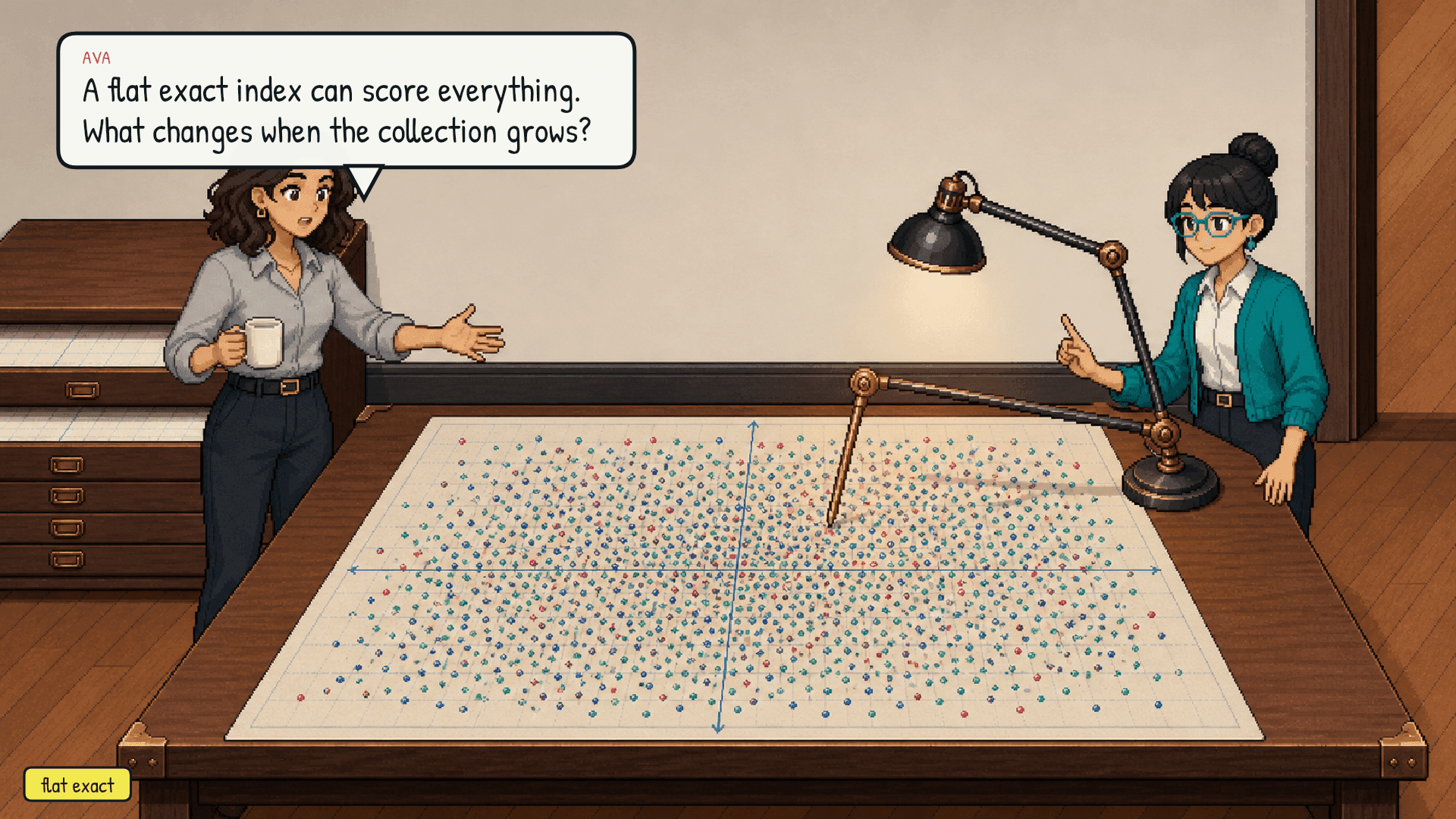
The map drawer expands into several index mechanisms rather than one magical set of partitions. Ria shows Ava that the storage layer returns candidates and exposes tradeoffs.


Problem: Exact comparison across a growing collection is expensive, and the system must store vectors, metadata, and IDs while supporting updates and filters.
Resolution: The reader learns that vector search systems can use flat, partition-based, graph-based, or compressed indexes, each with explicit recall, latency, memory, and maintenance tradeoffs.
Storage is more than coordinates
Embeddings are model-produced vector representations whose useful geometry depends on the task. Nearest-neighbor search ranks stored vectors under a chosen metric, exactly or through an approximate index. Long-term storage keeps records outside active context until an application retrieves them.
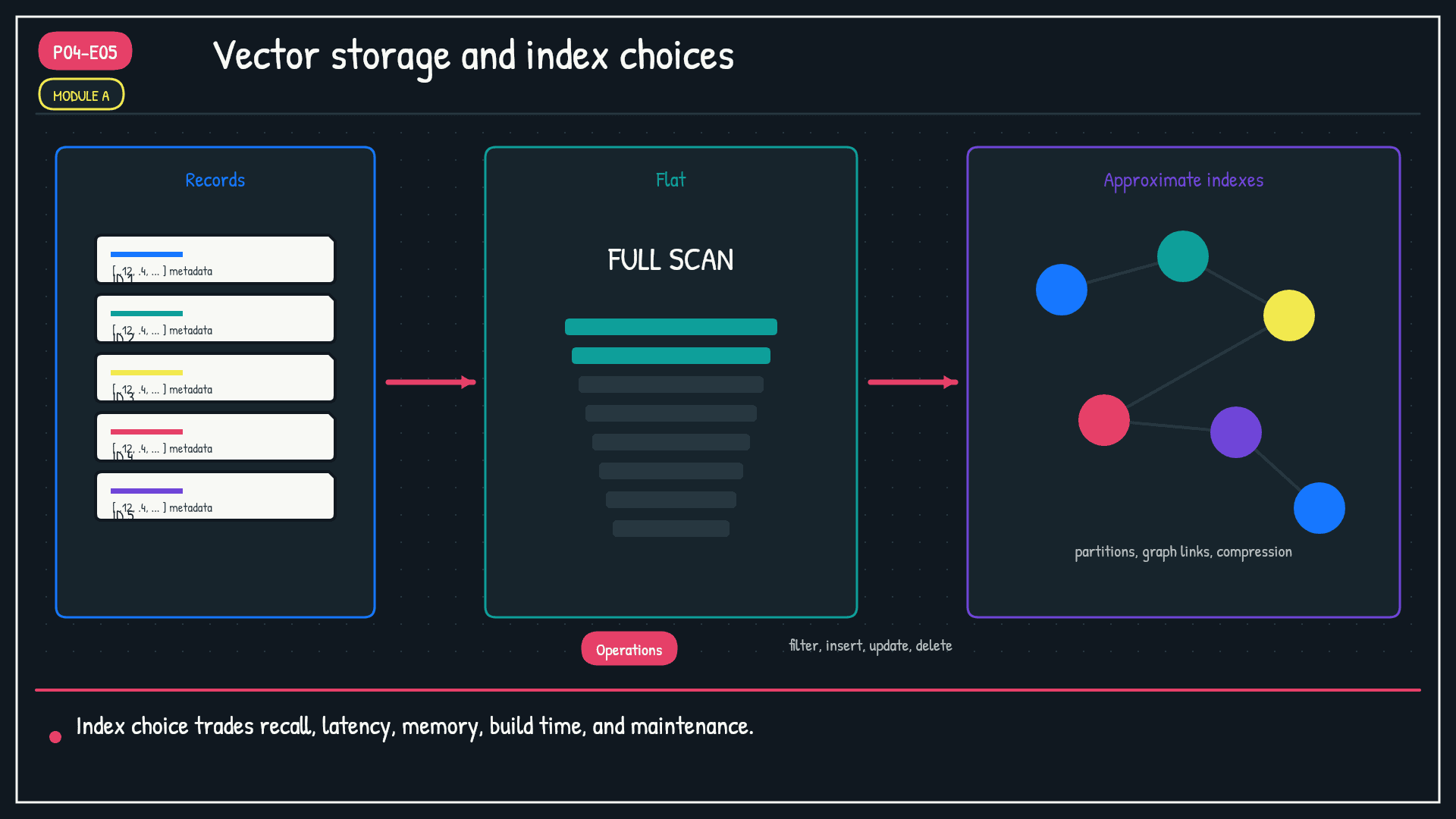
A practical vector record usually includes an identifier and metadata alongside the vector. Metadata can support filtering, permission enforcement, and traceability. Insert, update, and delete operations also have to keep the index and source records consistent.
The identifier links a candidate back to authoritative content. The vector is a search representation, not the full record and not a substitute for provenance. After retrieval, the application still needs the current document, its permissions, its version, and any labels required to decide whether it can govern a response.
Lifecycle behavior matters as much as initial insertion. When source text changes, the old vector may need replacement. When access is revoked, stale index entries must not remain queryable. A deletion that removes the document but leaves a candidate ID behind creates both quality and security problems.
There is no single vector index
A flat index performs exact comparison. Inverted-file approaches route a query toward selected partitions. Graph-based indexes navigate links among nearby vectors. Quantization compresses vectors or distances to reduce memory and computation. Systems often combine techniques.
These designs create different maintenance paths. Partition boundaries may need retraining as data shifts. Graph indexes may pay more work during updates. Quantized representations may need a full-precision reranking stage. A system can also keep a flat path for small collections or for an exact evaluation baseline.
Calling all of them a vector database can hide the decision. Ask which index family is active, which metric it supports, how filters affect candidate search, and whether updates become searchable immediately or after background work. Product names do not answer those operational questions.
Measure the tradeoff
An ANN index speeds retrieval by reducing or simplifying comparisons, but it can lower recall. More search effort can recover recall at a latency cost. Filters and updates can change the balance. Representative evaluation is part of the database design, not an optional final step.
Benchmark with the filters users actually need. A tenant or permission constraint can shrink the eligible set so sharply that an index must search more broadly to find enough allowed candidates. A fast unfiltered benchmark may therefore say little about the production path.
Measure build time, memory, update lag, deletion behavior, recall, and tail latency together. Then record the chosen settings with the embedding model and dataset snapshot. That evidence makes later tuning reviewable and prevents a silent index change from being mistaken for an improvement.
Plan for fallback behavior too. If the index is rebuilding, stale, or unavailable, the application may use a smaller exact path, return fewer candidates, or stop with a clear error. Quietly serving an old unrestricted index is not a safe availability strategy.
Glossary
- Vector databases
- Systems that store vector records and support similarity retrieval, often with metadata and specialized indexes.
- Vector indexing
- Structures or encodings used to reduce or organize comparisons during search.
- Quantization
- A compression technique that represents vectors or distances with lower-precision codes to save memory and work.
Try it yourself
- Teach the drawer choice back to a teammate: why might a faster index return a different candidate set from an exact scan?
- Record the embedding model and version with each collection so incompatible vectors are not mixed silently.
- Benchmark filters, updates, recall, and tail latency together. An index can look fast in an unfiltered demo and fail in production.
