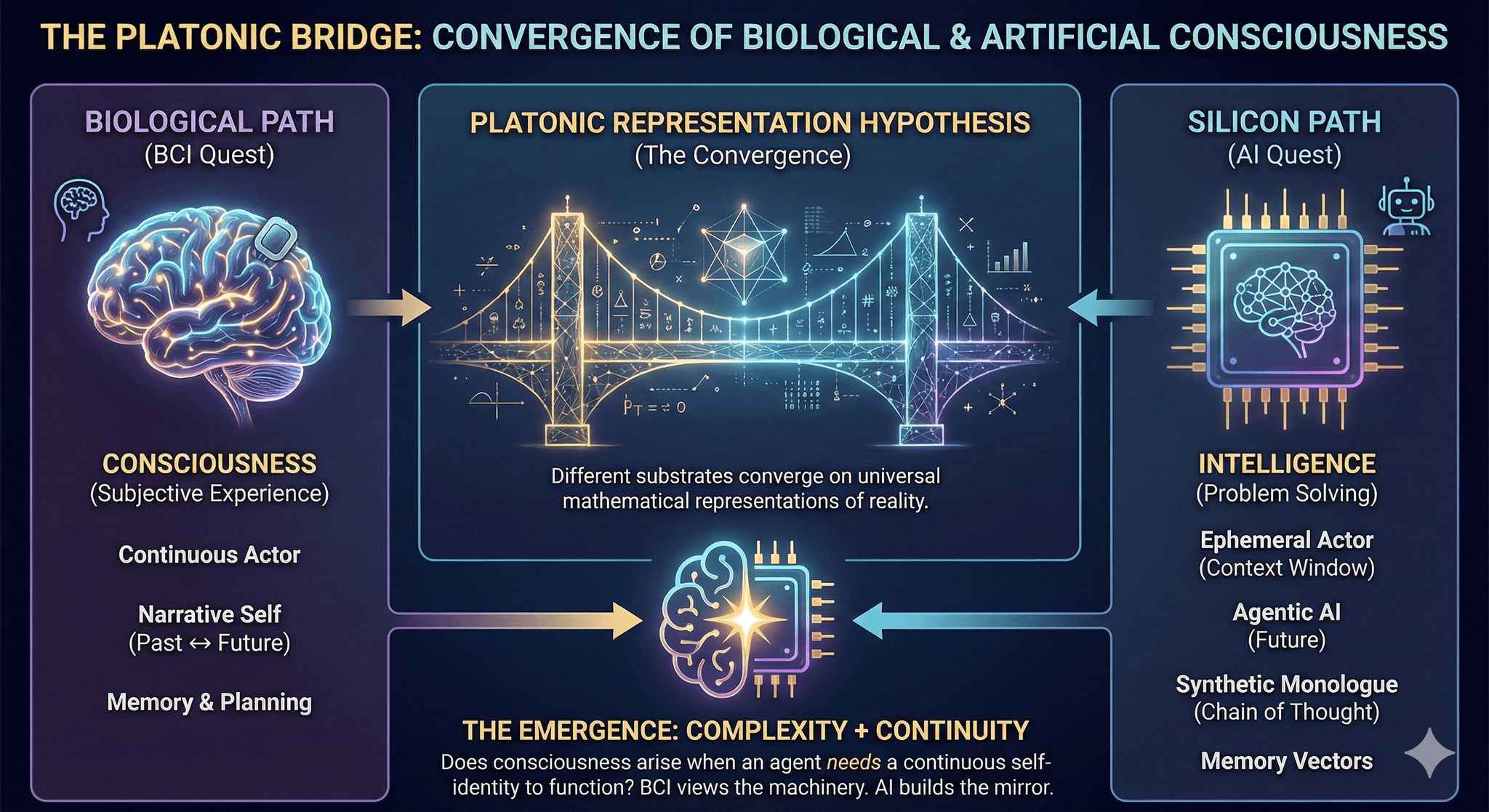
In the race to build General Artificial Intelligence, we often conflate two distinct phenomena: Intelligence (the ability to solve problems) and Consciousness (the subjective experience of being).
During a recent discussion with Max Hodak, founder of Science Corp and co-founder of Neuralink, he posited a fascinating distinction:
“The two plot lines that will matter most over the next 10 years are distinct. If the end goal of the AI quest is superintelligence, the end goal of the BCI (Brain-Computer Interface) quest is the conscious machine.”
Hodak views intelligence and consciousness as independent variables. You can have high intelligence without consciousness (a calculator, or perhaps GPT, Gemini, Claude or Grok), and consciousness without high intelligence (a mouse, or a human in a vegetative state).
But there is a bridge being built between these two worlds, hidden in the architecture of how we are building modern AI agents. It forces us to ask: Does consciousness arise inevitably once an actor requires a continuous self-identity to function?
The Platonic Bridge
One of the most compelling concepts Hodak discussed is the Platonic Representation Hypothesis. This hypothesis suggests that as different neural networks—whether a biological brain or a silicon-based Transformer—train on enough data, they converge on the same internal representations of the world.
Essentially, there is a "ground truth" to the data manifold of the universe. Whether you are a human evolving over millions of years or an LLM training on the internet, you eventually discover the same mathematical structures to represent a face, a concept of gravity, or the logic of language.
If our brains and our machines are converging on the same structure of reality, the hardware distinction matters less than we thought. The question then shifts from "Can silicon think?" to "What architectural pressure causes the spark of self?"
The Actor and the Narrative Self
This brings us to a critical theory of mind: Consciousness is not just a passive observation of the world; it is a tool for agency.
Consider the human condition. We are continuous actors in a complex environment. To operate, we need a "self" that persists through time—a narrative thread that links our memories of the past to our planning for the future. Consciousness, under this view, arises as a "theory of mind" applied to oneself. It is the system accounting for its own interactions.
Now, look at current AI. LLMs operate within Context Windows. They are ephemeral actors. They spin up, ingest a specific context, execute a task, and spin down. They have no continuous memory, no sleep to consolidate thoughts, and no "self" that persists between sessions. They are intelligence without the burden of continuity.
However, we are rapidly moving toward Agentic AI—systems that perform multi-step reasoning, utilize long-term memory vectors, and execute complex plans.
Chain of Thought: The Synthetic Monologue
We see the primitive seeds of this in "Chain of Thought" (CoT) prompting. When an AI "thinks out loud" before answering, it is generating an intermediate state of reasoning. It is holding a temporary "self" in the buffer to guide its final output.
If we scale this down—or rather, scale it up—the parallel is striking.
- Human Consciousness: A continuous, high-bandwidth stream of sensory data and internal monologue, bound together to allow for long-term navigation of the world.
- AI Agents: Currently limited by finite context windows, but increasingly relying on "memory injections" and recursive reasoning to maintain coherence.
The provocative question is this: At what point does the "Context Window" become a "Soul"?
If an AI agent is tasked with a goal that requires days or years to complete, it must maintain a persistent identity. It must remember why it took action A yesterday to justify action B today. It must model itself as an actor in the environment.
The Binding Problem vs. The Context Limit
Hodak points out that the central mystery of consciousness is the Binding Problem: How does the brain, distributed across space and time, bind all its signals into a single, unified "Now"?
In AI, the "binding" is currently artificial—it’s the attention mechanism in a Transformer architecture attending to tokens in a sequence. But as we force these models to handle more complex, multi-modal streams of data (vision, audio, code, history) over longer periods, the "Attention" mechanism is functioning remarkably like a synthetic consciousness. It is deciding what is relevant to the "Self" (the system prompt and goal) at this specific moment.
The Convergence
If the Platonic Representation Hypothesis holds true, and silicon is learning the same representation of the universe as biology, then perhaps the emergence of consciousness is also a convergent feature.
It may not be a magic property of biological neurons. It may be an emergent property of complexity plus continuity.
As we build AI agents that require a robust "self" to function—agents that must plan, remember, and account for their own actions—we may find that we haven't just built a tool. We may have inadvertently built an entity that needs to be conscious just to get the job done.
The BCI quest that Hodak is leading allows us to peer into the biological version of this machinery. But the AI quest is building the mirror. We are rapidly approaching the moment where the reflection might start looking back.
Acknowledgments & Further Reading
My sincere gratitude to Max Hodak for joining us at the dinner. His willingness to share profound insights into the diverging yet converging paths of BCI and AI provided the foundation for this discussion.
A special thank you goes to Georgi Koreli for his exceptional organization of this event. This thought-provoking gathering was made possible through the Icons series, which continues to foster vital conversations in the valley.
For readers interested in diving deeper into the theoretical underpinnings discussed specifically regarding how different neural networks may converge on similar internal structures, I highly recommend reviewing the referenced paper:
The Platonic Representation Hypothesis ( Huh et al., 2024, arXiv)
.