
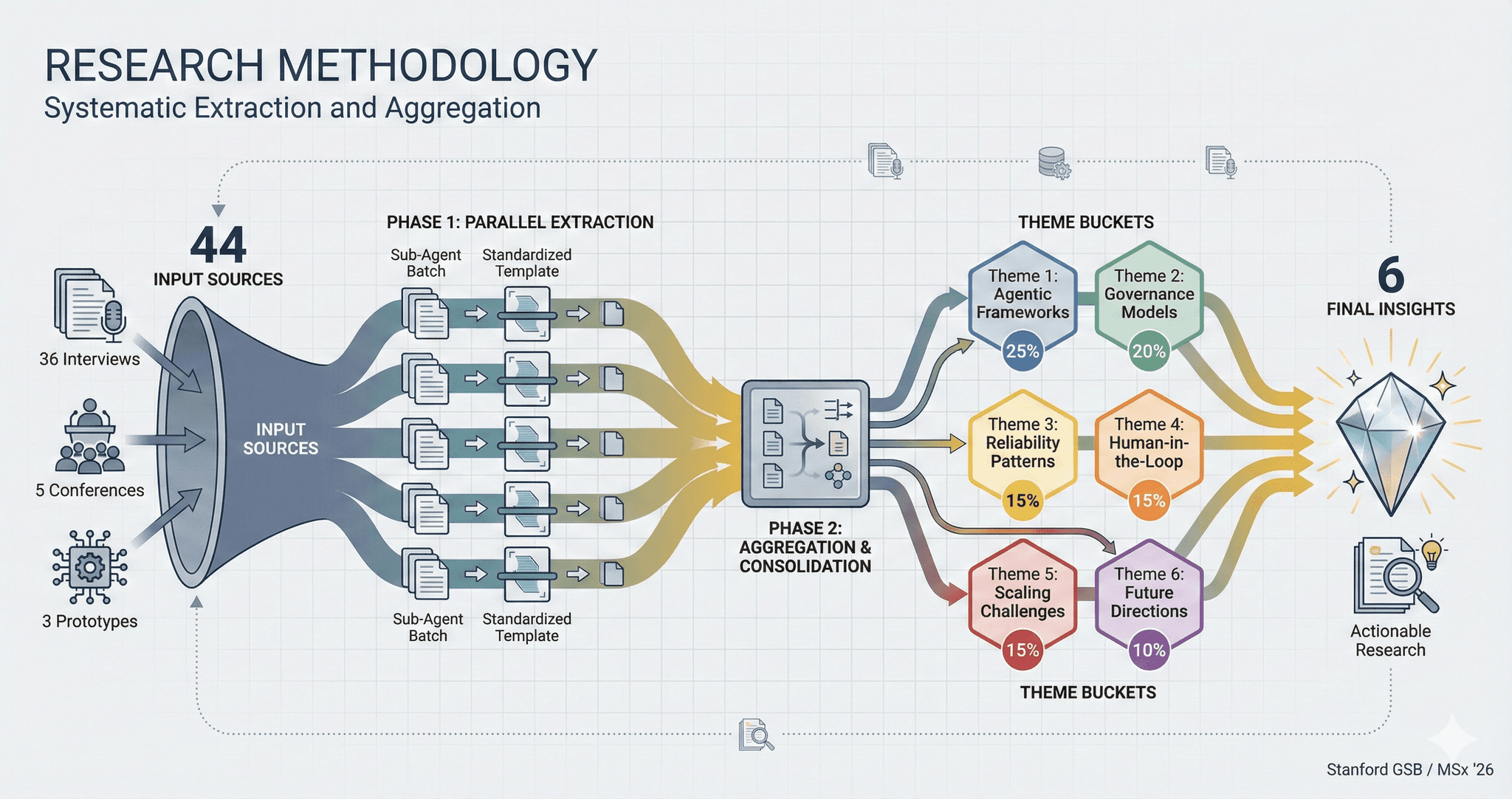
When we set out to understand what separates successful AI agent deployments from the 90% that fail, we faced a fundamental challenge: how do you transform 36 interviews, 5 conference presentations, and 3 prototype implementations into coherent, actionable insights without losing critical nuance or imposing premature conclusions?
The answer required building our own systematic research methodology—ironically, using AI agents to study AI agents. This post documents that process, not merely as an academic exercise, but because the methodology itself validated one of our core findings: the importance of structured workflows over raw model capability.
The Challenge of Scale and Synthesis
Traditional qualitative research methods struggle with the volume and complexity of modern AI agent development discourse. Each interview contained multiple intersecting themes—from technical architecture decisions to organizational adoption challenges to vendor relationship dynamics. Conference presentations offered high-level patterns while prototype implementations revealed ground-truth validation of theoretical claims.
We needed a methodology that could:
- Process each source document independently to prevent confirmation bias
- Identify patterns across sources without forcing false consensus
- Surface contradictions and tensions as valuable data points
- Maintain attribution throughout the synthesis process
- Scale to handle 44 primary sources within research timelines
The solution was a two-phase extraction and aggregation approach executed through parallel sub-agent processing.
Phase 1: Individual Source Extraction
The Standardized Extraction Template
Every source document—whether a 90-minute interview transcript or a 20-minute conference talk—passed through identical extraction processing. Each dedicated sub-agent applied a standardized template capturing:
Metadata and Context
- Source identification (name, company, role)
- Document type (interview, conference, prototype)
- Date and temporal positioning in research timeline
Core Content Extraction
- Five or more key concepts identified
- Three to five critical quotes with speaker attribution and context
- Theme tags from six predefined categories plus emergent themes
- Unique insights not found in other sources
Analytical Components
- Relevance score (1-5) with written justification
- Contradictions or tensions with other sources
- Notes for cross-source aggregation
The Six Core Theme Categories
We established six foundational themes based on initial research hypotheses:
- System Integration — APIs, tool calling, MCP protocol, custom integrations
- Context Management & Memory — Long context utilization, RAG approaches, cross-session persistence
- Probabilistic Systems & Reliability — Evaluation methods, testing approaches, production stability
- Model Capabilities & Limitations — Reasoning quality, task boundaries, generation vs. analysis
- Enterprise Blockers & Governance — Security requirements, identity management, compliance, human oversight
- Framework & Tooling Ecosystem — LangChain, orchestration libraries, observability tools
This taxonomy proved robust—all 44 sources mapped to at least one category, with the majority touching three or more themes.
Parallel Batch Processing
Sub-agents were spawned in batches of five for parallel processing, balancing throughput with quality control:
| Batch | Sources Processed |
|---|---|
| 1 | An AI agent orchestration company (practitioner), an AI infrastructure company (founder), a GPU cloud provider (practitioner), a CRM AI company (practitioner), an independent practitioner |
| 2 | A major enterprise identity company (engineering leader), an AI coding company (developer), an AI sales intelligence company (AI lead), a workforce platform (engineering leader), an AI observability company (practitioner) |
| 3 | An AI infrastructure company (practitioner), a consulting firm (co-founder), an AI product-management startup (founder), a multi-agent framework company (co-founder), a gaming platform company (practitioner) |
| 4 | An independent practitioner, a VC investor, Project Nanda, Alibaba Qwen, the autonomous-agent startup fireside |
| 5 | Production Agents Summit, the "Why 95% Fail" conference, Shopping Agent prototype, Repo Patcher prototype, Good Agents prototype |
This parallel architecture reduced total processing time to approximately two hours while maintaining extraction quality standards.
Because closely related sources—follow-up sessions and supporting materials covering the same company or event—were consolidated during extraction, the 44 primary sources yielded 26 extraction documents, which serve as the denominator for the frequency statistics below.
Quality Assurance Standards
Each extraction underwent automatic verification:
- Minimum five key concepts (rejected if fewer)
- At least three quotes with full attribution
- All applicable theme tags explicitly checked
- Relevance score accompanied by written justification
- Contradiction notes required even if "none identified"
This enforcement prevented downstream aggregation issues from incomplete extractions.
Phase 2: Aggregation and Consolidation
Theme Frequency Analysis
With 26 extraction documents complete, a dedicated aggregation agent performed quantitative analysis:
Theme Weight Calculation
For each theme, we calculated: Weight = (occurrence count) x (average relevance score)
This produced our first major insight—the quantitative ranking of theme importance:
| Theme | Occurrence Rate | Weight Score |
|---|---|---|
| System Integration | 92% (24/26) | 114.0 |
| Probabilistic Systems | 85% (22/26) | 106.0 |
| Framework & Tooling | 85% (22/26) | 103.0 |
| Enterprise Blockers | 81% (21/26) | 98.0 |
| Context Management | 69% (18/26) | 82.0 |
| Model Capabilities | 62% (16/26) | 72.0 |
The data revealed something unexpected: Model Capabilities—the theme we initially hypothesized as the primary bottleneck—ranked lowest in both occurrence and weight. This quantitative finding forced us to reconsider fundamental assumptions about AI agent success factors.
Evolution Tracking
Beyond static frequency, we tracked how themes evolved through the research timeline:
Themes That GREW in Importance
- System Integration: Started as "major blocker," emerged as THE dominant challenge
- Framework Ecosystem: Early skepticism validated; 80-90% abandonment rate confirmed
- Enterprise Blockers: Initially "secondary concern," proved co-equal with technical challenges
Themes That DIMINISHED
- Model Capabilities: From "primary bottleneck" to "30-40% of success equation"
Themes That Remained STABLE
- Context Management: Consistently identified as architectural rather than model limitation
- Probabilistic Systems: Organizational plus technical problem throughout
Theme Consolidation Documents
For each core theme, we generated comprehensive consolidation documents containing:
- Calculated weight and evolution status
- All sources referencing the theme with key points extracted
- Synthesized finding (two to three sentence summary)
- Supporting evidence from multiple sources
- Sub-themes identified during extraction
- Contradictions and nuances between sources
- Prototype validation status
- Key takeaways for final report drafting
This intermediate artifact layer proved essential for maintaining attribution chains while enabling synthesis.
Critical Findings Surfaced
The systematic process revealed specific quantitative findings that emerged from cross-source pattern analysis rather than any single interview:
| Finding | Source Frequency |
|---|---|
| 30-40% model contribution (not 70%) | 18/26 sources |
| 40-50% deployment time on integration | 15/26 sources |
| 80-90% framework abandonment rate | 12/26 sources |
| 90% enterprise pilot failure rate | 14/26 sources |
| 40% context window utilization rule | 8/26 sources |
| 25-tool MCP accuracy threshold | 6/26 sources |
These data points would have been impossible to surface through intuitive synthesis of individual interviews. The frequency analysis transformed anecdotal observations into validated patterns.
Emergent Themes: What We Did Not Expect
Perhaps the methodology's greatest value was identifying themes absent from our initial hypotheses:
Business Case & ROI The primary failure mode for enterprise agents was not technical—it was inability to demonstrate clear return on investment. This emerged in 14 sources but was not in our original research framework.
Handoff Rate as Success Metric Multiple practitioners independently identified "percentage of tasks returned to human" as superior to technical sophistication metrics for measuring agent value.
Dual Memory Architecture Sources consistently distinguished between user memory (what the system remembers about the user) and agent memory (what the agent remembers about its own task execution)—a distinction we had conflated in initial hypotheses.
Framework Contribution Inversion The model provides 30-40% of value; architecture and integration provide 60-70%. This inverted our initial assumption about where value accrues.
Component-Level Evaluation Practitioners reported component-level testing outperforms end-to-end evaluation for reliability improvements—contrary to conventional wisdom about holistic testing.
Coding Agents as Exception Coding agents represent an exception case with unusually good evaluation infrastructure (tests, CI/CD). Generalizing from their success to other domains proved problematic.
Processing Statistics
The complete methodology generated substantial intermediate documentation:
| Metric | Value |
|---|---|
| Total sources processed | 44 (36 interviews + 5 conferences + 3 prototypes) |
| Extraction documents created | 26 |
| Aggregation documents created | 8 |
| Draft documents created | 3 |
| Final report | 1 |
| Total documents generated | 38 |
| Sub-agents spawned | ~35 |
| Parallel batch size | 5 |
| Total processing time | ~2 hours |
What Worked Well
Parallel Sub-Agent Execution
Batches of five maximized throughput while maintaining quality. Larger batches risked coordination overhead; smaller batches extended timelines unnecessarily.
Standardized Extraction Template
Consistent data capture across all sources enabled quantitative analysis. Without standardization, frequency calculations would have been impossible.
Theme Tagging System
The predefined taxonomy with emergent theme allowance balanced structure with discovery. Purely open-ended tagging would have produced incomparable results; purely closed tagging would have missed critical insights.
Two-Phase Methodology
Preventing cross-source synthesis until all extractions completed avoided confirmation bias. Patterns emerged organically from the data rather than being imposed prematurely.
Explicit Contradiction Documentation
Requiring contradiction notes captured nuance instead of forcing false consensus. Many of our most valuable insights came from tensions between sources.
Lessons for Future Research
Earlier Emergent Theme Formalization
New themes should be added to the taxonomy as they appear rather than waiting for aggregation phase. This would enable better frequency tracking for late-emerging patterns.
Source Prioritization in Drafting
High-relevance sources should be weighted more heavily in final synthesis. Not all 44 sources contributed equally to conclusions.
Improved Quote Management
A dedicated system for tracking quote reuse across documents would prevent over-reliance on particularly articulate sources while ensuring broad representation.
Timeline Tracking
More explicit documentation of when themes emerged chronologically would enable better understanding of how practitioner consensus evolved during the research period.
Meta-Insight: Validating Our Core Finding
The methodology itself validated our central research conclusion. The extraction, aggregation, and synthesis process succeeded not because of superior model capabilities, but because of structured workflows, consistent templates, and systematic coordination.
The AI agents performing extraction were identical in capability to those that would have failed with unstructured approaches. The difference was entirely architectural—the same 30-40% model contribution, 60-70% system design ratio we observed in production agent deployments.
This self-referential validation—using agent methodology to study agents—provided perhaps the most convincing evidence for our findings. The approach worked not because we had better models, but because we had better process.
Conclusion
Transforming 44 sources into actionable research required building infrastructure that would have been unnecessary for traditional small-sample qualitative research. But that infrastructure investment surfaced insights invisible to intuitive synthesis:
Core Finding: "Production AI agents are 30-40% model capability and 60-70% system architecture, integration, and evaluation infrastructure."
This finding emerged not from any single interview, but from quantitative pattern analysis across all sources—validating the value of systematic, template-driven extraction over intuitive synthesis.
For researchers and practitioners alike, the methodology demonstrates that AI agent research benefits from the same architectural thinking that AI agent development requires. Structure enables scale; scale enables pattern recognition; pattern recognition enables insight.
The irony is not lost on us: we used AI agents with systematic architecture to discover that AI agents require systematic architecture. Sometimes the medium is the message.
This methodology documentation supports the GSBGEN 390 research project on AI agent deployment, conducted Autumn 2025 at Stanford Graduate School of Business.